 MMXXVI
Gungnir, Odin's spear that never misses its target, and what each source says about it
Gungnir is Odin's spear, made by the sons of Ivaldi and obtained by Loki. The Prose Edda says it hits any target; the poems speak of a spear thrown over the Vanir and of runes on its point.
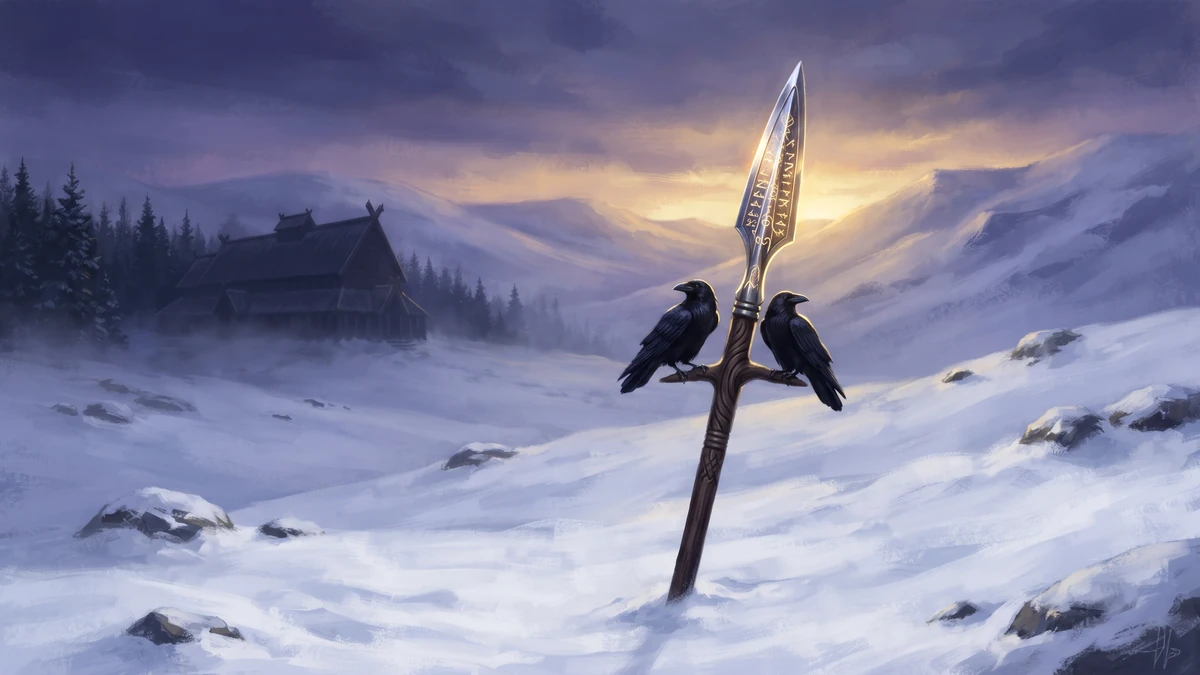
Gungnir is Odin’s spear. The name is usually glossed as “the rocker” or “the swaying one”. The sources say little about it, but what they say is precise: dwarves forged it, it does not miss, and it carries runes.
Who made it
According to Snorri Sturluson’s Skáldskaparmál, Gungnir was made by the sons of Ivaldi, under the direction of the dwarf Dvalinn. Loki obtained it from the dwarves as part of the reparation for cutting Sif’s hair. So the spear came to Odin along with other treasures of the gods.
What the spear does
Snorri says it is so well balanced that it strikes any target, whatever the skill or strength of the thrower. It is a weapon that does not depend on its owner’s arm, which says a good deal about the kind of power Odin stands for.
The spear in the poems
The Völuspá tells that the war between the Æsir and the Vanir begins when Odin hurls a spear over the enemy host. The poem, however, does not name the spear, and saying it was Gungnir is a modern reading, not a datum of the text.
In the Sigrdrífumál, the valkyrie Sigrdrífa teaches runes to the hero Sigurd and says some were carved on the point of Gungnir. It is the only source that links the spear to runes, but it fits the Odin who, in another poem, hangs himself on a tree to win them.
Images
On the Böksta runestone in Sweden, a rider hunts an elk. Lars Silén read him as Odin, in which case the object he carries would be Gungnir. This is a hypothesis, not a certain identification.
Much later, in Richard Wagner’s opera cycle, the god Wotan carries a spear made from a world-ash and engraved with contracts. The opera’s spear is a 19th-century creation.
In short
Gungnir is a legendary spear, with its origin among dwarves, a penalty paid by Loki and a perfect aim. To know what each text says, one has to separate what is in the Skáldskaparmál, what is in the Völuspá and what is in the Sigrdrífumál.
To test what you have learned, play Gungnir: what each text says.
Sources.
- Snorri Sturluson, Prose Edda, Skáldskaparmál (around 1220), on the treasures made by the dwarves
- Poetic Edda, Völuspá and Sigrdrífumál (13th-century manuscripts)
- English Wikipedia, article "Gungnir", with references to Andy Orchard (1997) and Lars Silén (1983)