 MMXXVI
Gunnhild, Mother of Kings: what each source says about Eric Bloodaxe's queen
Gunnhild appears in several Norse sources, and each tells a different story about her. See what Heimskringla, Egil's saga, Historia Norwegiae and other works say, and why scholars are wary.
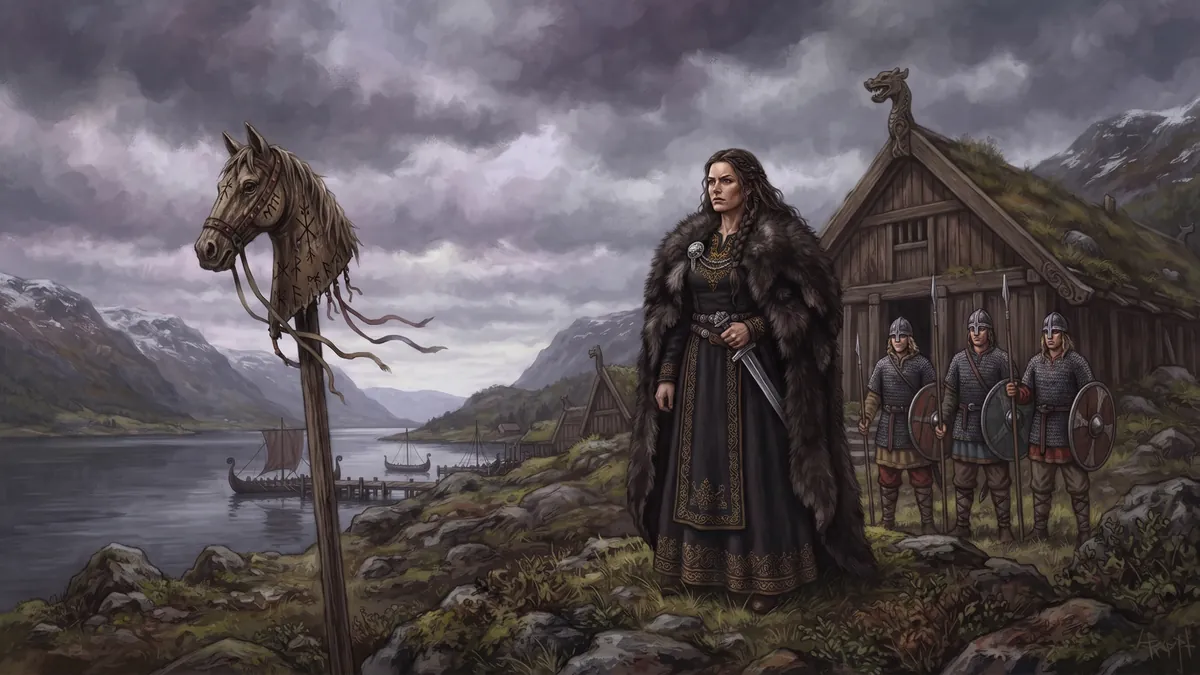
Gunnhild is called “Mother of Kings” because of the sons she had with Eric Bloodaxe. What is known of her comes from texts written long after the events, in large part by Icelanders, and each paints her differently. The honest way is to read each source separately.
What Heimskringla says
In Heimskringla, by Snorri Sturluson, Gunnhild’s father is Ozur Toti, a hersir of Hålogaland. She lives in a hut with two Finnish wizards and learns magic from them. The wizards kill other suitors, and Eric’s men, returning from Bjarmaland, help her kill the wizards.
The work also says that Haakon the Good’s rise followed the cruelty of Eric’s rule and forced Eric and Gunnhild to flee to England. In one passage a kitchen boy spins round “through the sorcery of Gunnhild”.
What Egil’s saga says
In Egil’s saga, Eric wins Gunnhild, daughter of Ozur Toti, on an expedition to Bjarmaland. The poet Egill Skallagrímsson kills Bárðr of Atley around 930, and Gunnhild sends her brothers to try to kill Egill and his brother Thorolf. Egill kills both. To curse Eric and Gunnhild, he raises a horse’s head on a pole, a níðstöng. Years later, in Jorvik, he composes the poem Höfuðlausn to save his life, and Eric forgives him, against her wishes.
What the other sources say
Historia Norwegiae, from the 12th century, makes Gunnhild a daughter of Gorm the Old and Thyra. The article says modern scholars have largely accepted this version, which contradicts that of Heimskringla.
Laxdæla saga shows her as patron and lover of Hrut, an Icelandic chieftain at court, a generation younger than she. Jómsvíkinga saga says she returned to Denmark around 977 and was drowned in a bog on King Harald’s orders.
That account led to a mix-up: the body of a woman found in a Jutland bog in 1835, the Haraldskær woman, was taken for her. Radiocarbon dating later showed she lived in the 6th century BCE.
What scholars say
Gwyn Jones regarded many Icelandic traditions about Gunnhild as fictional, and the article notes that those sources were hostile to her. Marlene Ciklamini calls the wizards episode a “fable”, and Jones sees it as a way of explaining her magic by tying her to the Finns. Even Gunnhild’s historicity is debated.
In short
Gunnhild is the mother of kings, wife of Eric Bloodaxe. Heimskringla tells of the Finnish wizards, Egil’s saga makes her the poet’s enemy, and Historia Norwegiae, Laxdæla saga and Jómsvíkinga saga bring different origin, love and end. The Haraldskær body is not hers.
To match each passage to its source, play Each passage in its source.
Sources.
- English Wikipedia, article "Gunnhild, Mother of Kings", with the passages on Heimskringla, Egil's saga, Historia Norwegiae, Laxdæla saga, Jómsvíkinga saga and the Haraldskær woman