 MMXXVI
Gunnlöð: the guardian of the mead of poetry and the "ill reward" Odin says he gave
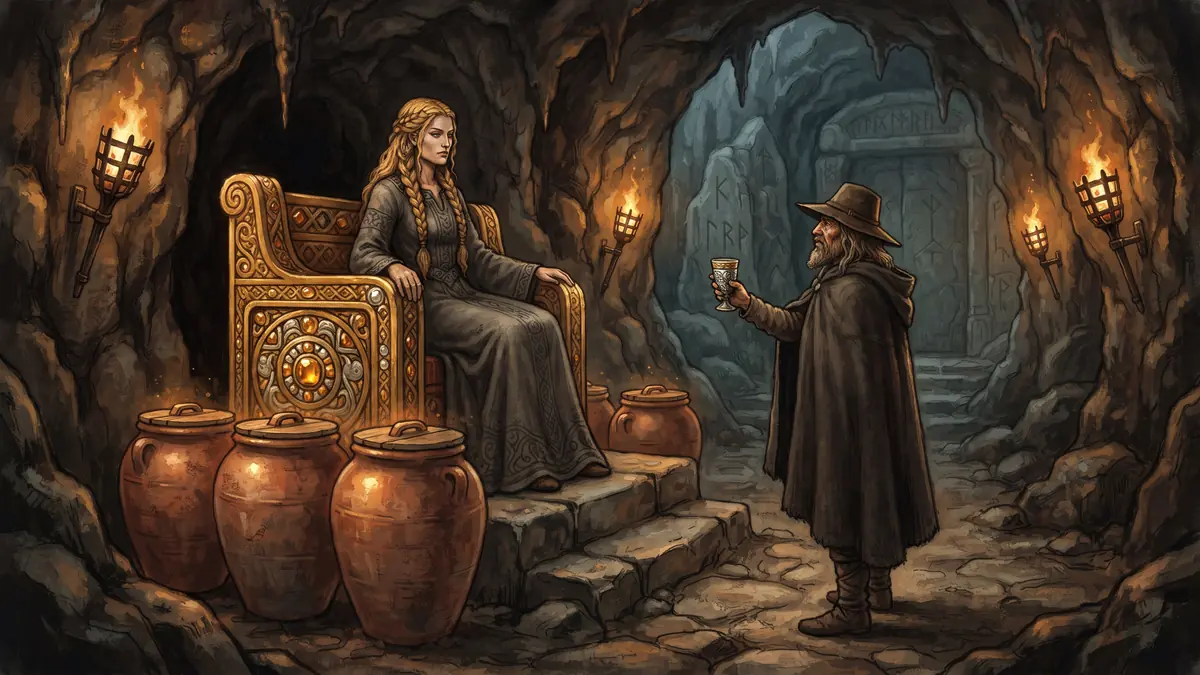
Gunnlöð, daughter of the giant Suttungr, guards the mead of poetry at Hnitbjörg. In Hávamál, Odin says she gave him a drink on a golden seat and that he gave her a bad return. See what Hávamál and Skáldskaparmál say, the name and what the sources do not tell.
In another text on this site, Odin steals the mead of poetry. This is the same story told from the side of the one who guarded the mead.
Who Gunnlöð is
Gunnlöð is a jötunn, the daughter of Suttungr, and the guardian of the mead of poetry. The name is translated as “war-invitation” or “battle-invitation”, and comes from gunnr, “battle” (Orchard, 1997; Lindow, 2002; de Vries, 1962).
Skáldskaparmál
According to Skáldskaparmál (chs. 57–58, Faulkes edition, 1987), Suttungr hid the mead in a place called Hnitbjörg and set his daughter to guard it. Odin, in snake form, entered the chamber where the mead was kept. He seduced Gunnlöð and spent three nights with her. In return, she let him take three draughts. With the three draughts he drank the mead from Óðrerir, then from Boðn and then from Són, and drained it all. Then he turned into an eagle and flew off as fast as he could.
Hávamál
In Hávamál, the story is told by Odin himself, and Gunnlöð gets more attention than in the Prose Edda version. In stanza 105, in Orchard’s translation (1997), Gunnlöð gave him a drink of the mead “on the golden seat” and Odin says: “In return I gave her bad recompense”, speaking of her whole heart and her sorrowful soul. In stanza 108, he says he doubts he would have returned from the giants’ realm without Gunnlöð, “that fine woman whom I laid in my arms”.
What the sources do not tell
Wikipedia describes no punishment or consequence for Gunnlöð beyond what the story says. In Hávamál, the “bad recompense” Odin mentions is left unexplained. The two versions differ in several details, and neither says what became of her afterwards.
In short
Gunnlöð is the figure the sources leave closer to silence than to a voice of her own: the guardian who opened the mead, and the guest who admits, himself, that he paid badly.
To train your eye on the cups of mead, play Gunnlöð’s vessels.
Sources.
- English Wikipedia, article "Gunnlöð", with the passages of Hávamál (stanzas 105 and 108, Orchard's translation, 1997) and Skáldskaparmál (chs. 57–58, Faulkes's translation, 1987)
- Studies cited: Orchard (1997), Lindow (2002) and de Vries (1962)