 MMXXVI
Hálfs saga ok Hálfsrekka: King Hálfr, Ásmundr's feast, the hall burned in Hörðaland and the survivors' revenge
Hálfs saga ok Hálfsrekka, an Icelandic legendary saga, tells how King Hálfr and half his men died in a burning hall in Hörðaland and how the survivors took revenge. See what the text says and what remains uncertain.
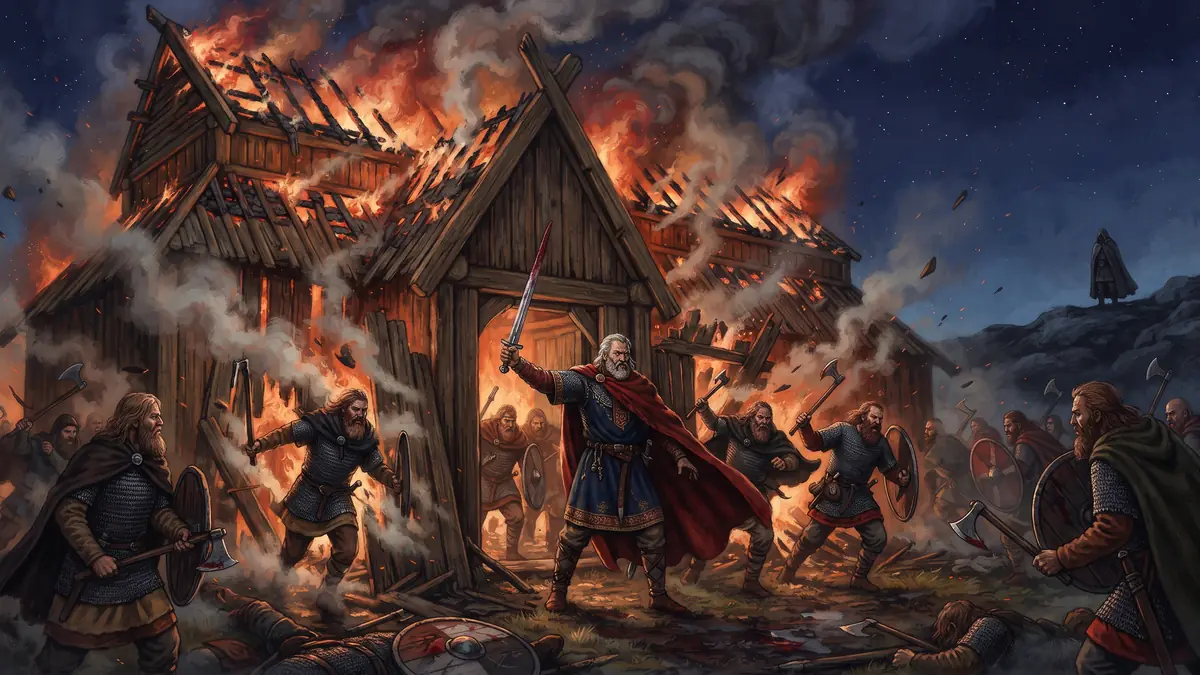
Hálfs saga ok Hálfsrekka is one of the fornaldarsögur, the “sagas of ancient times”, Icelandic stories about heroes who lived before the settlement of Iceland. Many scholars place it in the early fourteenth century, but it keeps poetry that seems much older. The scene everyone remembers is a feast that ends in fire.
King Hálfr and his companions
The first chapters of the saga are genealogy: kings of Hörðaland, in Norway, women who compete, revenge passed from father to son. Only then does Hálfr enter, son of Hjörleifr and Hildr. Hjörleifr dies on an expedition, and King Ásmundr takes Hildr and raises the boys. The elder, Hjörólfr, goes raiding at thirteen, badly equipped, and the saga says this is where the expression Hjörólfsfæri comes from, for an ill-prepared venture.
Hálfr, at twelve, was already the strongest man in the region and sets out with a single ship. Two sons of Earl Álfr, both called Steinn, join him: Innsteinn, eighteen, becomes his counsellor, and Útsteinn, twelve, goes along too. The crew, the Hálfsrekkar, had rules: you had to lift a great stone to enter, carry short swords, spare women and children, never pitch a tent on the ship and never reef the sail. Among them are two men called Hrókr, the Black and the White.
The burning hall
Back in Hörðaland, Ásmundr offers to swear loyalty to Hálfr and invites him, with half his men, to a feast. Innsteinn is suspicious and tells of three dreams of fire. Hálfr does not listen. The guests drink and fall asleep; the hosts set fire to the hall. The first man to wake sees the smoke and goes back to sleep, and the second sees the flames and does the same, until Hálfr wakes and rouses his companions. They break out through the walls, but the enemies outside are many. Hálfr dies, and the final verses say he died laughing.
The revenge
Gunnlöð, the mother of Innsteinn and Útsteinn, searches the field at night, finds Innsteinn dead and takes home those still breathing, among them Útsteinn. Hrókr the Black, wounded, is hidden by a farmer and then reaches the court of King Haki, in Scania. There, without revealing himself, he sings a long poem about the Hálfsrekkar, the betrayal and his oath of revenge; Haki honours him and gives him his daughter Brynhildr. Later an expedition joining Hrókr, Útsteinn and other kinsmen kills Ásmundr, and Hjörr, Hálfr’s son, becomes king of Hörðaland. The saga also records that Hrókr’s daughter, Gunnlöð, is the mother of the hero Hrómundr Gripsson.
What is uncertain
The end of the saga changes subject: it speaks of Hámundr and Geirmundr heljarskinn, “Hel-skin”, sons of Hagný, and of Icelandic families said to descend from them. This is a common device in the legendary sagas, which link heroes of the past to families of the present, and it does not prove that the events happened. The same legend exists in a Scandinavian ballad, Stolt Herr Alf, which shows that it circulated outside Iceland. Part of the saga’s poetry is considered old, which suggests a long oral transmission before the prose was written. Names, numbers and dates should be read as tradition, not as an archive record.
To see whether you remember the facts of the feast, the companions and the revenge, play Hálfr’s facts.
Sources.
- Hálfs saga ok Hálfsrekka, Icelandic legendary saga (fornaldarsaga), in Guðni Jónsson and Bjarni Vilhjálmsson (eds.), Fornaldarsögur Norðurlanda (Reykjavík, 1943–1944)
- C. C. Rafn (ed.), Fornaldar sögur Nordrlanda (Copenhagen, 1829–1830)
- Stephen A. Mitchell, Heroic Sagas and Ballads (Cornell University Press, 1991)