 MMXXVI
Hamðismál: the poem that closes the Poetic Edda, with the brothers Hamðir and Sörli and Guðrún's revenge
Hamðismál is one of the oldest heroic poems of the Poetic Edda: Guðrún sends her sons to avenge Svanhild against king Jörmunrekkr, an echo of the Gothic king Ermanaric.
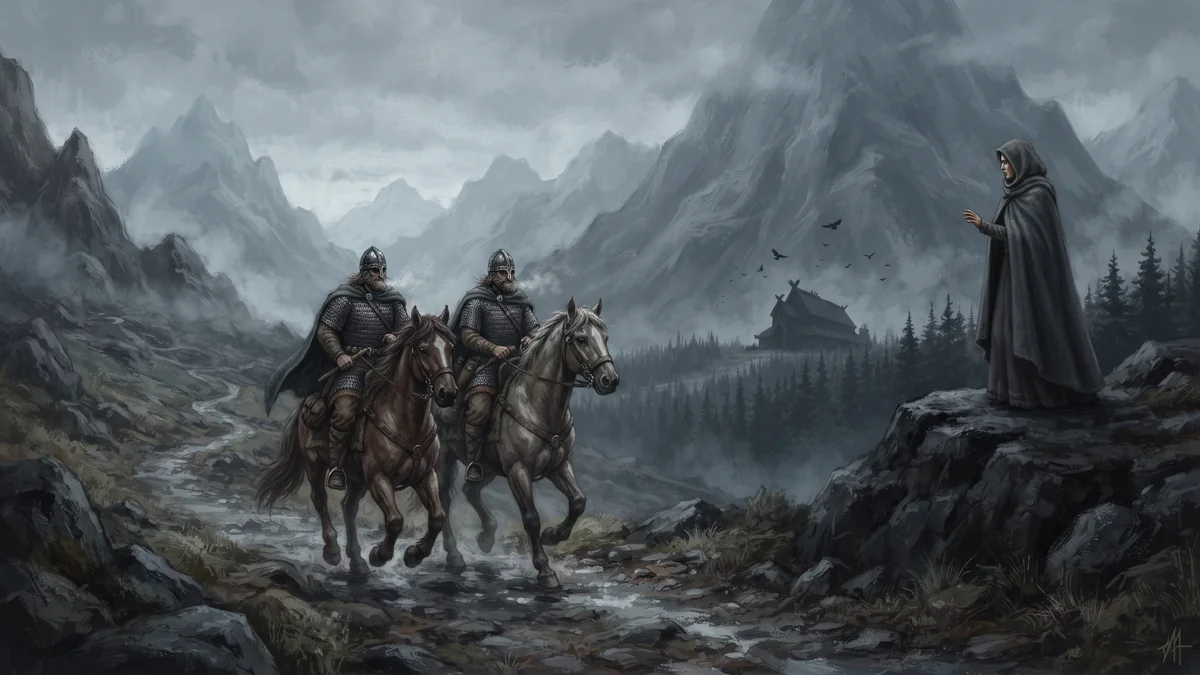
Hamðismál closes the heroic poems of the Poetic Edda and, with them, the whole collection. It is among the oldest heroic poems, probably from the 9th century, with an archaic, bitter and laconic style.
The background
Guðrún was the wife of the hero Sigurd, who was killed by her brothers. She and Sigurd had a daughter, Svanhild, who married the Gothic king Ermanaric, in Norse Jörmunrekkr. He had Svanhild trampled by horses. Guðrún then seeks revenge and urges her sons from a later marriage, the sons of Jonakr, to kill Jörmunrekkr. The poem Guðrúnarhvöt deals with that moment.
The ending
The brothers Hamðir and Sörli ride over a misty mountain, in a state of rage. The poem ends with the fall of both, one at the gable-end of the hall and the other at the back of the houses. The closing lines resemble an inscription on a runestone.
The historical echo
King Ermanaric was real: he died in 376, ruled a large part of the region of Oium, and Ammianus Marcellinus says he killed himself amid attacks by the Alans and the Huns. Jordanes, in 551, tells that Ermanaric had Sunilda, the Svanhild of the Norse sources, put to death by horses, for her husband’s treason. Her brothers, Sarus and Ammius, wounded him gravely, and he was left unable to resist the Huns. The Annals of Quedlinburg, from the end of the 10th century, say that the brothers Hemidus, Serila and Adaccar cut off Ermanaric’s hands.
Other sources
The legend also appears in the Völsunga saga, in the Gesta Danorum and in Bragi Boddason’s Ragnarsdrápa.
In short
Hamðismál turns a Gothic memory of the 4th century into a Norse family tragedy. To join the brothers’ ride, play The brothers’ ride.
Sources.
- English Wikipedia, articles "Hamðismál" and "Ermanaric"
- Jordanes, Getica (551), cited by Wikipedia
- Annales Quedlinburgenses (late 10th century), cited by Wikipedia