 MMXXVI
Haugsnes, 19 April 1246: the bloodiest battle in Icelandic history, the revenge of Þórður kakali and the more than a thousand stones of the field
In 1246, in Skagafjörður, Þórður kakali faced Brandur Kolbeinsson and the Ásbirningar at the battle of Haugsnes, the largest in Icelandic history. Today a field of stones marks the place of each fighter.
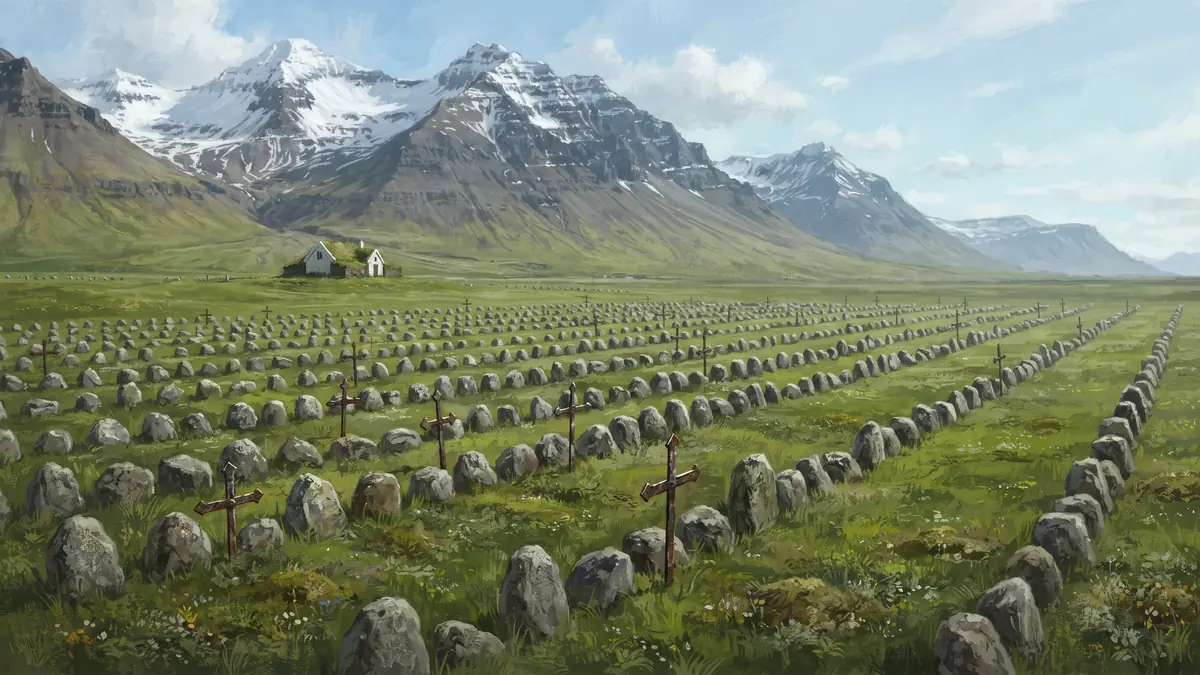
The battle of Haugsnes, on 19 April 1246, is remembered as the largest and bloodiest ever fought in Iceland. It took place in the valley of Skagafjörður, in the north of the island, during the Age of the Sturlungs, when families of chieftains fought over power in private wars.
Two sides and a revenge
On one side stood Þórður kakali Sighvatsson, of the Sturlungar. On the other, Brandur Kolbeinsson, of the Ásbirningar. Þórður wanted to avenge his father, Sighvatr, and his brothers, killed at the battle of Örlygsstaðir in 1238. Estimates of the forces vary between sources, but come to around six hundred men on each side.
What the saga and the studies tell
Íslendinga saga, written by Sturla Þórðarson, describes the fight on the low plain of Haugsnes. The Ásbirningar ended up breaking apart, and many died in flight. The accounts speak of about 110 dead, some 40 on Þórður’s side and 60 to 70 among the Ásbirningar. Among them was Brandur Kolbeinsson. The defeat ended the power of the Ásbirningar family in the north.
The numbers of dead and of fighters are approximate: the sources give no exact counts, and modern studies differ.
The field of stones
At Haugsnes, the farmer and artist Sigurður Hansen, of Kringlumýri, built a memorial: more than a thousand stones set out in the order in which the fighters are thought to have stood, each one standing for a man. The stones of those who fell carry an iron cross. Nearby, a large wooden cross at Róðugrund commemorates Brandur Kolbeinsson.
Why it still matters
Haugsnes shows what violence between Icelandic chieftains was like in the 13th century. The older sagas deal with feuds between families; here there are armies of hundreds of men, and the civil war weakened Iceland, which passed to the Norwegian crown in 1262 and 1264.
To pile up the stones of the memorial, one on top of another, without letting the tower fall, play The stones of Haugsnes.
Sources.
- Sturla Þórðarson, Íslendinga saga (13th century), part of the Sturlunga saga
- Sturlunga saga, in the English translation by Julia McGrew and R. George Thomas (Twayne, 1970–1974)
- Studies of the Age of the Sturlungs and of the Haugsnes memorial, in Skagafjörður