 MMXXVI
Helhest: the three-legged horse of death in Danish folklore, the one that prowls the churchyard and the saying "he gave death a bag of oats"
In Danish folklore, the Helhest is a three-legged horse linked to the goddess Hel, to death and to illness. Whoever sees it in the churchyard dies, and surviving a serious illness was to have given death a bag of oats.
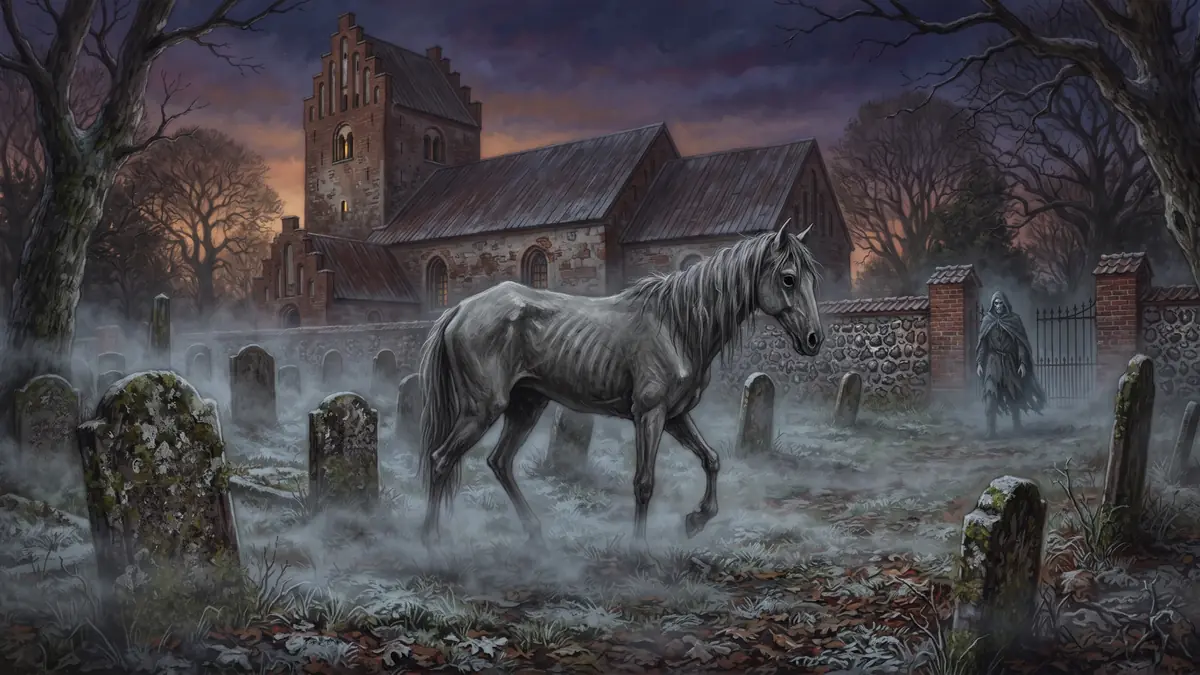
In the folklore of Denmark, the Helhest is a three-legged horse. The name means “Hel’s horse”, and it is linked to the goddess Hel, to death and to illness. It appears in the dead of night, in churchyards, and its presence almost always announces the worst.
Old sayings
The language keeps traces of it. To say someone “walks or treads like a Helhest” is to say they walk heavily, with hard steps. And there is a stranger phrase: to say someone gave death a bag of oats means the person survived an illness that might have been fatal. Thorpe read the oats as an offering to the horse of death.
Told cases
Grimm writes that the Helhest walks round the churchyard on three legs. A saying from Schleswig has Hel riding a three-legged horse in times of plague. At Aarhus Cathedral, a man who saw a horse in the yard turned pale and died. At Roskilde Cathedral, people spat on a narrow stone where a Helhest was said to be buried.
The horse buried alive
The legend says that, before the first human burial in each churchyard, a living horse was buried there. That horse returns, afterwards, as the Helhest. Grimm theorized that the horse had been, before Christianization, the steed of Hel herself.
Relatives in mythology
It recalls other animals of the world of the dead. Sleipnir, Odin’s eight-legged horse, rides to Hel. The Valravn, the raven of the dead, also watches the place. The Helhest is one of the few cases where the terror comes not from a monster but from an animal that seems almost ordinary, with just one leg missing.
To run through the churchyard gathering bags of oats and fleeing the three-legged horse, play Oats for death.
Sources.
- Grimm, Deutsche Mythologie (1835), and Finnur Magnússon (1826)
- Thorpe, Northern Mythology (1851); Vicary (1884)