 MMXXVI
Helreið Brynhildar: Brynhildr's journey by wagon to Hel and her talk with the giantess
In the poem Helreið Brynhildar, Brynhildr is burned on a pyre and travels by wagon toward Hel. On the way a giantess accuses her, and she tells, in the first person, her own version.
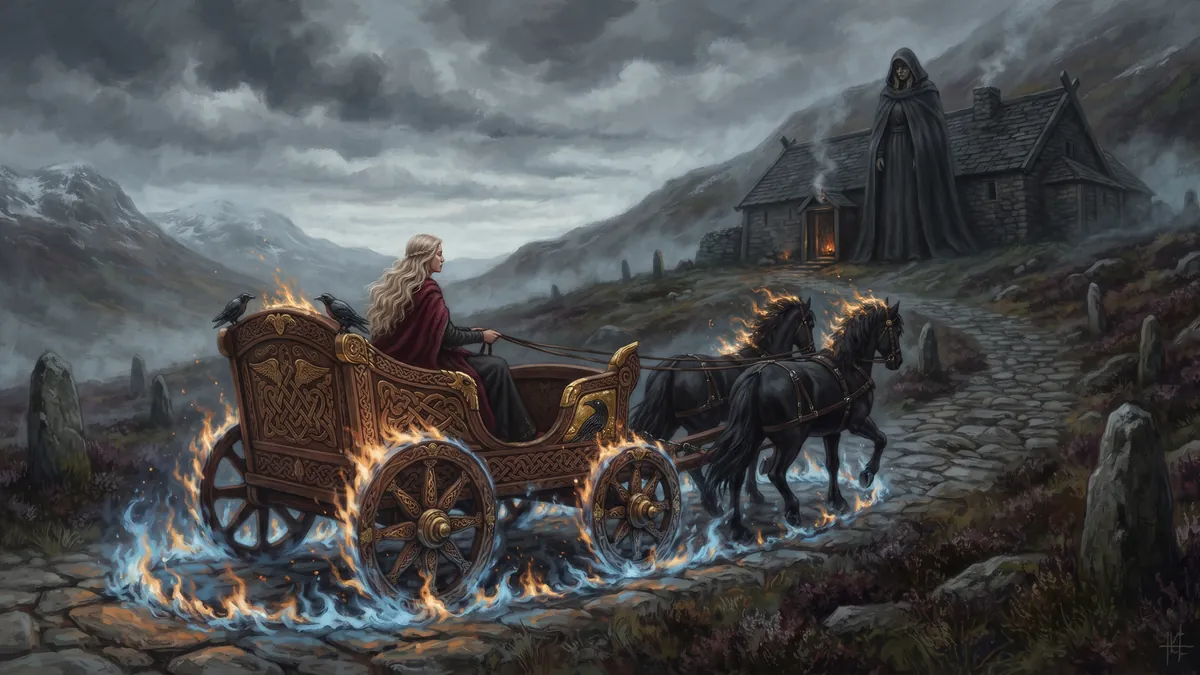
Helreið Brynhildar, “Brynhildr’s Hel-ride”, is a short poem of the Poetic Edda. Almost all of it, except stanza 6, is also quoted in Norna-Gests þáttr.
The two pyres
Sigurd and Brynhildr are burned on two separate pyres: first Sigurd, then Brynhildr, who lies on a richly decorated wagon. The wagon carries her toward Hel, the world of the dead. On the way she passes a house where a giantess, a gýgr, lives.
The giantess
The giantess accuses Brynhildr of causing the deaths of heroes and of coveting another woman’s husband, Sigurd. She also blames her for the downfall of the Nibelungs, the sons of Gjúki. Brynhildr answers that she will tell the truth and explains how the sons of Gjúki made her an unhappy oath-breaker.
Brynhildr’s story
She tells that she was once called Hildr of the helmet and lived among the valkyries in Hlymdalir. A king, presumably Agnarr, captured her and her sisters by taking their swan-robes. She was twelve winters old when she married him. Against Odin’s will, she caused the death of the aged Hjalmgunnar, king of the Goths, and gave victory to the young Agnarr, Auða’s brother. Odin punished her and imprisoned her in Skatalund, surrounded by fire and overlapping shields, and cursed her to sleep until a fearless man freed her.
Sigurd came on Grani, brought her Fafnir’s gold and shared her bed for eight nights without touching her. The Grípisspá says it was only three. Afterwards Guðrún reproached her for this and revealed that she and others had tricked Brynhildr, taking her away from Sigurd and giving her to Gunnar as a wife.
The end
Brynhildr ends by saying that people live in this world to suffer, but that she and Sigurd will never be parted again.
In other sources
The Sigurðarkviða hin skamma puts Sigurd and Brynhildr on the same pyre. Norna-Gests þáttr calls the sisters “sisters of Atli”. Skatalund is also called, in other sources, Hindarfjall. Henry Adams Bellows considers the poem a masterpiece, with an “extraordinary degree of dramatic unity”. Some scholars argue that parts of it originally belonged to the Sigrdrífumál, which is close in content.
In short
It is a short poem in which the woman the legend accuses defends herself, on the way to the world of the dead. To keep the wagon steady on the road, play Brynhildr’s wagon.
Sources.
- English Wikipedia, article "Helreið Brynhildar"
- Poetic Edda, poem Helreið Brynhildar
- Norna-Gests þáttr, which quotes almost the whole poem