 MMXXVI
Herr Mannelig: the Swedish ballad of the mountain woman who offers twelve steeds, twelve mills and a gilded sword to marry a knight
Herr Mannelig is a Swedish ballad in which a mountain creature asks a knight to marry her, in exchange for gifts. He refuses because she is a heathen. The oldest recorded version dates from 1877. See what is known.
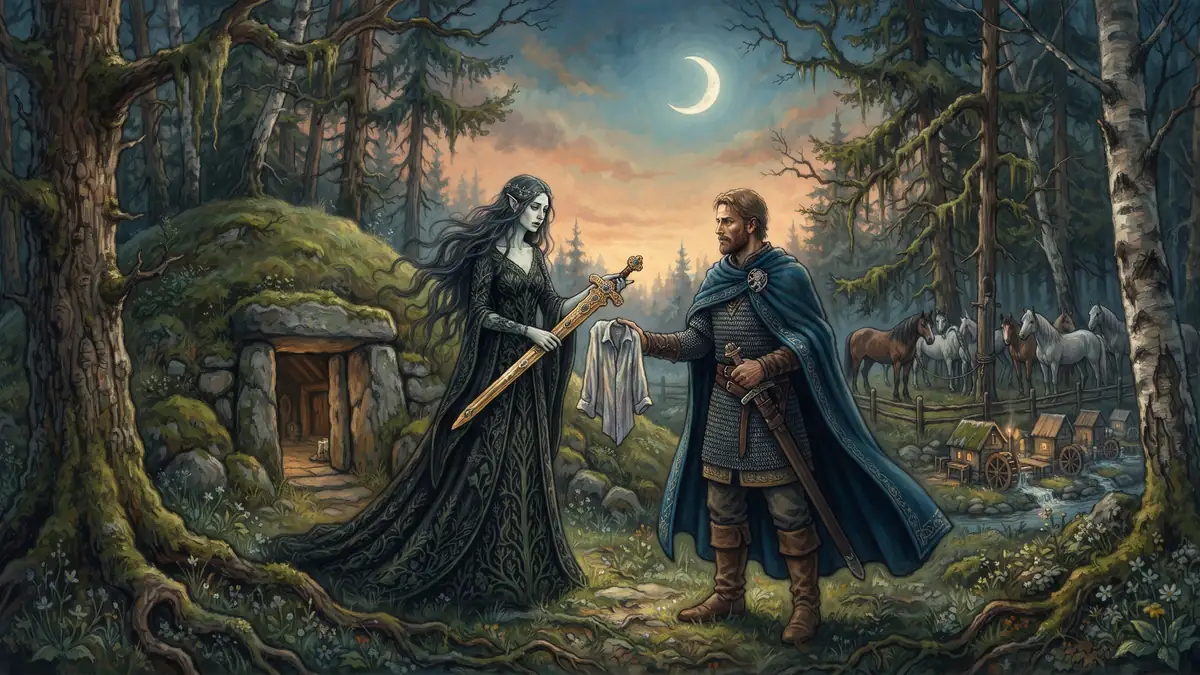
Few Scandinavian ballads have travelled as far in modern recordings as Herr Mannelig. It tells of a mountain creature’s marriage proposal to a knight. It is also known as Bergatrollets frieri, “the mountain troll’s wooing”, and is catalogued as SMB 26 and TSB A 59.
What is known of the source
The oldest version with a named source comes from H. Aminson’s book Bidrag till Södermanlands äldre kulturhistoria, vol. I, of 1877, pages 21 to 23, collected in the parish of Lunda, in Södermanland. That is, the text is recorded only in the nineteenth century, although the tradition is older.
The plot
In the ballad, a mountain creature asks Herr Mannelig to marry her. In the Lunda version she offers twelve steeds, twelve mills, a gilded sword and a silk shirt. In a variant from Näshulta, published in volume 3, of 1882, the gifts include a castle, a stable, a cap of red damask, a blue mantle and a treasure.
He refuses. In the Näshulta text, the reason given is that she is a heathen, that is, not a Christian. The refrain, which repeats, is what is most often recorded.
Variants
The same situation appears in other ballads. Skogsjungfruns frieri has a forest maiden. Herr Magnus, or Hertig Magnus och Hafsfrun, which appears in 1816 in Afzelius and Geijer’s collection, has Duke Magnus and a sea-woman. In 1862, Ivar Hallström made an operetta from this plot.
In the twentieth and twenty-first centuries
The melody became known worldwide in versions by groups such as Garmarna, who recorded it on Guds spelemän (1996), In Extremo and Haggard, among others. Many people know it without knowing the text comes from a medieval ballad of Sweden.
The ballad belongs to the genre of the folkvisor, Swedish narrative songs transmitted orally and written down by collectors in the eighteenth and nineteenth centuries, as happened with the collection of Afzelius and Geijer and with Aminson’s book. In ballads of this kind, the refrain repeats in every stanza, which makes them easy to memorise and to sing in a group.
The proposal refused on religious grounds, because the creature is a heathen, is read by some as a portrait of the border between the Christian world and the world of the creatures of nature. It is one possible interpretation, and not the only one: the ballad can also be read simply as the story of a generous offer and a firm answer, with no explicit moral.
To sing the ballad’s refrain at the right time, play The ballad refrain.
Sources.
- H. Aminson, Bidrag till Södermanlands äldre kulturhistoria, vol. I (1877), pp. 21–23, and vol. 3 (1882)
- Svenska medeltidens ballader (SMB 26), and the index Types of the Scandinavian Medieval Ballad (TSB A 59)
- Records of variants: "Skogsjungfruns frieri", "Herr Magnus" and "Hertig Magnus och Hafsfrun" (Afzelius–Geijer, 1816)