 MMXXVI
Hildigunnr and the blood-stained cloak: the widow who made Flosi avenge Höskuldr
In Njáls saga, Hildigunnr is Flosi's niece and the widow of Höskuldr. When Flosi arrives at her house, she gives back the cloak he had given her husband, stained with the blood in which he died. See the scene as Dasent's translation tells it and what it changes in the saga.
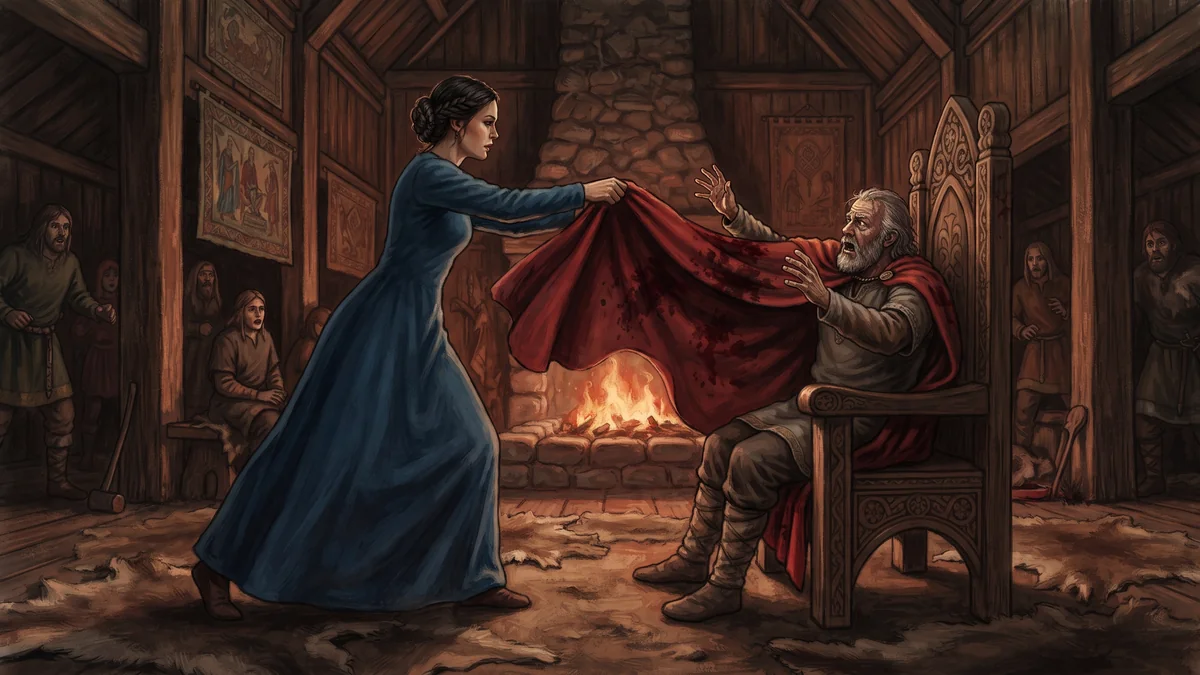
In Njáls saga, almost everyone who decides on a revenge is a man. Hildigunnr is the exception the saga remembers: without drawing any weapon, she forces a great chieftain of the east of Iceland to act.
Who she is
Dasent’s translation introduces her, in chapter 94, as Flosi’s niece: “a proud, high-spirited maiden, and one of the fairest of women”, so skilful with her hands that few were equally skilful. The same passage also says she was “the grimmest and hardest-hearted of all women”, though open of hand and heart when a fitting call was made on her. She marries Höskuldr, Njáll’s foster-son, and is a widow when her husband is killed. The cloak the story depends on is a gift from Flosi to Höskuldr himself, according to chapter 115.
Flosi’s arrival
In chapter 115, Hildigunnr has the house cleaned, tapestries hung and a high seat prepared for Flosi. He refuses the seat. She answers coolly and sits beside him to talk in private. When Flosi goes to wash, he finds the towel torn and wipes his hands on the tablecloth. She weeps and asks what help or revenge she can expect from him.
The cloak
Flosi says he will take the case to law. She reminds him that her brothers-in-law’s family once avenged a killing by force. Then she brings the stained cloak from her chest and says, in the words of the translation: “This cloak, Flosi, thou gavest to Hauskuld, and now I will give it back to thee; he was slain in it”. She throws the cloak over Flosi, and “the gore rattled down all over him”. Flosi flings it back and calls her “the greatest hell-hag”, saying that “women’s counsel is ever cruel”. He rides to Holtford, where he meets his allies.
What the scene does in the saga
Dasent shows that, after this visit, Flosi’s kinsmen gather and go to the Althing. The saga leaves no doubt that Hildigunnr’s gesture was the spark. It is also a scene about what the saga regards as a widow’s honour: to keep the proof, wait for the moment and use it.
In short
Hildigunnr does not fight, but she decides. The cloak is the object the saga chooses to show that, in Njáll’s world, revenge ran through cloth and memory as much as through the sword.
To train the rhythm of the needle on the cloak, play Hildigunnr sews the cloak.
Sources.
- The Story of Burnt Njal, English translation by George Webbe Dasent (1861), in the Sacred Texts edition, chapters 94 and 115