 MMXXVI
Hjálmþés saga ok Ölvis: the stepmother Lúða, the thrall Hörðr, the curse of not resting and the journey to Hundingr's daughter
Hjálmþés saga ok Ölvis, an Icelandic legendary saga, tells how Prince Hjálmþér, cursed by his stepmother, crossed seas with his friend Ölvir and the thrall Hörðr to find Hervör, daughter of Hundingr. See what the text says and what remains uncertain.
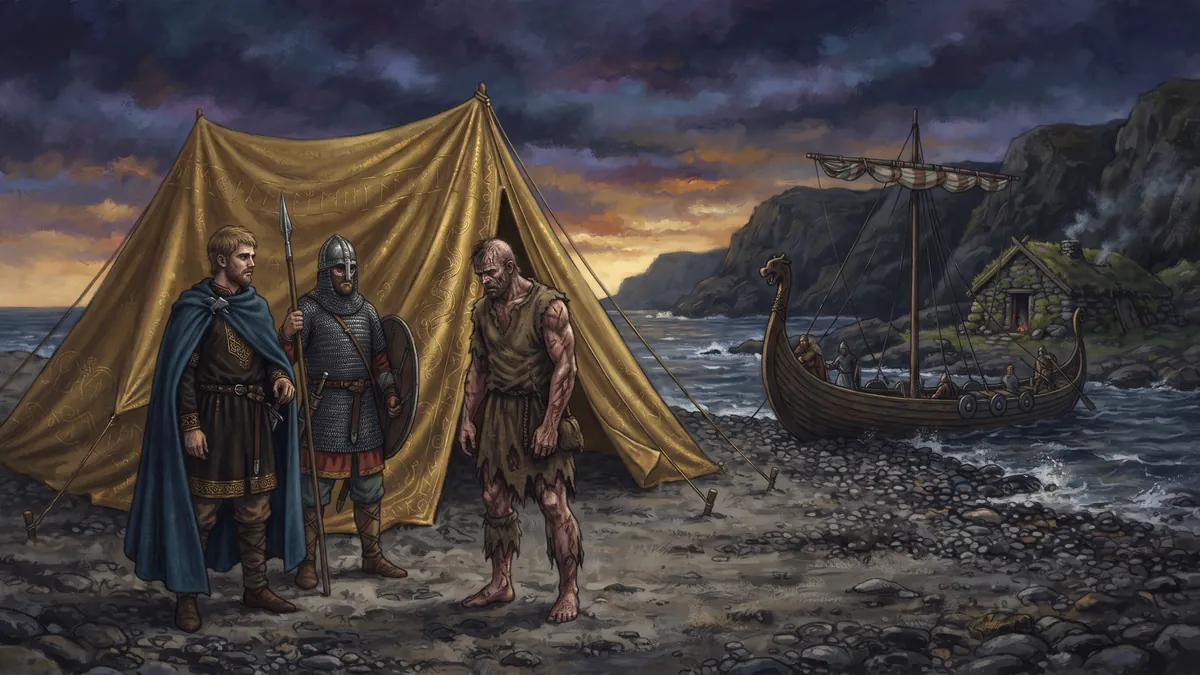
The Hjálmþés saga ok Ölvis is an Icelandic legendary saga that stacks several tale motifs: a wicked stepmother, a curse, a thrall who is not what he seems and a bride who lives in a golden tower. There is no secure date. There are also Hjálmþésrímur, narrative poems on the same story, and the scholar Finnur Jónsson argued that they show the saga once had another structure.
Two friends and a stepmother
King Ingi rules Mannheimar. His son Hjálmþér is raised by Herrauðr, whose son Ölvir becomes his inseparable companion. In a tournament, Hjálmþér unseats Ölvir, and Herrauðr has them swear brotherhood. When Hjálmþér’s mother dies, the king marries again, to Lúða, who arrives in a boat with a big, strong thrall who tends pigs. Lúða is cold and ambitious, and men begin to vanish from the court at night.
Hjálmþér and Ölvir set out with five ships and five hundred men. They beat the viking Koll and take his dragon, the Kollsnaut; then they defeat his brother, Tóki, who had the Tókanaut. Further on, a king hosts them, and his daughter Díana, learned and skilled, plays chess with Hjálmþér. He kills Núdus, son of the king of Serkland, and Díana gives him a golden tent that protects whoever is inside.
The curse
Back home, Lúða seeks Hjálmþér in the forest castle and makes him a proposal. He strikes her, her nose bleeds and she sinks into the earth. On a hunt, he and Ölvir shelter in a cave where a giant lives with his sister Skinnhúfa, who saves them with magic; they kill the giant with a sword only he feels. On an island, Hjálmþér meets the monstrous Vargeisa, who has a famous sword, Snarvendill, and advises him to choose a thrall of the household as his companion.
Hjálmþér chooses Hörðr, the pig thrall. Lúða then casts a curse: Hjálmþér will not be able to rest anywhere except on the ships or in a tent until he sees Hervör, daughter of Hundingr.
The journey to Hundingr
On a northern beach, Hörðr tricks the men and leads them to sleep in a hut; nine troll-women attack, and Hörðr kills them. Then he tricks a giant into a cliff crevice and frees the captive Ýma. They reach Hundingr’s land, where Hervör lives in a golden tower. Hundingr sets trials, among them fetching the horns of a giant ox. Hörðr kills it at night, wins a fight with a dark-skinned man and beats the counsellor Hástigi in a tug-of-war over the hide. A trap in the bed kills Hástigi instead of the heroes. Hörðr takes Hervör to the ship. A sea monster attacks, and Hjálmþér kills it with Snarvendill.
At the end, Hörðr falls as if dead in a house on an island; Hjálmþér and Ölvir carry the body for three days, and the curse ends. It turns out he is King Hringr, whom Lúða had bewitched. Hjálmþér marries Álsól, Ölvir marries Hildisif, and Hringr marries Hervör. The stepmother falls into the fire, and Hjálmþér becomes king.
What is uncertain
Ralph O’Connor proposed, in 2000, that the saga has an analogue in Irish stories about stepmothers; others link it to the English tale The Laidly Worm of Spindleston Heugh. Since summaries vary, it is worth checking the original text. Dates, names and the golden tower belong to the tradition of tales.
To run along the beach, gather the gold coins and flee the troll women, play Hörðr’s beach.
Sources.
- Hjálmþés saga ok Ölvis, Icelandic legendary saga (fornaldarsaga), in Guðni Jónsson and Bjarni Vilhjálmsson (eds.), Fornaldarsögur Norðurlanda (Reykjavík, 1943–1944)
- Ralph O'Connor, "'Stepmother Sagas': An Irish Analogue for Hjálmþérs saga ok Ölvérs", Scandinavian Studies 72, no. 1 (2000)
- Finnur Jónsson, Fornaldarsögur og nogle dermed beslægtede sagaværker (1923)