 MMXXVI
Hrafn Sveinbjarnarson, the Westfjords chieftain who pilgrimed to Santiago, healed without charge and was killed in 1213 in a dispute with Þorvaldr
Hrafn Sveinbjarnarson (d. 1213) was a chieftain in Arnarfjörður, a poet and a healer. Hrafns saga, written decades later, tells of his journeys to Santiago and Rome, his cures and his quarrel with Þorvaldr Snorrason.
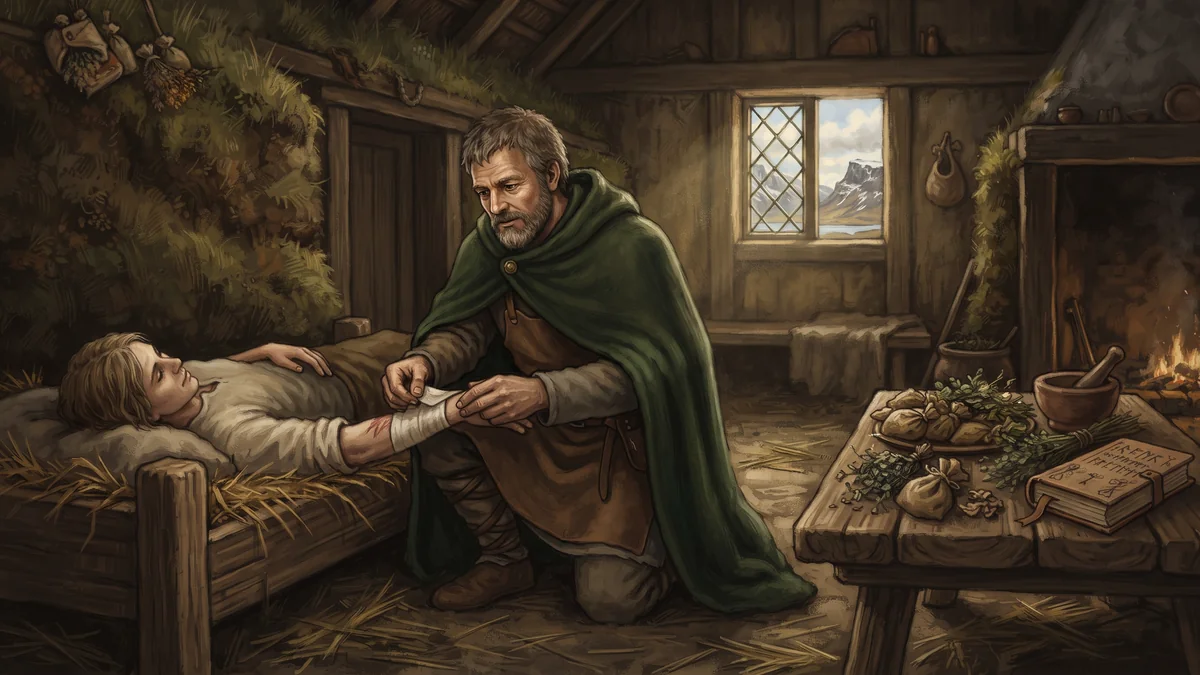
Among the Icelandic sagas, Hrafn Sveinbjarnarson’s is one of the few that tell the life of a man who lived and died not long before the author. Hrafn was a chieftain at Eyri, on the fjord Arnarfjörður, in the Westfjords, and died in 1213.
Who Hrafn was
He was the son of Sveinbjörn Bárðarson, nicknamed “the Black”, and of Steinunn Þórðardóttir. He married Hallkatla Einarsdóttir, and the couple had eight children. The saga describes him as a poet, a skilled craftsman, a man learned in the law and a great traveller, generous and well liked.
The pilgrimage and the cures
Shortly before 1200, Hrafn went on a pilgrimage that took in Canterbury, Saint-Gilles, Rome and Santiago de Compostela. On his return, through Norway, he began to treat the sick without charge. The saga tells of cures of wounds, of severe swellings and of bladder stones, and two cases that today we would call mental distress, treated with bloodletting and with cautery. The saga credits God with the gift, and ties the lineage of the skill to the holy king Óláfr of Norway.
The quarrel with Þorvaldr and the death
The other half of the saga deals with the dispute between Hrafn and Þorvaldr Snorrason, chieftain of Vatnsfjörður, also in the Westfjords. That dispute led to Hrafn’s death in 1213.
A saga between history and saint’s life
Hrafns saga was written between 1230 and 1250, by an author whom tradition does not name. There are two separate versions, the long and the condensed, and an episode in the Sturlunga saga, which leaves out the cases of mental distress. Scholars call it a contemporary saga with traits of a saint’s life: the author seems to have taken as models the life of Saint Magnús, written by Master Robert, and a life of Thomas Becket.
That means the image of Hrafn as almost a saint may have been shaped by the model. All the same, the source is valuable for the history of medicine in medieval Iceland.
To put each sentence in the right stage of Hrafn’s life, play Hrafn’s life.
Sources.
- Hrafns saga Sveinbjarnarsonar (13th century), preserved in two versions and also inside the Sturlunga saga
- Studies by Guðrún P. Helgadóttir (1987 edition) and Anne Tjomsland (1951 English translation)
- Research on Hrafns saga as the account of a 12th-century Icelandic physician and chieftain