 MMXXVI
Hrafnagaldr Óðins: Odin's "raven chant", a poem that looks like the Edda but survives only in 17th-century paper copies
Hrafnagaldr Óðins has 26 stanzas and tells how Iðunn falls from the world-tree and Heimdallr goes to question a woman who answers only with tears. Almost all scholars see it as a post-medieval poem, copied on paper from the 17th century on.
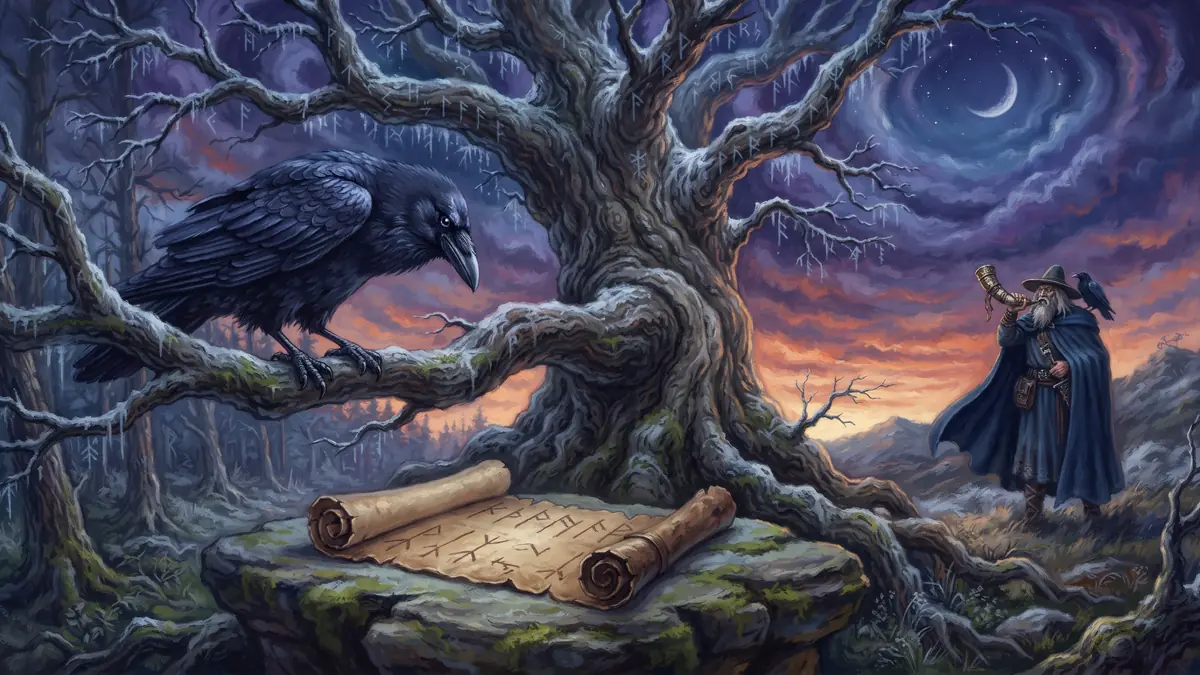
The title, Hrafnagaldr Óðins, means “Odin’s raven chant”, and every manuscript also carries a subtitle: Forspjallsljóð, “prelude poem”. It has 26 stanzas in fornyrðislag, the most common metre of early Norse poetry, with eight lines each. The order of the stanzas is the same in all the manuscripts. At first sight it looks like a poem of the Edda. Almost all scholars say it is not.
What the poem tells
The first five stanzas are ominous. The narrative begins in the sixth: Iðunn falls from the world-tree and is given a wolfskin to wear (stanzas 6 to 8). Odin sends Heimdallr, at the head of three messengers, to a woman called “the doorpost of Gjöll’s sun”, a kenning for a woman (stanza 9). The messengers ask about the beginning, the duration and the end of heaven, the world and Hel, and she answers only with tears (stanzas 11 to 13). She has been identified as Iðunn, as Hel or as Urðr. They return to Asgard and join a feast. Heimdallr tells the gods, and Loki informs the goddesses (stanzas 14 to 19). The festivities end, and night is described in mythological terms (stanzas 21 to 26). The last verse shows Heimdallr raising his horn towards heaven. The ending seems unsatisfying, which is why the poem is thought to be incomplete.
Why it looks late
The poem survives only in paper copies: at least 37, from the second half of the 17th century to the 1870s, scattered across Iceland, Denmark, Sweden, Britain, Germany and the United States. Metre, language and style point to the 16th century at the earliest, and today the consensus rests on the 17th. Annette Lassen (2011) calls it “a postmedieval poem”, probably written soon after 1643, when the Codex Regius was rediscovered. A proverb in stanza 22 may come from Erasmus’s Adagia, which sets a lower limit of 1500, and the word máltíð (stanza 20), borrowed from Middle Low German, points to after the middle of the 14th century. Sophus Bugge argued for the 17th century in 1867; Jónas Kristjánsson, in 2002, allowed for a 14th-century date, which hardly anyone accepts.
A riddle that is still being edited
The first printed edition is from 1787. There are editions by Rask and Afzelius (1818), Scheving, Munch, Lüning, Möbius, Bugge and Bergmann, and the critical edition by Lassen, of 2011. A letter from Árni Magnússon, of 1729, hints at a lost vellum, but Bugge dismissed it.
To hit the raven’s chant in the right rhythm, play The raven’s chant.
Sources.
- *Hrafnagaldr Óðins* (also *Forspjallsljóð*), poem in paper manuscripts of the 17th to 19th centuries; critical edition by Annette Lassen (2011), with an English translation by Anthony Faulkes
- Earlier editions: Guðmundur Magnússon (1787), Rask and Afzelius (1818), Bugge (1867), among others