 MMXXVI
Hrafns þáttr Guðrúnarsonar: the young Icelandic outlaw, King Magnús's ring returned on the point of a spear and the battle in Denmark
The Hrafns þáttr Guðrúnarsonar tells how Hrafn, Guðrún's son, avenges his father in Hrútafjörður, flees to Norway, escapes King Magnús the Good and is pardoned after fighting in Denmark beside the king and his uncle, the poet Sighvatr. See the plot.
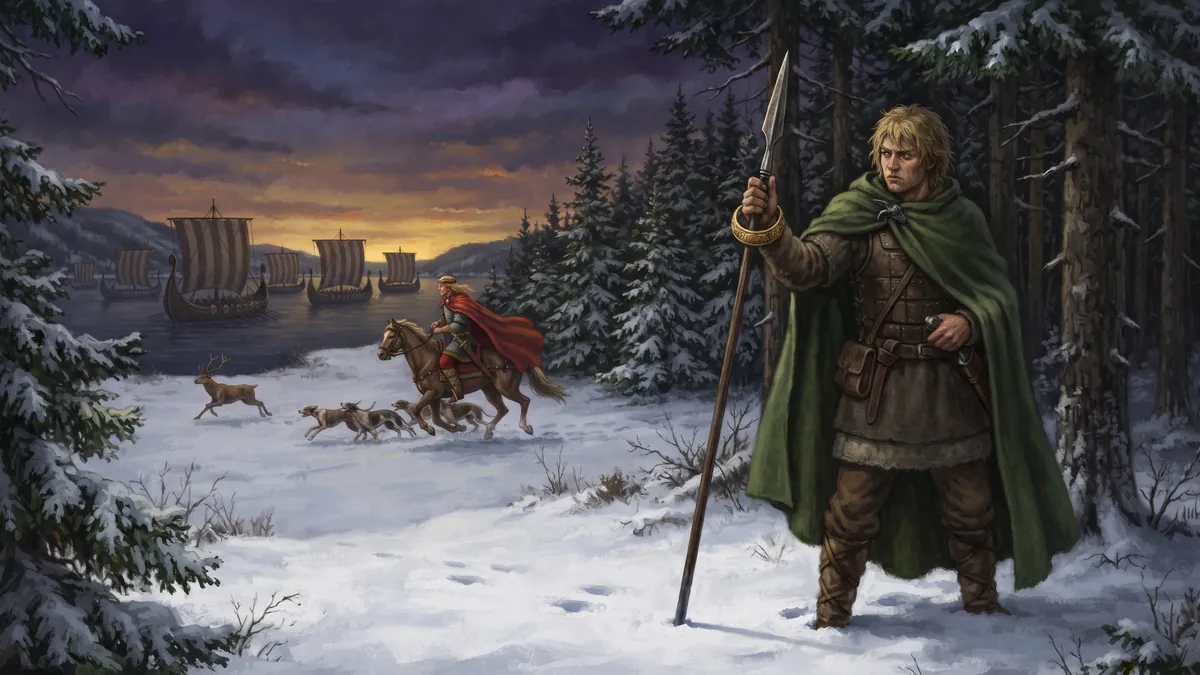
The Hrafns þáttr Guðrúnarsonar is a tale of revenge, flight and pardon, with the Norwegian king Magnús the Good as judge. Its centre is an Icelandic youth who kills twice and has to find out how to live afterwards.
The quarrel in Hrútafjörður
Þorgrímr of Staðr is a rich, petty farmer, father of Kálfr and Grímr. His neighbour Sighvatr, of Melar, is in debt and has a wife, Guðrún, and a small son, Hrafn. Sighvatr sells Þorgrímr a meadow, Grænateigr, and Þorgrímr begins to treat Sighvatr’s pastures as his own. When Sighvatr drives off one of Þorgrímr’s oxen, Þorgrímr kills him with a spear. Guðrún hides the truth from her son and says his father died of illness. Þorgrímr offers to make peace by marrying her, and she refuses.
The first killing
Hrafn grows up strong and well liked. At fifteen, Kálfr taunts him at the games and tells him who killed his father. Hrafn questions his mother, who confirms it. At eighteen, Kálfr mocks him again, and Hrafn kills him. Guðrún hides him in an underground storehouse and gathers the neighbours. At the next Alþingi, Hrafn is declared an outlaw.
The flight to Norway
Norwegian merchants are preparing a ship in Hrútafjörður. Guðrún asks Einarr Naumdælr to take her son. Einarr hesitates, but his brother, Sigurðr, insists and casts off the gangway when Þorgrímr arrives. The ship sails for Trondheim.
There, Einarr leaves Hrafn with Ketill, nicknamed Rípr, a royal official. Ketill’s wife, Signý, and his daughter, Helga, treat the lad well. Ketill resents him, mocks him in verse and tries to sell him as a slave to some merchants. Hrafn resists and kills Ketill. He tells everything to Signý and Helga, who give him clothes and food and urge him to avoid the king’s anger, and he flees into the forest.
The king, the ring and the sea
King Magnús is furious, because Ketill was his official. Hunting alone, he meets Hrafn, who asks for protection. The king sends him to spend the winter with Kolr, in Þauskadalr, and gives him a gold ring as a token. Later Hrafn returns the ring on the point of the king’s spear and vanishes into the woods, and the king understands he has been tricked. He declares Hrafn an outlaw, with a reward of three marks of silver, and marches toward Denmark, against King Sveinn Úlfsson.
Hrafn goes to the coast, where the royal fleet awaits a wind. He asks his maternal uncle, the poet Sighvatr, who is on the king’s ship, for help. Sighvatr does not hand him over, but does not support him openly either. Einarr refuses to defy the king. Hrafn says he would rather die than bring the king’s wrath on the others. Sighvatr prays to Saint Óláfr and takes him on board.
The battle and the pardon
The fleet faces a large Danish army. Hrafn fights bravely near the king, and the men see Saint Óláfr in the battle. The king wins. Afterwards, he asks about Hrafn, and Einarr and Sighvatr plead for him. The king says that Saint Óláfr appeared to him in a dream and rebuked him for mistreating Sighvatr’s kinsman, and he pardons Hrafn. He promises to marry him to Helga and give him a large dowry.
Hrafn asks to go first to Iceland to clear his name. At the Alþingi, his sentence is set aside. He returns to Norway with his mother, marries Helga, receives lands from the king and serves him for the rest of his life.
What remains uncertain
Magnús the Good and the poet Sighvatr Þórðarson are historical figures, but Hrafn’s deeds, Saint Óláfr’s appearances and the moral ending belong to the tale. The text does not name the battle in Denmark or give dates. The date of composition is not secure.
To run through the forest and escape the pursuers, play Hrafn’s flight.
Sources.
- Hrafns þáttr Guðrúnarsonar, Old Norse text available at heimskringla.no
- Ármann Jakobsson, "The life and death of the medieval Icelandic short story", Journal of English and Germanic Philology 112:3 (2013)