 MMXXVI
Hrafnsmál: the poem in which a valkyrie and a raven talk about King Harald Fairhair
Hrafnsmál, or Haraldskvæði, is a fragmentary poem attributed to the skald Þorbjörn Hornklofi: a dialogue between a valkyrie and a raven about the life and battles of Harald Fairhair.
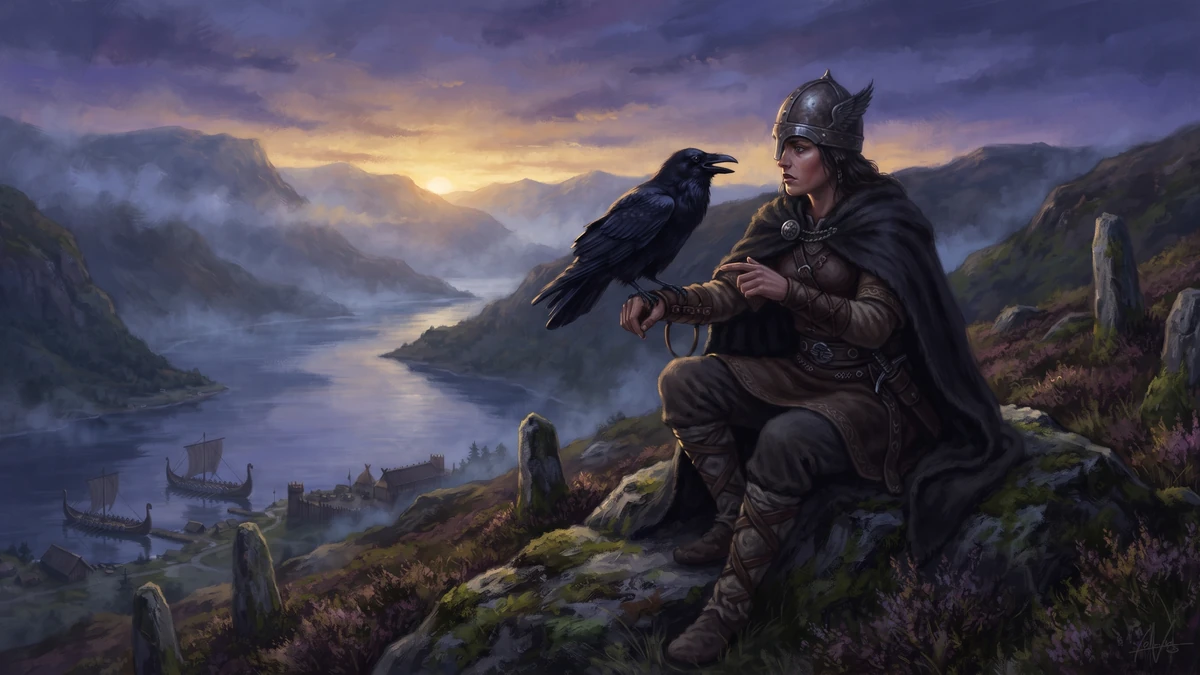
Hrafnsmál, “the raven’s speech”, is also called Haraldskvæði, “the poem of Harald”. It is a fragmentary skaldic poem, usually attributed to Þorbjörn Hornklofi, a Norwegian skald of the 9th century. It is, for the most part, a dialogue between a valkyrie, who has no name, and a raven, about the life and battles of Harald Fairhair.
A poem that looks like another genre
Hrafnsmál is usually described as a praise poem, but it resembles the Eddic poems more than typical skaldic verse. It mainly uses the metre málaháttr, with smaller sections in ljóðaháttr and fornyrðislag. The parts date consistently and share the same metre, so they may be separate compositions, but scholars have not reached a consensus. The style is close to that of Atlakviða, and some suggest Hornklofi wrote both.
A question of authorship
In the Prose Edda, Snorri attributed two verses to Þjóðólfr of Hvinir, the poet of Haustlöng. They were later identified as the work of Þorbjörn Hornklofi, of the 9th century. The fact shows how hard it is, in early skaldic poems, to tie a stanza to a name.
The raven
The bird of the poem recalls Odin’s ravens, Huginn and Muninn, and also the Danish Valravn, a figure from a 19th-century folk song. But the raven of Hrafnsmál is a simple informant: it answers what the valkyrie asks about the king.
After the poem
Hrafnsmál was translated into English by George Borrow in 1862, under the title “Harald Harfagr”, by Nora Kershaw in 1922, and by Lee Milton Hollander in 1980. R. D. Fulk published an edition in 2012. Einar Selvik adapted stanzas from it in a song for the game Assassin’s Creed Valhalla.
In short
In Hrafnsmál, information about the king passes between two birds and a woman of war. To gather the raven’s news, play The raven’s news.
Sources.
- English Wikipedia, articles "Hrafnsmál" and "Haustlöng"
- R. D. Fulk, edition of the poem (2012), cited by Wikipedia