 MMXXVI
Hreiðars þáttr heimska: the Icelander taken for a fool at the court of Magnús and Haraldr
An Icelander who seems to have an intellectual disability travels to Norway in the time when Magnús góði and Haraldr harðráði ruled jointly, wins Magnús's friendship and ends up drawing Haraldr's wrath.
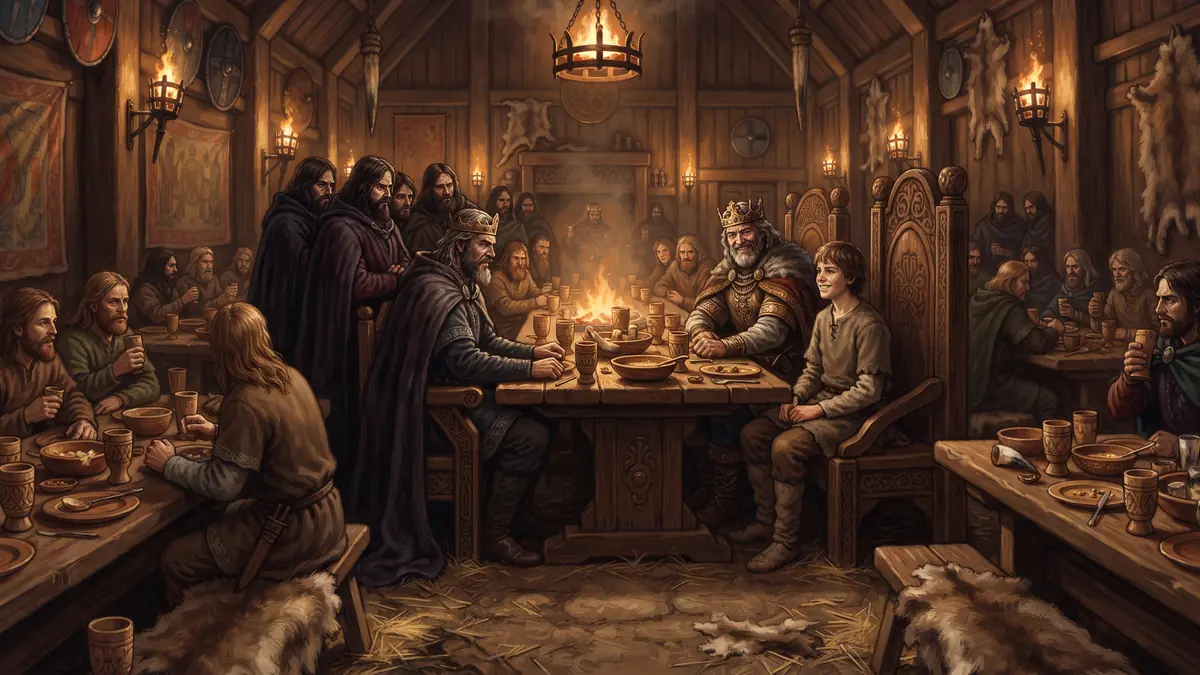
Hreiðars þáttr heimska, “the tale of Hreiðarr the fool”, is a short account of an Icelander who travels to Norway and changes his place at court.
The Icelander in Norway
Hreiðarr is an Icelander who seems to have an intellectual disability. He travels to Norway during the joint rule of the kings Magnús góði and Haraldr harðráði. Through his eccentric behaviour he wins the friendship of Magnús. Later he kills one of Haraldr’s courtiers and draws the king’s wrath.
The text
The tale was probably composed around 1200, and no later than the middle of the 13th century. It is preserved within the Morkinskinna and its derivative, the Hulda-Hrokkinskinna, and may have existed earlier as a separate work.
Studies and editions
Anthony Faulkes edited the text in 1978 and, in a corrected and expanded second edition, in 2011, with open access. Among the scholars who have discussed it are Anthony J. Gilbert (1991), Ármann Jakobsson (2014), Anita Sauckel (2016), Yoav Tirosh (2018) and Judith Higman (2021). In English, “Hreidar’s Tale” was translated by Robert Kellogg in 1997.
In short
It is a court tale in which the one who seems a fool proves cleverer than the king expected. To tap only the cups of the royal feast and avoid the courtiers’ knives, play The king’s feast.
Sources.
- Reference work in English, article "Hreiðars þáttr"
- Anthony Faulkes (ed.), Hreiðars þáttr heimska (1978; 2nd edition, 2011)
- Robert Kellogg, translation "Hreidar's Tale", in The Complete Sagas of Icelanders (1997)