 MMXXVI
Hrólfs saga Gautrekssonar: Hrólfr and the warrior princess Þornbjörg, the siege of Ullarakr, King Ella's lion and the Irish king
Hrólfs saga Gautrekssonar, an Icelandic legendary saga, tells how Hrólfr, king of the Gauts, won the warrior princess Þornbjörg, faced a giant and rescued his sworn brother in Ireland. See what the text says and what remains uncertain.
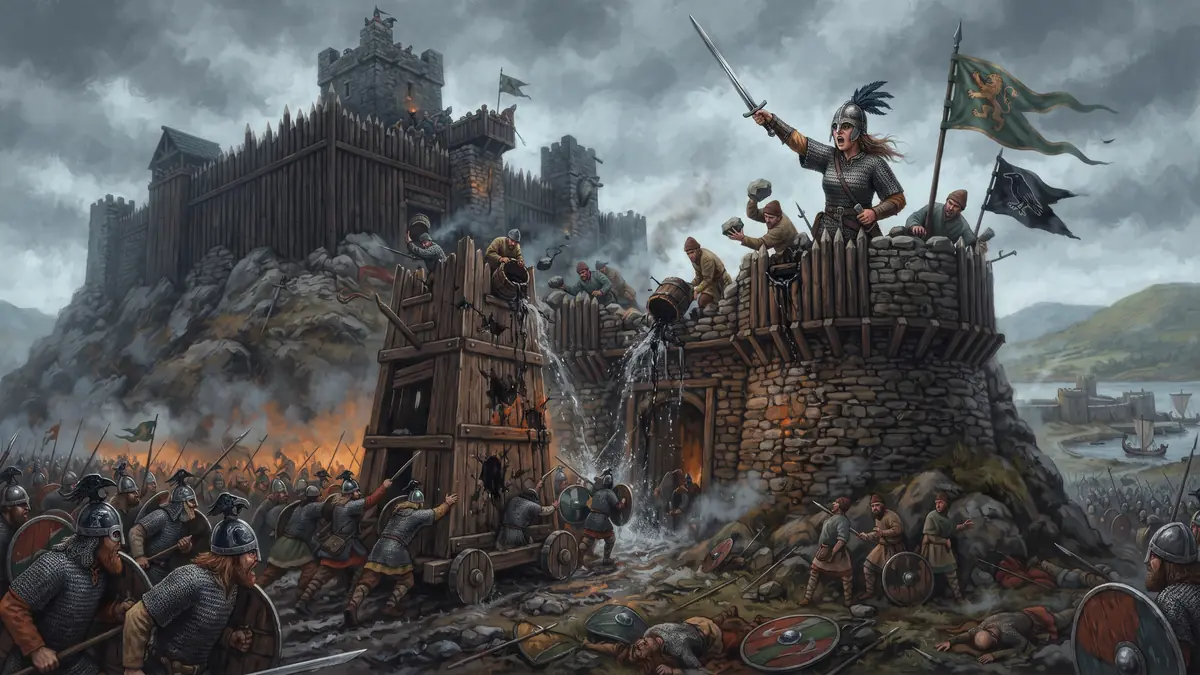
The Hrólfs saga Gautrekssonar, “the saga of Hrólfr, son of Gautrekr”, is one of the fornaldarsögur and tells the story of a prince of the Gauts (Gautland, in the south of present-day Sweden) who wins a Swedish princess, the warrior Þornbjörg. It has siege adventures, giants, a lion and a sorcerer, in the tone of a Nordic “romance”.
Two brothers and a princess who would not take a husband
King Gautrekr, a widower, marries Ingibjörg, daughter of the chieftain Þórir, of Sogn, who prefers him to the rival Óláfr. Óláfr ambushes the couple and dies. Two sons are born: Ketill, small, quick and hot-tempered, and Hrólfr, big, strong, quiet and slow to act but fierce in revenge. Hrólfr is raised by King Hringr, of Denmark, and swears brotherhood to his son Ingjaldr.
In Sweden, King Eiríkr has a daughter, Þornbjörg, skilled with arms and horses. She takes a third of the kingdom at Ullarakr, rules under the name Þórbergr and forbids anyone to call her a maiden. When Gautrekr dies, Hrólfr is crowned, at about twelve years old. Ketill urges him to ask for her hand, and Hrólfr sets out for Uppsala with about sixty men.
The siege of Ullarakr
Eiríkr receives the Gauts coldly and calls them starving. Queen Ingigerðr, who dreamed of wolves and bears, advises him to be kinder. In the end, Eiríkr allows Hrólfr to win Þornbjörg by force. Hrólfr breaks into her hall, kills several men and withdraws. Þornbjörg fortifies Ullarakr with engines.
Hrólfr raids the western isles and Scotland, where he fights Ásmundr, son of a Scottish king, and the two become sworn brothers. Back in Sweden, he attacks Ullarakr, but is repelled with pitch, water and stones. He then builds a timber engine, and Þornbjörg’s men flee. Ketill insults her, and she slaps him. Hrólfr captures her and forbids anyone to harm her. The wedding takes place in Uppsala, and Hrólfr makes Ketill king of Gautland.
The giant and the lion
On the way to a funeral feast in Denmark, Hrólfr faces the raider Grímarr and twelve invulnerable followers on the ship Grímarsnautr, beats them with timber and clubs, and Grímarr dies at sea. Later, to help Ketill ask for the hand of Álof, daughter of King Hálfdan, of Garðaríki, Hrólfr sails East. A storm scatters the fleet, and he meets the giant Grímnir, Grímarr’s brother, and kills him with the sword Risanaut, thanks to a trick with a ski.
In Garðaríki, Hrólfr beats Hálfdan’s army. Þórir járnskjöldr, wounded, agrees to serve if Hálfdan is spared. Ketill marries Álof, and Hrólfr receives the horn Hringhorna.
Then Ásmundr asks for help to win Ingibjörg, daughter of the sorcerer Hrólfr, king of Ireland. Hrólfr sets out with ten ships and a hundred men in each. In England, King Ella invites him to a feast and lets a fierce lion loose. Ásmundr imitates a squealing pig to lure the animal, and Hrólfr kills it with one sword stroke. In Ireland, almost all of Hrólfr’s men die, and he is thrown into a pit. Þórir, disguised as a troll, frees him, and Þornbjörg’s fleet of sixty ships arrives. Hrólfr spares the Irish king on condition that he give Ingibjörg to Ásmundr.
The ending
Hrólfr returns to Sweden, where Eiríkr dies and Hrólfr inherits the whole kingdom. The saga ends with the weddings and says Hrólfr dies of illness and his son Eiríkr inherits. The epilogue observes that people today are smaller than the giants of the past and that the stories may differ depending on who tells them.
What is uncertain
There are two sagas with Hrólfr’s name: this one, about Hrólfr Gautreksson, and the Göngu-Hrólfs saga. The saga has no known historical basis, and Þornbjörg is an example of the “warrior princess” typical of the legendary sagas. The numbers of ships and warriors belong to the narrative tradition.
To stack the timber tower precisely under the walls of Ullarakr, play The siege engine of Ullarakr.
Sources.
- Hrólfs saga Gautrekssonar, Icelandic legendary saga (fornaldarsaga), Icelandic text of the Netútgáfan (snerpa.is) and in Guðni Jónsson and Bjarni Vilhjálmsson (eds.), Fornaldarsögur Norðurlanda (Reykjavík, 1943–1944)
- Hermann Pálsson and Paul Edwards (trans.), Hrolf Gautreksson: A Viking Romance (Edinburgh, 1972)
- C. C. Rafn (ed.), Fornaldar sögur Nordrlanda (Copenhagen, 1829–1830)