 MMXXVI
Hrómundar saga Gripssonar: Þráinn's mound, the sword Mistilteinn, the swan-witch Lára and Hrómundr's marriage to Svanhvít
Hrómundar saga Gripssonar, an Icelandic legendary saga, tells how the hero Hrómundr avenged two warriors, broke into Þráinn's mound, won the sword Mistilteinn and faced a swan-witch. See what the text says and what remains uncertain.
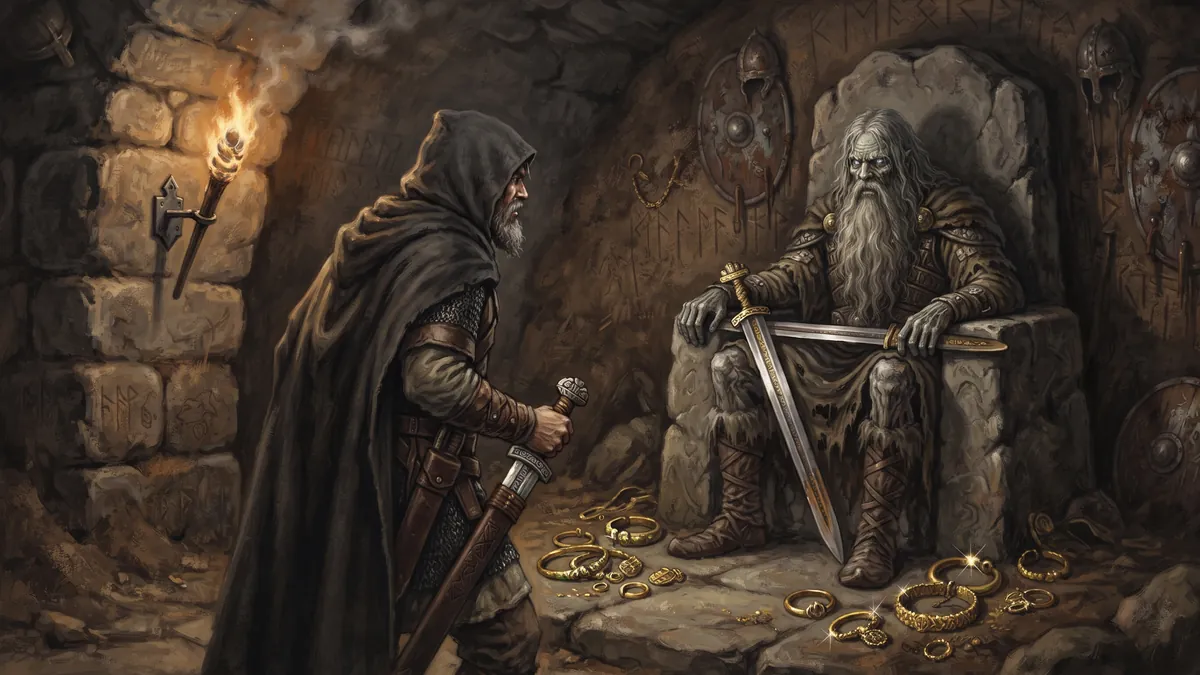
The Hrómundar saga Gripssonar, “the saga of Hrómundr, son of Gripr”, is one of the fornaldarsögur. It has a hero who faces a revenant inside the barrow, takes his sword and ends up married to the princess. The prose version that has reached us is late: a reference work quoted in the translation says it goes back to the seventeenth century and probably derives from the Griplur, narrative poems (rímur) on the same story, which in turn may come from a lost saga.
The nine sons of Gripr
King Óláfr of Denmark has two warriors, Kári and Örnúlfr. Gripr and Gunnlöð have nine sons, and the greatest is Hrómundr. At Úlfasker, the warrior Hröngviðr, owner of the sword Brynþvari, kills Kári and Örnúlfr. Hrómundr, disguised with a false beard and a hood, avenges both and kills Hröngviðr with a club. Helgi the Valiant, Hröngviðr’s brother, is spared and becomes a landwarder in Sweden.
A farmer, Máni, tells Hrómundr about the barrow of Þráinn, an ancient king of Gaul. Hrómundr enters the mound, faces the sorcerer Þráinn, who lives there as a revenant, and beheads him. He takes the sword Mistilteinn, a ring and a necklace.
Slander at court
Hrómundr gives a gold ring to Hrókr, and Váli later kills him to take it. Svanhvít, the king’s sister, favours Hrómundr, which provokes Váli and Bíldr, who slander him. Hrómundr and his brothers leave the court. Next, two Halding kings, with Helgi, attack Óláfr. Hrómundr refuses to fight at first, but his brothers go to battle, and the witch Lára, who takes the form of a swan, kills them. Svanhvít’s shield-garter protects Hrómundr.
The victory and the marriage
Helgi kills Lára by mistake and then falls before Hrómundr. Váli knocks Mistilteinn into a lake, and Hrómundr kills him. Badly wounded, he is healed in secret by Hagall and his wife, while a pike returns the sword. Blindr, who is searching for him, is fooled: the wife hides Hrómundr in women’s clothes at a quern.
Blindr reports to the king a series of dreams, and the king interprets each in his own favour, until the last, with an iron ring around his neck, which predicts the gallows. Hrómundr and Óláfr break into Halding’s hall, kill him and hang Blindr. Óláfr gives Svanhvít to Hrómundr, and the saga says their descendants became royal lines.
What is uncertain
The Þorgils saga ok Hafliða describes a wedding at Reykjahólar in 1119, where the farmer Hrólfr told a story about Hröngviðr, Þráinn’s barrow and Hrómundr Gripsson. That passage shows this plot already existed in the thirteenth century, but it is not the saga we read today. The Hálfs saga says Hrómundr’s mother, Gunnlöð, was a daughter of Hrókr the Black, which links the two sagas. There are also numbers and details that vary between translation and original. Read it as legend, not as history.
To run through the mound and gather rings without stepping on the dead man’s bones, play Inside Þráinn’s mound.
Sources.
- Hrómundar saga Gripssonar, Icelandic legendary saga (fornaldarsaga), in Guðni Jónsson and Bjarni Vilhjálmsson (eds.), Fornaldarsögur Norðurlanda (Reykjavík, 1943–1944)
- Gavin Chappell (trans.), Hrómundar saga Gripssonar (2011)
- Þorgils saga ok Hafliða, part of the Sturlunga saga (the wedding scene at Reykjahólar, in 1119)