 MMXXVI
Illerup Ådal: the Danish valley where a lake kept more than 15,000 objects of war, spearheads with the word "Wagnijo" and 124 combs
At Illerup Ådal, in Jutland, excavations from 1950 to 1985 found more than 15,000 Iron Age objects, dated to AD 200–500. They were weapons and equipment of defeated armies, thrown into a lake as an offering.
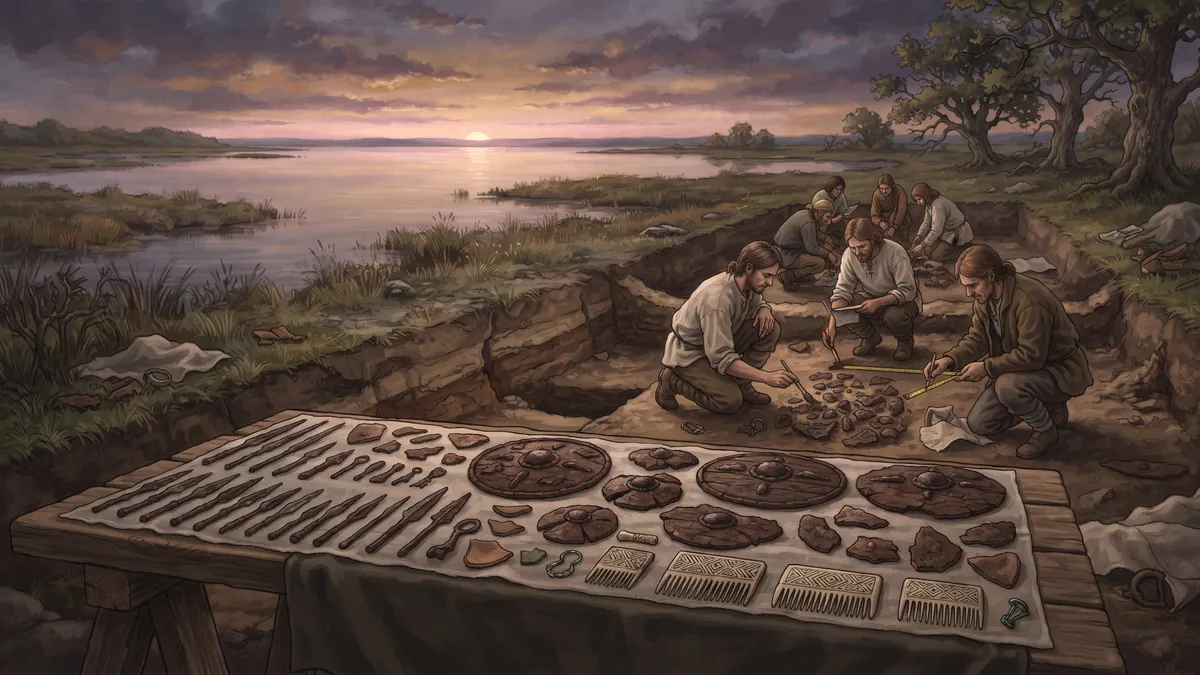
In 1950, during drainage work in a valley near Skanderborg, in eastern Jutland, Denmark, ancient objects turned up. The place is called Illerup Ådal, and excavations, between 1950 and 1956 and again from 1975 to 1985, found more than 15,000 items, almost all of them weapons and personal equipment of the Iron Age, dated to about AD 200 to 500.
What the lake kept
The oldest deposit held 300 spear points, and two of them had a name carved in runes: Wagnijo. There were also shields, belts and scabbards. Among the finds, excavators recovered about 129 tinderboxes and 124 combs. These are everyday objects of warriors, and not only weapons.
A sacrifice at the end of a war
The general interpretation is that the pieces were the equipment of an enemy army, taken after a victory and thrown into the lake as a votive offering. Illerup Ådal is one of 25 sites in Denmark and southern Sweden where sacrificed weapons have been found. The place was given official protection in 1996.
Alken Enge, a neighbouring site
Nearby lies Alken Enge, beside Lake Mossø. In 2008 and 2009, archaeologists found there the remains of hundreds of Iron Age warriors, across 40 hectares. Many may have been sacrificed prisoners of war. That layer is older than the one at Illerup Ådal.
What this tells us
The finds show a Denmark where armies faced each other on a large scale, with standardized weapons and many people involved, and where the end of a war could be marked by a ritual: taking what had belonged to the loser and handing it to the water. The word Wagnijo makes a spearhead an object that, almost two thousand years later, still “speaks” in a language older than Old Norse.
To pick out the spearheads and leave the stones in the water, play The spears of the lake.
Sources.
- Excavations at Illerup Ådal, in eastern Jutland, from 1950 to 1956 and from 1975 to 1985, and later studies of the site
- Research on the Iron Age weapon deposits of Denmark and southern Sweden, including the Alken Enge sites