 MMXXVI
Illuga saga Gríðarfóstra: Illugi and the troll Gríðr in the cave, the fire asked for after the storm and the three truths
Illuga saga Gríðarfóstra, a short Icelandic legendary saga, tells how Illugi crossed a fjord looking for fire, faced the troll Gríðr without fear and broke her curse. See what the text says and what remains uncertain.
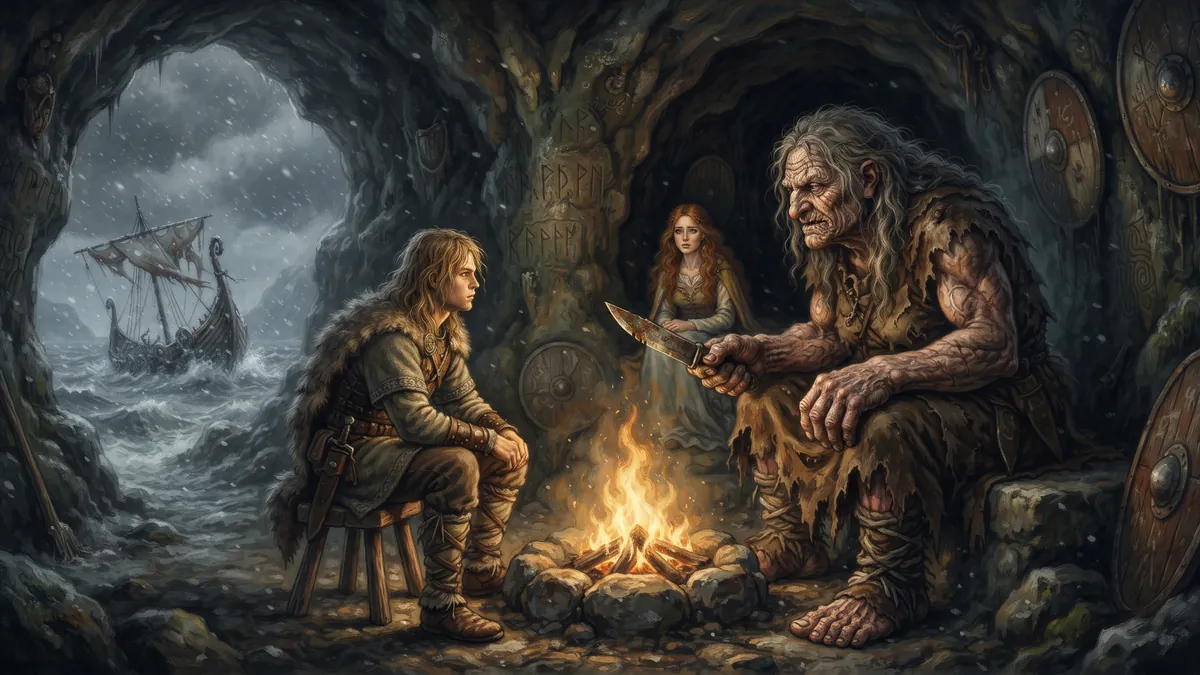
The Illuga saga Gríðarfóstra, “the saga of Illugi, Gríðr’s foster-son”, is one of the shortest and simplest fornaldarsögur, centred on a single episode. The motif of rescuing a bewitched woman through someone who is not afraid also appears in Danish, Faroese and Norwegian ballads. One translation dates it to “about 1600”, without clarifying whether this refers to the manuscript or to the composition.
Two friends and a jealous counsellor
Hring, king of Denmark, son of Skjöldr, and Queen Sigríðr have a son, Sigurðr. Near the royal hall live Sviði and Hildr, parents of Illugi, big, strong and skilled at games. Sigurðr and Illugi swear to be foster-brothers and to avenge each other if either dies by iron.
Björn, the king’s counsellor, is a warrior and a liar. He is jealous of Illugi and slanders him, but Sigurðr does not believe it. When Sigurðr plans an expedition, the king sends Björn with him and leaves Illugi at home. Hildr says the lad is too young, but later sends him to a shieling. On the way, Illugi is attacked by Sunnlöð, a bondwoman and witch, and kills her, breaking her back on a stone. Hildr then lets him go with Sigurðr.
The storm and the fire
Sigurðr, Björn and Illugi sail to the Orkneys and Scotland, where Sigurðr wins battles and plunder. On the way back, a storm drives the fleet north and damages the ship. The crew reaches a bay, with no fire, and freezes. Björn orders Illugi to row across the firth to look for fire, promising him a ring if he returns and demanding his head if he fails.
On the other side, Illugi finds a cave ruled by the troll Gríðr. She is hideous, but offers fire if Illugi speaks three true words; if he does, he may sleep with her daughter, also called Hildr. Illugi insults Gríðr with his “truths”. The daughter is pretty, and he falls in love. In bed, Gríðr threatens him again and again with a knife, and he is not afraid. She admires his courage, gives him her daughter and a way to escape. She says she has killed sixteen men with the knife and was cursed.
Signý’s curse
Gríðr tells her story. She had been Signý, daughter of Áli, king of Álfheimr. When her mother died, her father married Grímhildr, a powerful witch, who poisoned the king and ruined the kingdom. She cursed Signý to live as a troll in a cave with her daughter and set seven sisters to attack her every night. The curse would be undone only before a man who did not fear her knife.
Seven giantesses attack in the cave. Illugi helps Gríðr kill them and burns the bodies. Gríðr says the curse had lasted eleven winters. She gives him gold, treasures and fire. Illugi goes back to his companions, who warm themselves.
The ending
The fleet is becalmed for a month. Björn blames Hildr, calling her a troll. One night, Björn is found hanged from the mast, and the saga hints it was Gríðr. Sigurðr returns with great plunder and succeeds his father, who has died. The saga closes with the weddings and says Illugi was the foster-brother of Gnóðar-Ásmundr, the same name that appears in the Egils saga einhenda.
What is uncertain
The translation cited here has confusing passages, and Gríðr’s daughter appears with two names, Hildr and Signý, without explanation. The translation gives no information on manuscripts. The saga is a fairy tale in saga form, and the names and numbers belong to the tradition of tales.
To catch the embers Illugi carries and avoid Gríðr’s knives, play Gríðr’s fire.
Sources.
- Illuga saga Gríðarfóstra, Icelandic legendary saga (fornaldarsaga), in Guðni Jónsson and Bjarni Vilhjálmsson (eds.), Fornaldarsögur Norðurlanda (Reykjavík, 1943–1944)
- Gavin Chappell (trans.), Illuga saga Gríðarfóstra (2011)
- Medieval Scandinavia: An Encyclopedia (1993), entry on Illuga saga Gríðarfóstra