 MMXXVI
Inge, Sigurd Munn and Eystein: the three brother kings who shared Norway without dividing the territory, from 1142 to 1157
Inge, Sigurd and Eystein, sons of Harald Gille, reigned together over all Norway, until in 1155 a quarrel in Bergen killed Sigurd and in 1157 Eystein was abandoned and killed. See the story of the three brothers.
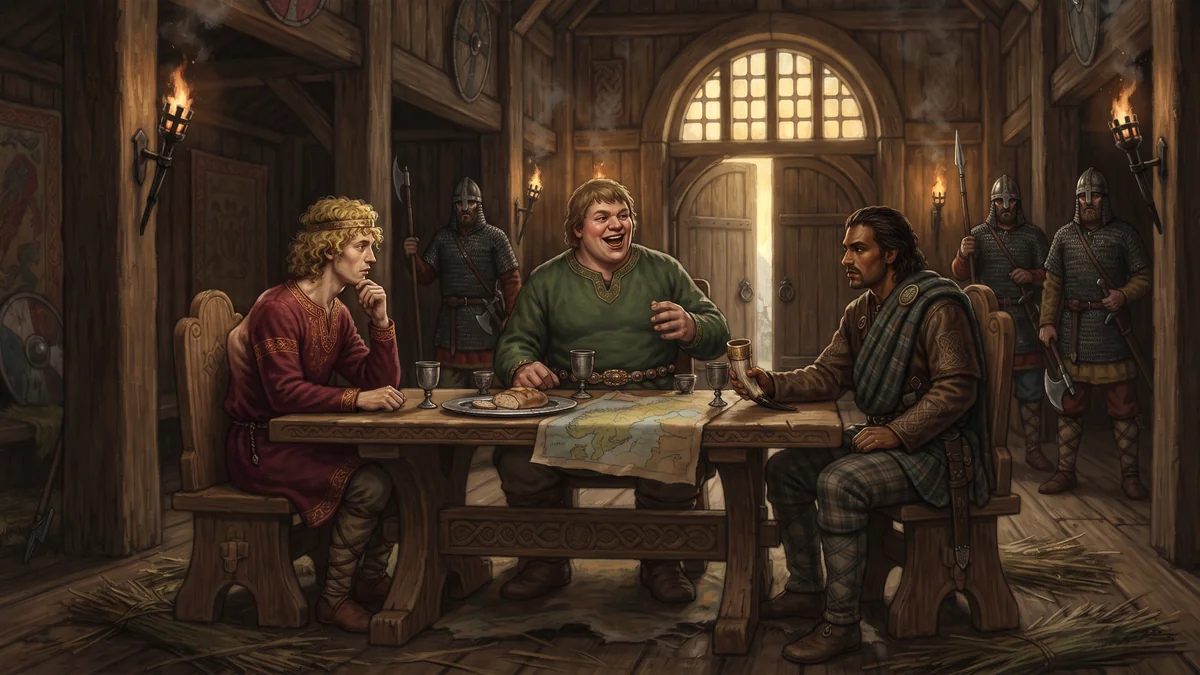
After Harald Gille was killed, in 1136, Norway had several kings at the same time. Three of them were brothers, sons of Harald, and all reigned over the whole country, without dividing the territory. It is a strange arrangement for anyone thinking of divided kingdoms, and it is the key to understanding why the quarrel ended in blood.
Inge, the boy crowned at one year old
Inge was born in 1135, son of Harald Gille and Ingiríðr Ragnvaldsdóttir, who remained influential throughout his reign. He was raised in Viken by Ögmund, or Ámund, Gyrðarson. He was named king at the Borgarting thing, near Sarpsborg, when he was one year old. He had a hump on his back and difficulty walking. Heimskringla and Morkinskinna explain this by the battle of 1137, in which a guardian carried him; Saxo Grammaticus says a maid dropped him as a baby. The nickname krókhryggr, “hunchback”, does not appear in medieval sources. Heimskringla describes him as handsome, cheerful, generous and popular, with curly yellow hair.
Sigurd Munn, the “Mouth”
Sigurd was born in 1133, son of Harald and Thora Guttormsdotter, and was raised in Trøndelag. His nickname, Munn, means “the Mouth”. He was proclaimed king at the Eyra thing in 1136, and never married.
Eystein, the one who came from Scotland
Eystein, born around 1125, was the son of Harald and Bjaðǫk, and seems to have been born in Scotland, where his father was raised. In 1142, several Norwegian lendmenn went to fetch him, and his mother came too. He began to reign with his half-brothers. In the early 1150s, according to Heimskringla and the Orkney saga, he raided Scotland, captured Harald Maddadson, earl of Orkney, in Caithness, and demanded a large ransom. He also attacked the coast at Aberdeen and plundered the English coast during the Anarchy. Heimskringla describes him as dark-complexioned, of medium height, prudent and capable, but says that avarice and narrowness cost him support.
Bergen, 1155
In 1152, the Norwegian Church gained an independent archbishopric at Nidaros. In 1155, the three brothers met in Bergen to keep the peace, but Inge accused Sigurd and Eystein of planning to depose him. Sigurd denied it. A few days later, one of Inge’s guards was killed by a man of Sigurd’s. On the advice of his mother and of Gregorius Dagsson, Inge ordered an attack on the house where Sigurd was staying. Sigurd had few men and no mercy was shown. He was buried beside the old cathedral of Bergen, where the Bergenhus fortress stands today. Eystein arrived late, after his brother’s death.
Moster and Bohuslän
The sagas say that Sigurd and Eystein planned to strip Inge of his title, although modern historians see in this a justification for Inge’s own aggression. In 1157, the two brothers’ troops met near Moster, on the west coast. Inge had more men, and Eystein’s deserted him. Eystein fled overland toward Viken, was left by his men and captured in the area of present-day Bohuslän. His captors killed him, on 21 August 1157. He was buried in the church at Foss, and Heimskringla says the locals began to venerate him as a saint.
What remains
The sagas portray Eystein and Sigurd negatively and Inge as the rightful king. They rely in part on Hryggjarstykki, written between 1150 and 1170 and now lost. What was left was a country with a single king, Inge, and supporters of Sigurd and Eystein who soon rallied around Sigurd’s son, Haakon.
To take each phrase to the right brother, among Inge, Sigurd Munn and Eystein, play Inge, Sigurd Munn or Eystein.
Sources.
- Snorri Sturluson, Heimskringla, saga of the sons of Harald; Fagrskinna; Morkinskinna
- Ágrip af Nóregskonungasögum; Hryggjarstykki (lost), used by the first three
- reference works (English), entries "Inge I of Norway", "Sigurd II of Norway" and "Eystein II of Norway", with the sources cited