 MMXXVI
Ivar Aasen: the farmers' son who travelled Norway gathering dialects and built Landsmål, today's Nynorsk
Born in 1813 into a farming family in western Norway, Ivar Aasen studied the country's dialects and made of them Landsmål, today's Nynorsk, one of the two official written forms of Norwegian.
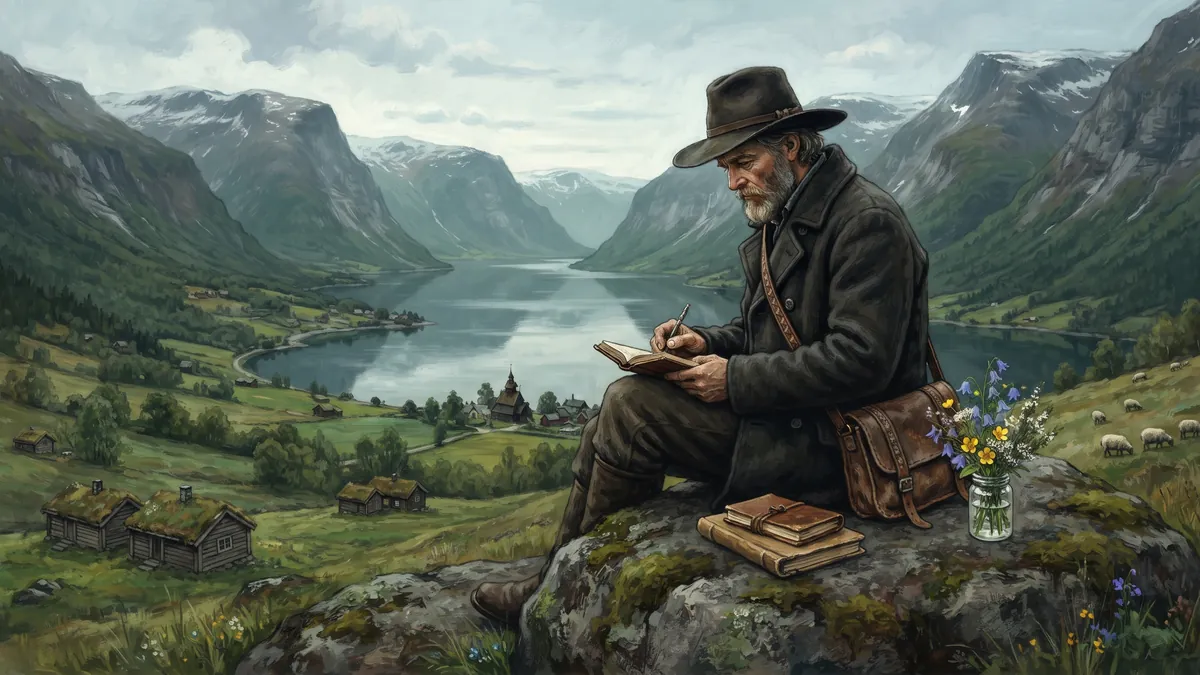
Ivar Aasen was born on 5 August 1813 in Åsen, in the parish of Ørsten (now Ørsta), in the Sunnmøre region of western Norway, into a family of farmers. According to the sources, his father, a small-scale farmer, died in 1826, and Aasen did farmwork as a child.
A self-taught man
He spent nearly all his spare time reading and developed an interest in botany. At about 18 he opened an elementary school in his home parish. In 1833 he was tutored by Hans Conrad Thoresen, from whom he learned basic Latin, and he went on to master several languages.
The journeys
In 1841 he moved to Bergen. The Royal Norwegian Society of Sciences and Letters funded his travels across the country, and from 1842 a stipend let him devote himself fully to philology. His travel reports for 1842–1847 were published later, edited by Halvdan Koht, in 1917.
Grammar, dictionary and Landsmål
In 1848 he published Det norske Folkesprogs Grammatik and, in 1850, Ordbog over det norske Folkesprog, both based on his dialect research. By 1853 he had developed the methods for his new language, Landsmål, which later became Nynorsk. He published Norsk Grammatik in 1864 and the final dictionary, Norsk Ordbog, in 1873. He also wrote verse and plays in Landsmål; one of them, The Heir (1855), was very popular. In 1856 came his study of Norwegian proverbs, Norske Ordsprog.
After him
Aasen died on 23 September 1896 in Christiania, now Oslo, and was buried with public honours. Nynorsk is now one of the two official written standards of Norway. Nynorsk Day, 12 May, commemorates the 1885 law that made Landsmål an official language. The Ivar Aasen-tunet institution opened in Ørsta in 2000, and the 200th anniversary of his birth, in 2013, was marked as a Language Year.
To leaf through the notebooks of words and avoid the ink blots, play Aasen’s notebooks.
Sources.
- Reference work in English, article "Ivar Aasen"