 MMXXVI
Ívens saga: the knight Íven, the enchanted fountain and the lion in the Norse version of Chrétien de Troyes's Yvain
The Ívens saga is the Norse version of Chrétien de Troyes's Yvain. It keeps almost the whole plot but clothes it in alliteration. See the plot, what the saga changes, the debate over author and date, and manuscripts A, B and C.
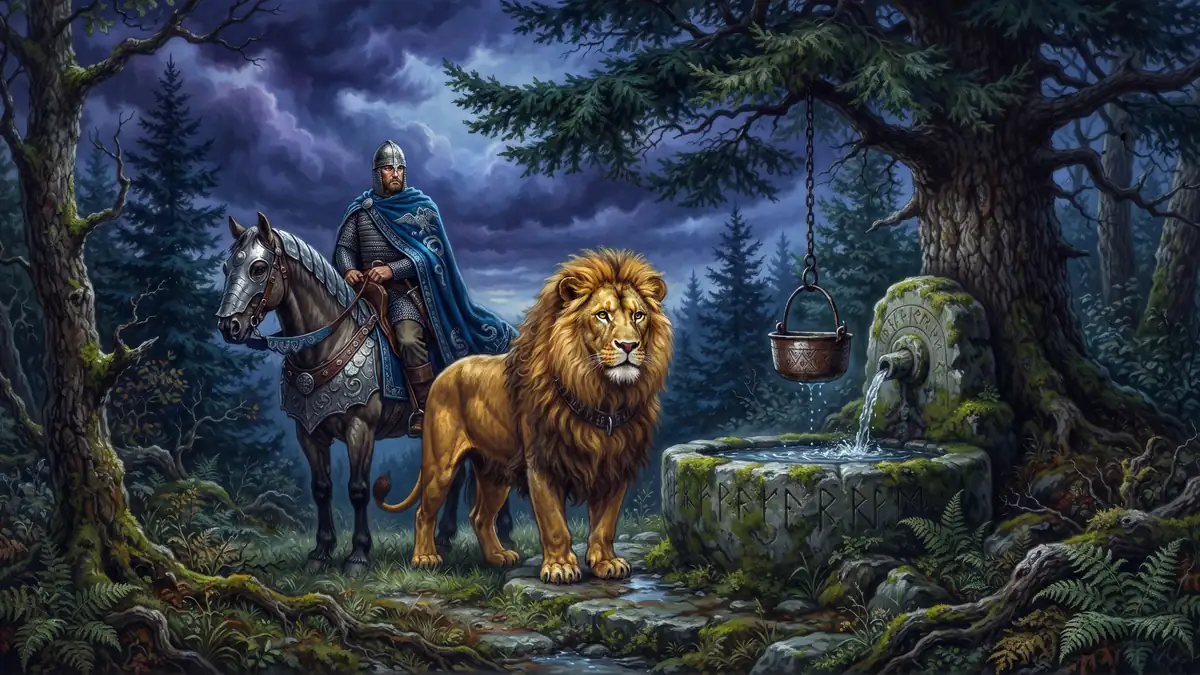
The Ívens saga is one of three Norse sagas tied to the works of Chrétien de Troyes, with Erex saga and Parcevals saga. It is a reworking of Yvain, or Le Chevalier au lion, and is usually linked with the circle of translations of the reign of Hákon Hákonarson (1217–1263), king of Norway, who wanted to bring the literature of the Continent to his court. Date and authorship remain disputed, including whether the author was Norwegian or Icelandic.
The plot
The plot follows Chrétien’s almost entirely. Kalebrant, a knight of Artús’s court, tells the others of an adventure in which he was humiliated at an enchanted fountain: whoever pours water from the fountain on a stone unleashes a storm, and an armed knight appears to defend the place. Íven decides to go to the same place, defeats the knight and marries his widow, with the help of the maiden who serves her.
Later Íven goes off with his friends to tournaments and promises to return within a year. He forgets the deadline, and his wife rejects him. Íven goes mad, lives like a wild man in the forest, is cured and takes up knightly life again. He saves a lion attacked by a serpent, and the lion accompanies him from then on, fighting at his side. Íven passes through several trials until he achieves reconciliation with his wife.
What the saga changes
The great novelty is formal. According to Marianne Kalinke’s analysis, the redactor’s creative contribution is dense alliteration, which clusters in scenes such as Kalebrant’s fight with the knight of the fountain, the fountain episode itself and Íven’s lament for his lost honour and wife. When his wife upbraids him, the saga doubles terms where Chrétien uses a single pair, such as “water and wind” and “lightning and foul weather.”
Other changes are smaller. Kalebrant, in the saga, openly admits his shame, whereas Calogrenant in Chrétien stresses that his opponent was bigger and had a better horse. Íven’s last fight takes about 25 lines, against 62 for the first, whereas in Chrétien the two fights are of similar length.
Manuscripts
The saga has three main manuscripts, A, B and C. C is the youngest and has sparse alliteration, so Kalinke left it out of her analysis. A and B have gaps in different places. The Stockholm manuscript Papp. fol. 46 became a main one only in the 1970s, after being ignored in Kölbing’s edition.
A group of sagas
Scholars group Ívens saga and Parcevals saga in Hallberg’s “Tristram group,” with the Tristrams saga of 1226. Blaisdell doubted the grouping, because Erex and Yvain were supposedly translated by different authors.
To withstand each blow from the knight of the fountain, play The knight of the fountain.
Sources.
- Marianne E. Kalinke, King Arthur, North-by-Northwest: The Matière de Bretagne in Old Norse-Icelandic Romances (Museum Tusculanum, Copenhagen, 1981)
- Marianne E. Kalinke and P. M. Mitchell, Bibliography of Old Norse-Icelandic Romances (Cornell University Press, 1985)
- Academic theses and articles on the transmission of Chrétien de Troyes's romances to Old Norse literature (Durham and other universities)