 MMXXVI
Jarlmanns saga ok Hermanns: the foster-brothers, the bride of Miklagarðr, the giantess Þorbjörg and Iceland's first dance of elves
The Jarlmanns saga ok Hermanns is an Icelandic chivalric saga about two foster-brothers, a prince who wants to marry and an earl who woos on his behalf. It has the first written attestation of the hringbrot dance. See the plot, the two versions and the 76 manuscripts.
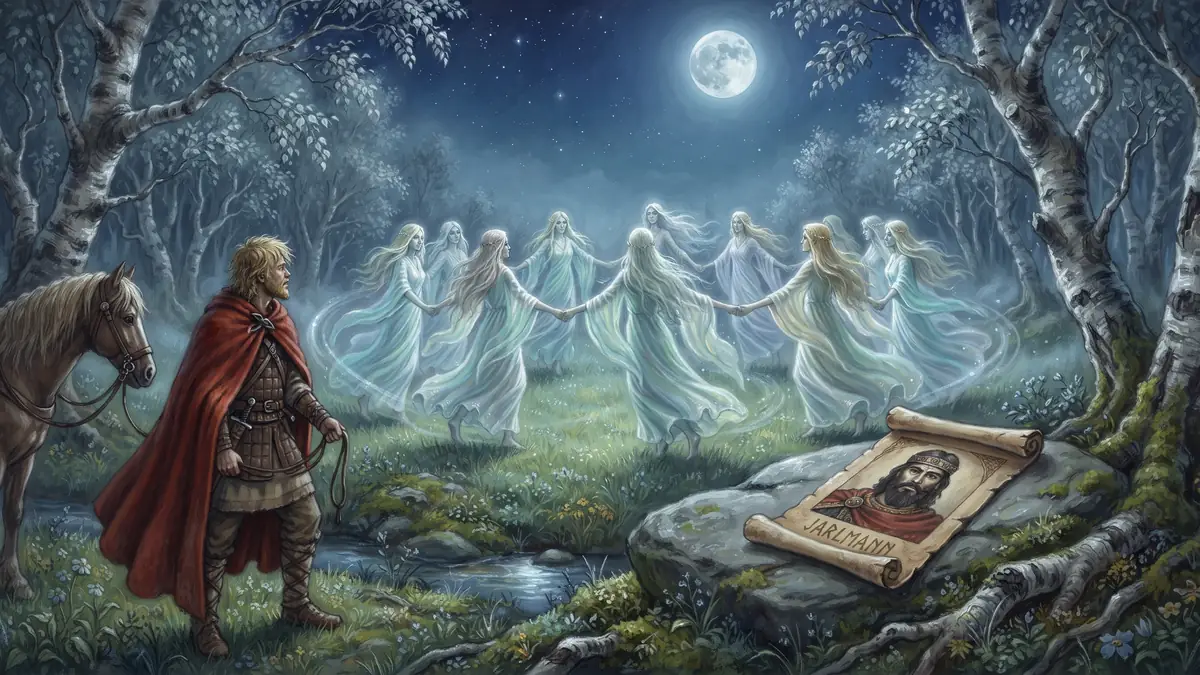
The Jarlmanns saga ok Hermanns, also called Hermanns saga ok Jarlmanns, is an Icelandic chivalric saga. It survives in 76 manuscripts, by a 2020 count, more than almost any other Icelandic saga. Only Mágus saga jarls is comparable.
The foster-brothers
Hermann, son of the king of France, and Jarlmann, son of an earl, are foster-brothers of the same age. Hermann sends Jarlmann to Miklagarðr, the Constantinople of the Norse texts, to woo Ríkilát, who has turned down many suitors. Jarlmann wins her for Hermann with a magic ring, but she can leave only when the forces of another suitor have been driven off.
The abduction and the giantess
At the wedding, the old king Rudent of Serkland abducts Ríkilát and imprisons her, intending to marry her. Jarlmann pretends to love Þorbjörg, the giantess who guards Ríkilát, and the weddings are double: Rudent with Ríkilát, Jarlmann with Þorbjörg. Hermann kills Rudent and recovers his bride. Jarlmann kills Þorbjörg in the bridal bed.
Back in France
The group returns to France, where there is a second double wedding. Jarlmann marries Herborg, the king’s sister, and receives half the kingdom.
Sources and influences
According to scholars, the saga is related to Konráðs saga, which the shorter version cites explicitly, and which also treats the loyal companion who is unjustly suspected. From Tristrams saga ok Ísöndar seem to come the proxy wooing, the bride as healer and the proxy wooer who becomes a lover. The scene in which Jarlmann draws a portrait of Hermann for Ríkilát was probably inspired by the hall of statues in Tristram’s saga.
Two versions and a dance
The saga exists in two medieval versions: an “older” one, longer and more learned, first attested in the Eggertsbók (AM 556a-b 4to), and a “younger” one, shorter and livelier. Recent scholarship considers both independent adaptations of a lost original, not one derived from the other. The earliest manuscripts date from the later fifteenth century, and copies range from about 1660 to 1912.
It contains the first written evidence of the Icelandic hringbrot dance, a circle dance, and the first Icelandic attestation of elves dancing.
To dance the hringbrot in the right rhythm, play The hringbrot.
Sources.
- Agnete Loth (ed.), Late Medieval Icelandic Romances (Editiones Arnamagnæanæ, Series B, Copenhagen, 1962–1965)
- Philip Lavender and others (trans.), Jarlmanns saga ok Hermanns (University of Leeds, 2020)
- Marianne E. Kalinke and P. M. Mitchell, Bibliography of Old Norse-Icelandic Romances (Cornell University Press, 1985)