 MMXXVI
Jón Arason, the last Catholic bishop of Iceland, beheaded in 1550 with two of his sons
Jón Arason, bishop of Hólar, refused the Lutheran Reformation imposed by King Christian III. He was captured at Sauðafell and beheaded on 7 November 1550, with his sons Ari and Björn.
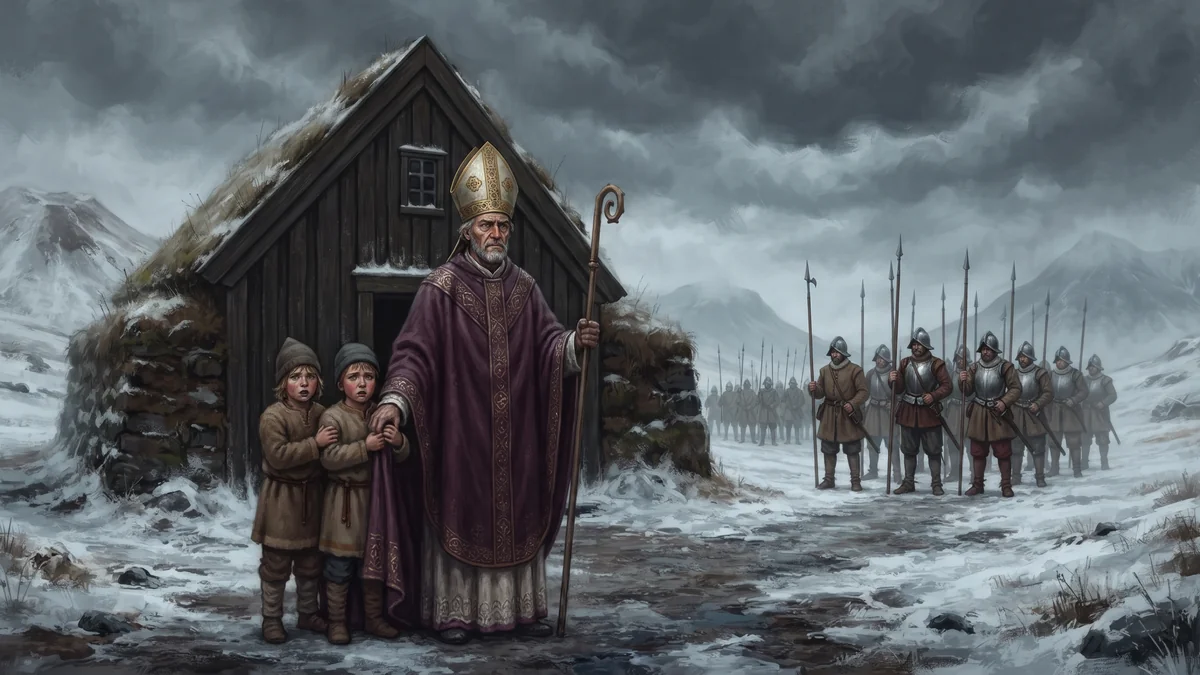
Jón Arason (1484–1550) was the Catholic bishop of Hólar, in northern Iceland, and a poet. According to the sources, he was executed in his struggle against the Reformation in the country.
The career
He studied at the Benedictine abbey of Munkaþverá and was ordained a priest around 1504. He made two missions to Norway and drew the notice of Bishop Gottskálk Nikulásson, whose successor he was chosen to be when Gottskálk died in 1520. The article gives the appointment on 22 December 1520 and the consecration in 1524, by Olav Engelbrektsson. In 1522, Bishop Ögmundur Pálsson of Skálholt tried to arrest him, and Jón fled Iceland on a German ship. The two were reconciled in 1525.
The family
He had at least nine children with his long-time partner, Helga Sigurðardóttir, and six lived to adulthood. In 1522 he formally adopted four of them as heirs: Ari, Björn, Magnús and Þórunn.
The conflict with the Crown
Jón refused to promote Lutheranism, which led to a dispute with King Christian III. At first he stayed on the defensive. In 1548, he and Ögmundur joined forces against the Lutherans, and Ögmundur was soon exiled to Denmark because of infirmity. Jón received a letter of support from Pope Paul III. The article suggests that the resistance came also from nationalism and ambition, but this is interpretation.
The capture and the death
At the battle of Sauðafell, Jón and his sons Ari and Björn were captured by Daði Guðmundsson and handed to the king’s bailiff. In 1550, the three were beheaded, and the source gives Jón’s death as 7 November, at Skálholt. The bailiff Christian Skriver pronounced the sentence. Skriver was later killed by fishermen, reportedly at the urging of Jón’s daughter, Þórunn, and the article sees personal revenge in this, and not only religious conflict.
The legend and the memory
A legend says a priest, Sveinn, tried to comfort Jón at the execution, saying there is a life after this one, and Jón replied that he knew it. From this comes the Icelandic saying veit ég það, Sveinki, used to state something obvious. Gunnar Gunnarsson wrote a novel about him, Jón Arason (1930), originally in Danish.
To sort what came before, during and after 1550, play Before, in and after 1550.
Sources.
- Reference work in English, article "Jón Arason"