 MMXXVI
Karlamagnús saga: the ten branches of the saga of Charlemagne and his paladins, compiled in Norway in the late thirteenth century
The Karlamagnús saga is a Norwegian compilation in ten branches about Charlemagne and his paladins, made from chansons de geste and Frankish historiography. See the ten branches, the sources of each, the journey to Jerusalem, the battle of Runzival and the work's fortunes.
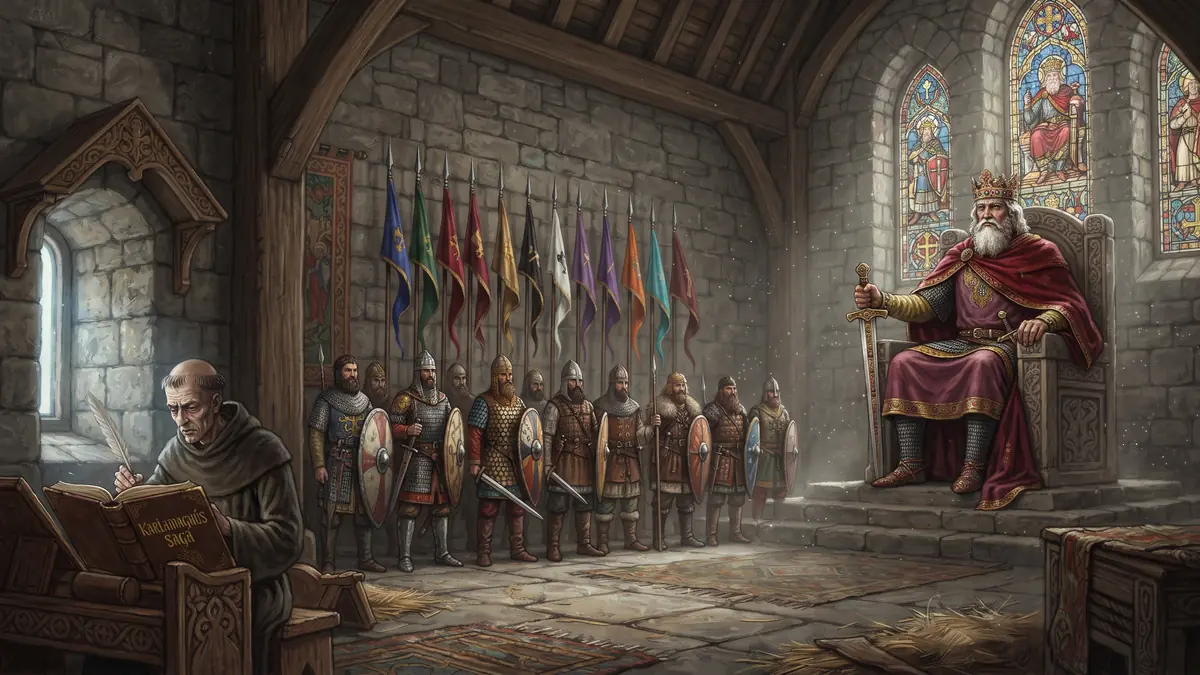
The Karlamagnús saga is one of the most extensive works of medieval Norse literature. It was compiled in the late thirteenth century in Norway and gathers, in ten branches, stories about Charlemagne and his twelve paladins. The material comes from varied origins: Latin historiography and French chansons de geste.
The ten branches
The branches deal, in turn, with:
- The beginning of the story of Charlemagne (Upphaf Karlamagnúss).
- Olif and her son Landres.
- Oddgeir the Dane, from the chanson de geste La Chevalerie Ogier de Danemarche.
- King Agulandus, the longest branch, which joins the Historia Caroli Magni and a version of the Chanson d’Aspremont.
- Gvitalin the Saxon, a campaign against the Saxons recalling Jean Bodel’s Chanson de Saisnes.
- Otuel, a version of the Chanson d’Otinel.
- The journey to Jerusalem, a very close translation of an Anglo-Norman manuscript of the Pèlerinage de Charlemagne.
- The battle of Runzival, a version of the Song of Roland.
- William Short-Nose, from the Moniage Guillaume, of the Guillaume d’Orange cycle.
- Miracles and signs, or the death of Charlemagne, based on Vincent of Beauvais’s Speculum historiale.
The Agulandus branch
Branch IV is by far the largest. Charlemagne and Roland fight Agulandus, his son Jamund and the giant Ferragut. The Agulandus þáttr shows class tensions breaking down during the war against the “infidels,” and Saracen warriors panic the Christian cavalry.
Roland in Norse
Branch VIII is textually close to the Oxford manuscript of the Song of Roland, with a few notable differences, and served as the basis of the Norwegian ballad Roland og Magnus kongen. The name Karlamagnús comes from Latin Carolus Magnus, and the ballad uses a similar form, Magnus, for the king.
The work’s fortunes
A Danish abridgment, whose earliest manuscript dates from 1480, and a fourteenth-century Swedish verse translation show that the saga was read outside Norway.
To stack the ten branches, one on top of another, play The ten branches.
Sources.
- Constance B. Hieatt (trans.), Karlamagnús saga: The Saga of Charlemagne and His Heroes (Pontifical Institute of Mediaeval Studies, Toronto, 1975–1980)
- Marianne E. Kalinke and P. M. Mitchell, Bibliography of Old Norse-Icelandic Romances (Cornell University Press, 1985)
- Stephen A. Mitchell, Heroic Sagas and Ballads (Cornell University Press, 1991)