 MMXXVI
Ketill Flatnose: the lord of the Hebrides, father of Auðr the Deep-Minded, the four versions of his quarrel with Harald Fairhair and the "Caittil" who may have been him
Ketill Flatnose, or Ketill flatnefr, appears in the sagas as lord of the Hebrides in the 9th century and father of Auðr the Deep-Minded. The sources tell his quarrel with Harald in four ways, and historians doubt them all.
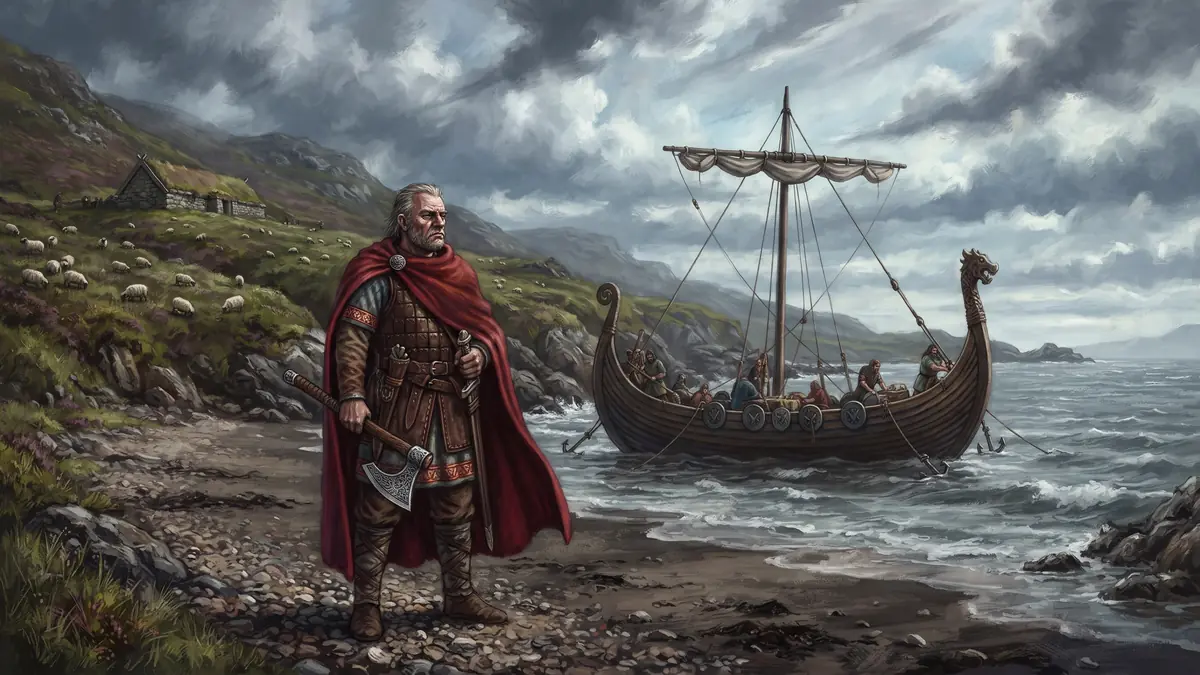
Ketill Björnsson, nicknamed flatnefr, “Flatnose”, appears in several sagas as lord of the Hebrides in the 9th century. Laxdæla makes him come from Romsdal, in Norway; the Landnámabók, from Sogn. He married Yngvildr, daughter of Ketill Wether, a hersir from Ringerike. Their children included Björn, Helgi Bjólan, Þórunn, who married Helgi the Lean, the first settler of the Eyjafjörður fjord, and Auðr the Deep-Minded.
The descendants
Auðr married Óláfr the White, king of Dublin, and their son Þorsteinn the Red briefly conquered much of northern Scotland in the 870s and 880s, until he was killed. Auðr and many relatives ended up settling in Laxárdalr, in Iceland. These threads appear in Laxdæla, the Landnámabók and Eyrbyggja saga.
Four versions of a quarrel
Each source tells it differently. In Orkneyinga saga, Harald conquers the Hebrides and the Isle of Man after raids by exiled Norwegians. In Eyrbyggja, Ketill leads the expedition and keeps the islands as his own domain. In Laxdæla, he is a Viking fleeing the king’s tyranny. In the Landnámabók, Harald sends him to recover the islands; Ketill pays no tribute, the king seizes his property in Norway and drives out his sons.
What historians say
Alex Woolf considers the tribute story a later construction, useful for backing Norwegian claims. There is also a problem of dates: if Harald only annexed the northern isles around 875, that does not fit with Þorsteinn already being active in the 870s. Ketill’s rule would then predate Hafrsfjörðr. Some scholars think the expedition is based on later voyages by King Magnús Barefoot.
A “Caittil” in the Irish annals?
The Annals of Ulster record, in 857, the defeat of a “Caittil Find” in Munster. Some scholars identify him with Ketill; others doubt it. Woolf calls the link “extremely tenuous”: find means “white”, not “flat-nosed”, and in the sagas Ketill is Óláfr’s father-in-law, whereas in the annals Caittil is his enemy.
Ketill is thus plausible but poorly documented: no source from the time names him with certainty.
To raise the turf hall of the Hebrides block by block, play The turf hall.
Sources.
- Landnámabók, Laxdæla saga, Eyrbyggja saga and Orkneyinga saga (Iceland, 12th and 13th centuries), which tell different versions of Ketill's life
- Annals of Ulster, entry for 857, which names a "Caittil Find" defeated in Munster, an identification that is disputed
- Studies by Alex Woolf, Jennings and Kruse on the Gaelic-Norse society of the Hebrides