 MMXXVI
Ketils saga hœngs: young Ketil of Hrafnista, the dragon, the arrow duel against the Sami chief Gusir and the sword Dragvendill
Ketils saga hœngs, an Icelandic legendary saga, tells how Ketil Hœng, of Hrafnista, killed a dragon, beat giants, won an arrow duel against the Sami chief Gusir and cut King Framarr in two. See what the text says and what remains uncertain.
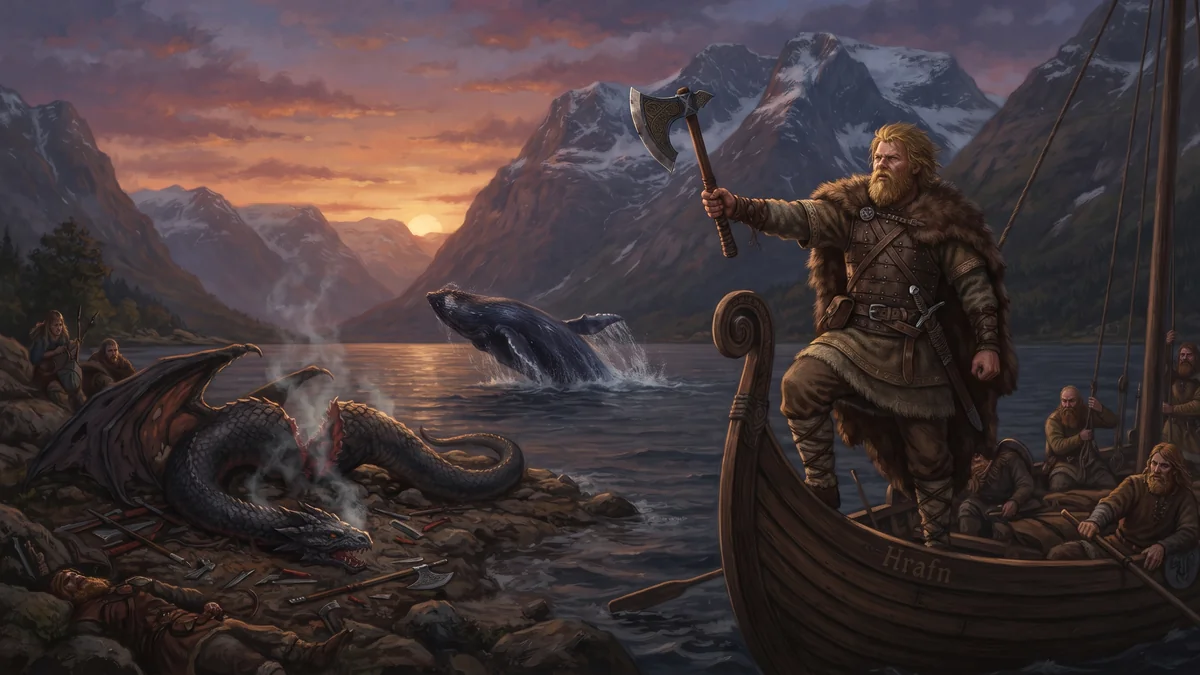
The Ketils saga hœngs, “the saga of Ketil Trout”, is the first of a group of four legendary sagas about the family of Hrafnista, an island off the Norwegian coast. It mixes humour, giants, magic and a bow duel. Scholars do not fix a secure date: the translation cited here places it probably in the thirteenth century, but other works date it later.
The half-troll’s son
Hallbjörn, “half-troll”, lives on Hrafnista, rich and influential among the farmers of the north. His son Ketil is big and strong, but seems lazy. As a child, he lies by the fire, and Hallbjörn disapproves. Ketil vanishes for three nights and returns with a well-made chair, which he gives to his mother. At the hay harvest, he works so hard that eight stacks are raised and two oxen collapse from exhaustion. Hallbjörn gives him a broad axe and forbids him to go north of the island after sunset.
A neighbour, Björn, mocks Ketil as “the fool of Hrafnista”. On a fishing trip, Ketil hooks a poor cod and hurls it at Björn’s boat; the fish strikes the neighbour’s skull, and he drowns. One night, Ketil goes north and faces a winged serpent, which he cuts in two. His father then renames him Ketil Hœngr, “trout”. According to the saga, he was eleven.
Giants in the fjords
When famine afflicts the region, Ketil goes fishing alone in three fjords: Næstifjord, Miðfjord and Vitaðsgjafi. In Miðfjord, he destroys a pit of carcasses and salted human flesh. The owner, the giant Surtr, returns, insults Ketil and his father, and Ketil, hidden behind the door, beheads him as he stoops to enter. In Vitaðsgjafi, someone steals the catch; the thief is the giant Kaldrani, who runs into a cave full of trolls. Ketil’s axe is stuck in the wound. He poses as a physician, recovers the axe and kills the giant.
Finnmark and the duel against Gusir
In a storm, Ketil is carried to Finnmark. He escapes from a troll-woman who shakes his boat, takes a butter chest and is wrecked on a beach. He reaches the farm of Bruni, whose daughter Hrafnhildr is tall and strong. Bruni hides the lad from the Sami (Finnar) and, in spring, gives him arrows, among them one with a barbed head.
On the journey, Ketil meets Gusir, the Sami chief. They exchange hostile verses and duel with bows. Gusir steps on a bent shaft, and Ketil’s barbed arrow kills him. The saga says Bruni, Gusir’s brother, planned the trick of the bent arrows. Ketil takes Gusir’s sword, Dragvendill, and three named arrows, Flaug, Hremsa and Fífa. He goes home, where they were holding a funeral feast for him and it turns into a welcome. Later, Hrafnhildr arrives with their son, Grímr, nicknamed Loðinkinni, “hairy-cheek”, because one cheek has hair and iron does not wound it.
Framarr and the end
Ketil marries Sigríðr, daughter of Bárðr, and has a daughter, also Hrafnhildr. Two suitors ask for the girl. The first, Áli, the warrior of Uppdalir, fights Ketil, who cuts off both his feet. The second is Framarr, a pagan king whom iron cannot cut by a gift from Óðinn. Ketil refuses to force his daughter, and Framarr challenges him to a duel at Árhaugr, on the first day of Yule.
Ketil travels alone on skis through Naumudalr, Jamtaland, Hálsingjaland and the forest of Eyskog, which is twenty rastir wide. There he kills the robber Sóti in a wrestling bout. At Árhaugr, Böðmóðr, Framarr’s son, hosts Ketil and agrees to hold his shield. In the duel, an eagle attacks Framarr, and on the third blow Dragvendill cuts him in two. Böðmóðr asks for Ketil’s daughter as a reward, and she is given. Ketil rules Hrafnista while he lives; his son Grímr succeeds him, and Grímr’s son is Örvar-Oddr.
What is uncertain
The saga does not narrate Ketil’s death, and the links with the Gríms saga, the Örvar-Odds saga and the Áns saga make Hrafnista a legendary family tree. The Landnámabók names a Ketil hængr among the settlers of Iceland, but that does not prove the hero is the same person. Numbers, place names and the iron that does not wound are tale elements.
To catch fish and avoid the giant’s stones, play Ketil’s fish.
Sources.
- Ketils saga hœngs, Icelandic legendary saga (fornaldarsaga), in Guðni Jónsson and Bjarni Vilhjálmsson (eds.), Fornaldarsögur Norðurlanda (Reykjavík, 1943–1944)
- Gavin Chappell (trans.), Ketils saga hœngs: The Saga of Ketil Trout (2011)
- Stephen A. Mitchell, "The Supernatural and the fornaldarsögur: The Case of Ketils saga hœngs", in Fornaldarsagaerne: Myter og virkelighed (2009)