 MMXXVI
Knock y Doonee: the Viking ship burial of the Isle of Man, the three hundred iron rivets and the man buried with his smith's tools
In the north of the Isle of Man, a 1927 dig revealed a Viking boat about 9 metres long with a man, weapons, tools and the remains of a horse and a dog. See what was found and what is still unknown.
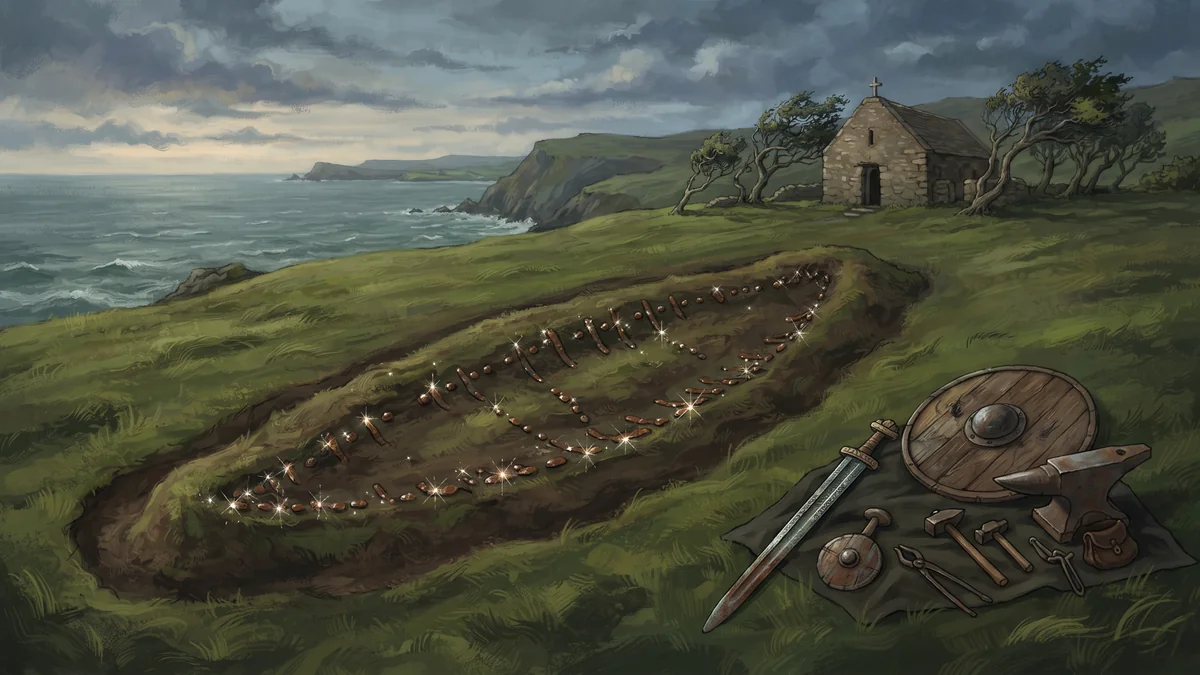
On the Isle of Man, in the Irish Sea, the Vikings left many traces: stone crosses with runes, place names and graves. One of the most remarkable is Knock y Doonee, in the parish of Andreas, in the north of the island. It is a boat burial, excavated in 1927.
The chapel and the hill
The keeill, a small Christian stone chapel typical of the island, was excavated in 1911 by the Manx Archaeological Survey, under the direction of P. M. C. Kermode. About three hundred metres to the south-east, on top of a hill, there was another site. There, in the autumn of 1927, Kermode, by then director of the Manx Museum, excavated what proved to be a boat burial.
What was in the boat
The boat was between 8.5 and 9 metres long and 1.8 to 2.4 metres wide. About three hundred iron rivets remained, marking the outline of the long-vanished timber. Inside lay a man wrapped in a cloak, with a set of objects:
- fishing gear, a cloak pin and a bowl;
- smith’s tools, such as a hammer and tongs, plus nails, which led to the guess that he may have been a blacksmith;
- a sword, a shield, an axe and a spear;
- the remains of a horse and a dog.
The dating places him between 900 and 950, when Scandinavians were already settled on Man.
Pagan within sight of the chapel
What stands out most is the neighbourhood: a pagan burial, with weapons and animals, within sight of a Christian chapel. This suggests a period of transition, when the two practices coexisted. Unlike another boat burial on the island, Balladoole, there is no sign of human sacrifice at Knock y Doonee.
What can be seen
Among the stone pieces of the region, there is a bilingual ogham stone in the Manx Museum and a stone cross in Kirk Andreas church. The boat site is not open to the public.
The two excavations, that of the chapel in 1911 and that of the boat in 1927, took place sixteen years apart, which shows how the archaeology of the island advanced in stages. The presence of smith’s tools and fishing gear, beside the weapons, makes archaeologists think of a man of several activities. But that is a hypothesis: the dig left no name, text or inscription, and who this man was remains unknown.
To catch the iron rivets while dodging the stones, play The rivets of Knock y Doonee.
Sources.
- Manx National Heritage, site record "Knock y Doonee ship burial", Andreas, Isle of Man
- P. M. C. Kermode, reports of the Manx Archaeological Survey (digs of 1911 and 1927)
- Entry on the Knock y Doonee boat burial and the neighbouring keeill, Manx Museum