 MMXXVI
Kumlbúa þáttr: the tale of the man who took a sword from a burial mound and had to answer the dweller in verse
The Kumlbúa þáttr, "the tale of the cairn dweller", tells how Þorsteinn Þorvarðsson takes a sword from a burial mound and, in a dream, the dead man demands it back with a threat in verse. See what the text says and how poetry decides the duel.
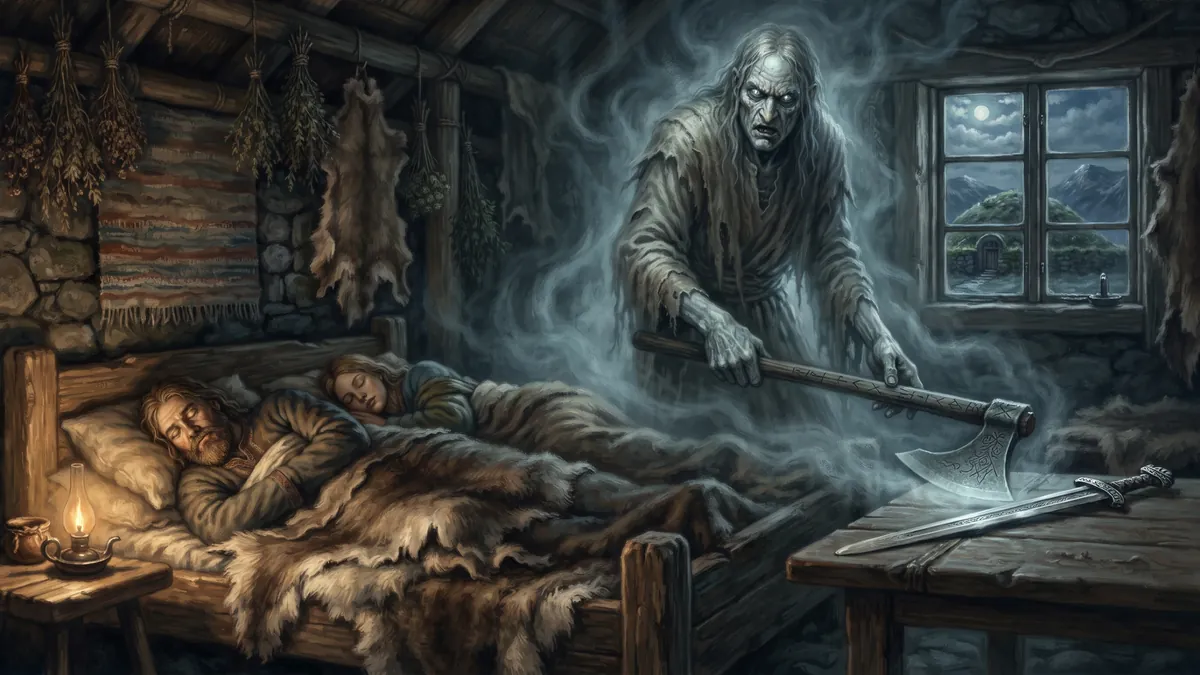
The Kumlbúa þáttr, “the tale of the cairn dweller”, is one of the shortest pieces of Icelandic literature, and it has a clear idea: a man robs a burial mound and is saved by a verse. It survives in fragments in the manuscript AM 564a 4to and in paper copies made by Árni Magnússon from the Vatnshyrna codex, destroyed in the Copenhagen fire of 1728. The action is set between the end of the twelfth century and the beginning of the thirteenth.
The sword from the mound
Þorsteinn Þorvarðsson, the central figure of the tale, comes upon a burial mound, a kuml or haugr, and takes a sword from it. He goes home, lies down and sleeps.
The dweller appears
In a dream, the dweller of the mound comes to him. It is a figure wielding a huge long-hafted axe. He demands the sword back and threatens Þorsteinn. His wife wakes him and asks why he sleeps so badly, but he tells her nothing and falls asleep again at once. The dweller returns and speaks a stanza of threat.
The better-made verse
Þorsteinn answers with another stanza. The reply is technically more skilful than the dead man’s, and the tradition of verse exchanges asks exactly that: whoever “caps” the other’s verse wins. The dweller of the mound leaves and lets him be.
The next day, Þorsteinn looks for the mound but cannot find it. He goes home and tells his wife and the others what happened.
What remains uncertain
The text is too short to say what became of the sword. The tale does not claim that the mound vanished by magic, only that Þorsteinn did not find it. It belongs to a group of stories about the dead who defend their goods, such as Grettir’s fight with Kárr the Old in the mound. Here the threat is beaten with poetry and not with strength, which makes the tale a small praise of skill in verse.
To fend off each blow of the dweller’s axe, play The mound dweller’s axe.
Sources.
- Kumlbúa þáttr, in Guðni Jónsson (ed.), Íslendinga sögur, vol. IV: Breiðfirðinga sögur; and in Þórhallur Vilmundarson and Bjarni Vilhjálmsson (eds.), Harðar saga, Íslenzk fornrit XIII (Reykjavík, 1991), pp. 451–455
- Marvin Taylor (trans.), "The Tale of the Cairn-Dweller", in Viðar Hreinsson (ed.), The Complete Sagas of Icelanders, vol. 2 (Reykjavík, 1997), pp. 443–444
- Ben Waggoner, "Kumlbúa þáttr: The Tale of the Cairn-Dweller" (Troth Publications)