 MMXXVI
Kveld-Úlfr, the "Night Wolf": Egill's grandfather who turned gloomy as evening fell, the fury that wore him out and the coffin the tide carried to an Icelandic shore
Egil's saga begins with Kveld-Úlfr, a strong, wealthy man who grew moody at nightfall and was called hamrammr. He never swore loyalty to Harald Fairhair, fled to Iceland and did not arrive alive.
Egil’s saga, written in Iceland in the 13th century, does not begin with Egill. It begins in Norway around 850, with his grandfather, a tall, strong man, rich from raiding expeditions and known for his wisdom. His name, Kveld-Úlfr, means “Evening Wolf” or “Night Wolf”. The nickname comes from the bad temper that, according to the saga, came over him as the afternoon wore on. He was said to be hamrammr, “shape-changing”, and later chapters link that to the frenzy of berserkers.
The family
Kveld-Úlfr was the son of Bjálfi and Hallbera Úlfsdóttir; a maternal uncle was called Hallbjörn Half-Troll. He married Salbjörg Káradóttir, and they had two sons: Þórólfr, the handsomest and most popular, and Grímr, the future Skalla-Grímr, more like his father, bald and sombre.
The king he would not serve
Kveld-Úlfr looked unfavourably on the growing power of Harald Fairhair, but did not join the alliance led by Kjötvi the Rich. He never swore loyalty to the king, and was left to live in peace all the same. Þórólfr joined Harald’s retinue with his father’s leave, and was later killed by the king’s men. Harald refused any compensation.
The vengeance and the flight
Kveld-Úlfr and Skalla-Grímr killed those responsible, including the crew of a boat they had retaken, and left Norway for Iceland. In the clash with the king’s forces, Kveld-Úlfr’s frenzy left him badly weakened. The old man did not survive the voyage.
The coffin
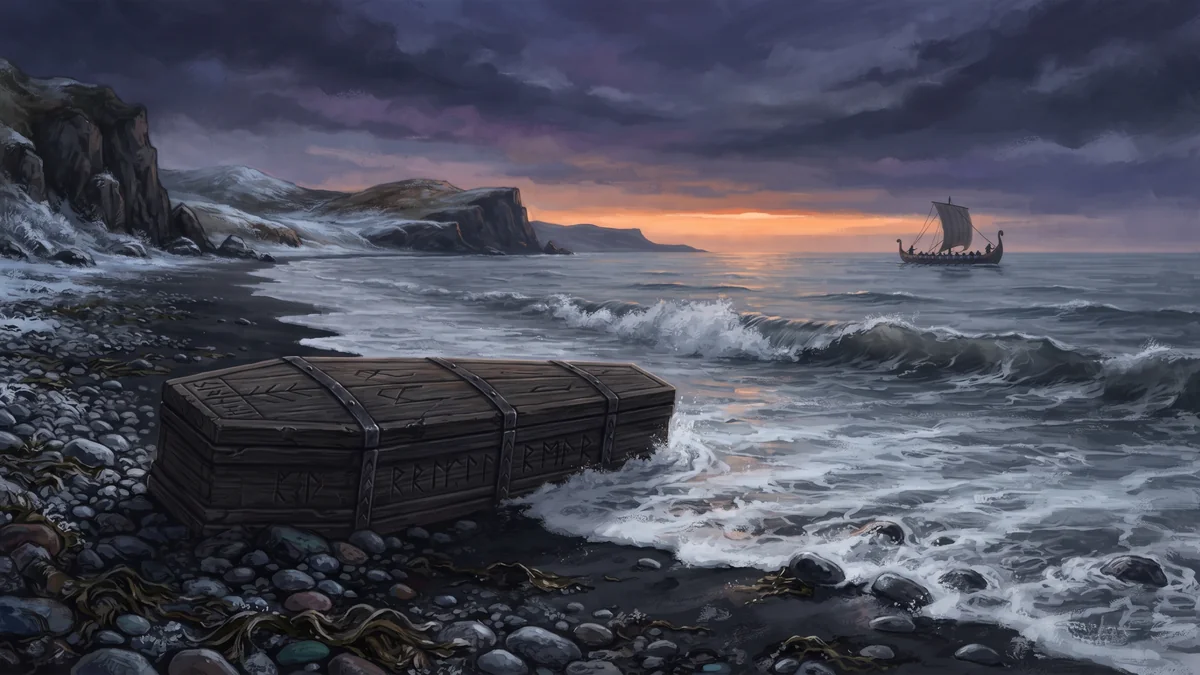
According to the saga, the coffin was cast into the sea and ended up on the Icelandic coast. Skalla-Grímr built his farm near where it came ashore and called it Borg. The scene is one of the first steps of the Icelandic settlements told in the saga.
Saga, not record
The frenzy, the shape-changing and the coffin the water carries to land are motifs of the narrative, not checked facts. The saga is the main source for him, and nobody knows whether he existed as a person. The oldest manuscript fragment dates to about 1250, and many scholars attribute the work to Snorri Sturluson.
To block every blow of the night without lowering your shield, play The blows of the night.
Sources.
- Egils saga Skalla-Grímssonar (Iceland, 13th century), opening chapters on Kveld-Úlfr, Þórólfr and Skalla-Grímr
- Landnámabók, which also records the family and the settlement at Borg
- Studies of the term hamrammr, "shape-changing", and of the wolf-warriors and berserkers of the Norse sources