 MMXXVI
Lævateinn, the weapon Loki forged: sword, arrow or wand? What Fjölsvinnsmál says
In Fjölsvinnsmál the porter Fjölsviðr says only Lævateinn can kill the rooster Viðófnir, and that it is kept with nine locks. Nobody knows for sure what it is: it has been read as a sword, an arrow, a wand and a cudgel.
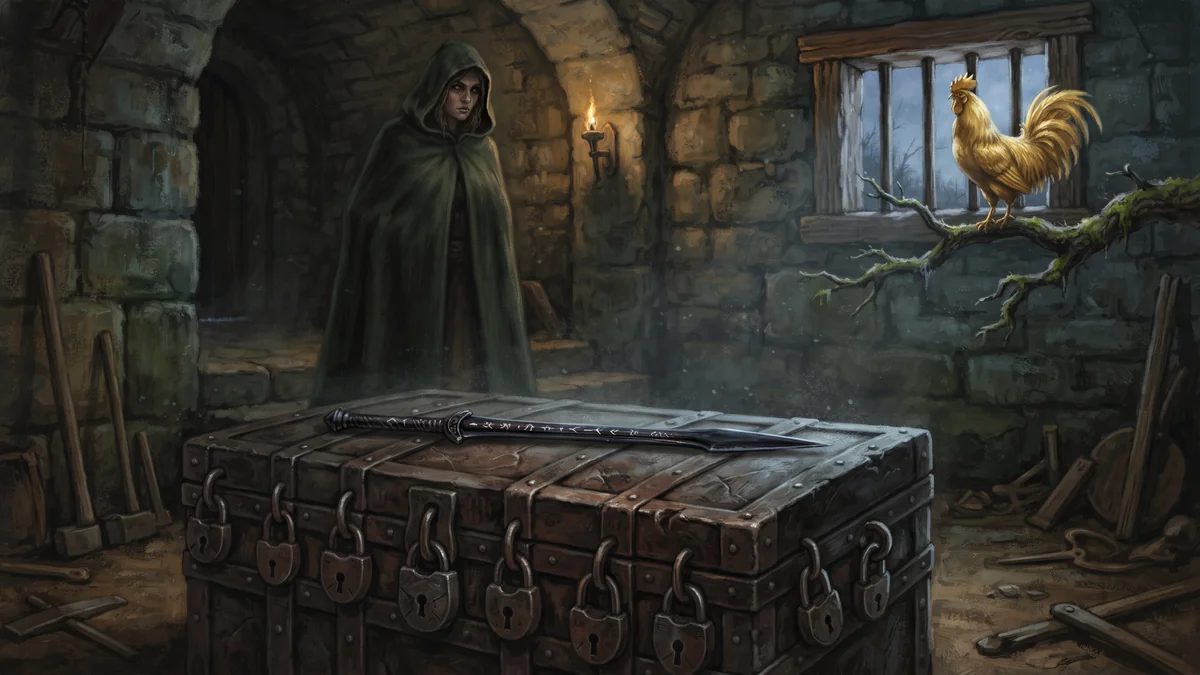
Lævateinn is a weapon that appears only in one poem, the Fjölsvinnsmál of the Poetic Edda, and nobody can identify it. The poem says what it does, who made it and where it is kept, but not what it is. So, over the centuries, it has been read in four ways.
What the poem says
The porter Fjölsviðr answers that there is a rooster called Viðófnir, sitting at the top of the tree Mímameiðr, and that only one weapon kills it: Lævateinn. According to him, the weapon was made by Loki, here called Lopt, and is kept at Sinmara’s, with nine locks. Commentators cite this as stanzas 25 to 27 (in Bugge’s edition) or 26 and 27 (in others).
The name that changed
The old text, in the manuscript, says Hævateinn. It was Sophus Bugge who, in 1860, changed the first letter to L and created “Lævateinn”. The element læ can mean “cunning”, “deception” or “injury”, and so the name has been translated as “wand of destruction” and “wounding wand”, while Einar Ól. Sveinsson read it as “wand of non-deceit”.
Sword, arrow, wand or cudgel
Árni Magnússon, in 1787, translated it as “sure-striking dart”, that is, an arrow. Finnur Jónsson and other early 20th-century editors preferred sword, and Henrik Schück linked it to Surtr’s flaming sword. Lee Hollander said the name is literally “wand of destruction” but that the word is, in origin, a kenning for sword.
Albert Sturtevant and, citing Rudolf Simek, other authors read it as a seiðr wand, the staff of sorcerers, and Leszek Gardeła notes that the staff called gambanteinn has the same ending -teinn, meaning “twig”. There is also the cudgel reading, by Zavaroni and Emilia.
Henry Adams Bellows rejected linking it to the mistletoe that killed Baldr.
In short
Lævateinn is not a “famous” sword: it is a word that scholars have tried to decipher for more than two centuries. To separate what each reading says, play Lævateinn: sword, arrow or wand?.
Sources.
- Poetic Edda, Fjölsvinnsmál, stanzas 25 to 27 (Bugge's edition)
- English Wikipedia, article "Lævateinn", with the references to Bugge (1860), Árni Magnússon (1787), Hollander (2011) and Gardeła (2009)