 MMXXVI
Lagertha: Saxo's shieldmaiden, the bear, the hound and what is known about her
Lagertha appears in Saxo Grammaticus, Gesta Danorum Book IX: a warrior with loose hair whom Ragnar wins, divorces and meets again on the battlefield. See what Saxo says, what scholars say about her historicity and the proposed link with the goddess Þorgerðr.
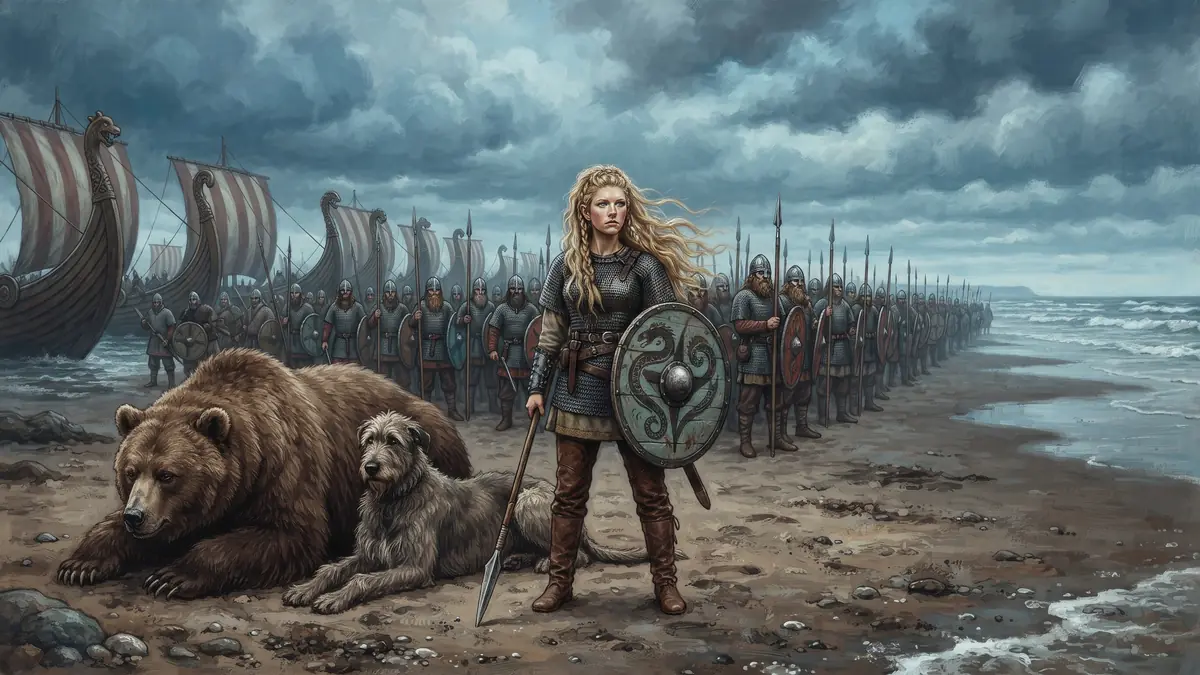
Lagertha is today one of the best-known figures of the Viking Age, yet her story has a single source: the Danish chronicler Saxo Grammaticus. He calls her Ladgerda and tells her story in Book IX of the Gesta Danorum, written around 1200.
What Saxo tells
According to Saxo, Frø, king of Sweden, invaded Norway, killed King Siward and handed the women of the family over to a brothel. Ragnar Lodbrok came to avenge his grandfather. Several of these women fought for him dressed as men, and Lagertha was the most remarkable: Saxo says she fought with her hair loose and that her deeds amazed everyone.
The bear and the hound
Ragnar admired her from afar. Lagertha feigned interest and, when he came to claim her, left a bear and a huge hound guarding her home. Ragnar killed the bear with his spear and choked the hound, and so won her hand. They had a son, Fridleif, and two daughters whose names Saxo does not give.
The divorce and the return
Back in Denmark because of a civil war, Ragnar, still annoyed about the animals, divorced Lagertha to marry Þóra borgarhjǫrtr, daughter of the jarl of Västergötland. Later, in another war, he sent to Norway for help. Lagertha, who still loved him, came with 120 ships. At the height of the fight, when Ragnar’s son Siward was wounded, she attacked from behind the enemy and turned the battle.
Saxo ends with a blow: back in Norway, the two quarrelled and she killed him with a spearhead hidden in her gown. Afterwards, he says, she took his name and sovereignty, preferring to rule alone.
What scholars say
Judith Jesch describes the tales in the first nine books of the Gesta as “generally considered to be largely fictional”. English Wikipedia notes that Saxo drew on classical legends of Amazons and on Old Norse, especially Icelandic, sources that have not been clearly identified. His portrayal of warrior women is shaped by his Christian view: shieldmaidens who rejected the expected role would be a sign of the disorder of the pre-Christian world.
There is also a hypothesis about who Lagertha might be. Hilda Ellis Davidson considers it possible, and Nora Chadwick thought it very probable, that she is the goddess Þorgerðr Hölgabrúðr, worshipped by Hákon Sigurðarson at Hlaðir. The Old Norse name Hlaðgerðr could come from that link, and the Gaular valley, where Saxo places her, was a centre of the cult. Jesch reads Saxo’s phrase about Lagertha “flying round” to the enemy’s rear as a sign of kinship with the valkyries.
In short
Lagertha exists in the sources as a character of Saxo, not as a proven person. What the story shows is how a twelfth-century Christian chronicler imagined a warrior woman of the Norse past, and why she became such a strong symbol.
To practise defending with the shield, play Lagertha holds the line.
Sources.
- Saxo Grammaticus, Gesta Danorum, Book IX (English translation by Oliver Elton, 1894), passage on Ladgerda
- English Wikipedia, article "Lagertha", with the citations of Judith Jesch (2001) and Hilda Ellis Davidson (1979)