 MMXXVI
Lund: the city believed founded in 990, from 65 farms to 700 plots
Lund is believed to have been founded around 990, in the reign of Sweyn Forkbeard, to compete with the old centre of Uppåkra. See the wooden church, the churches, the cathedral and the figures of the town's growth, with the uncertainties.
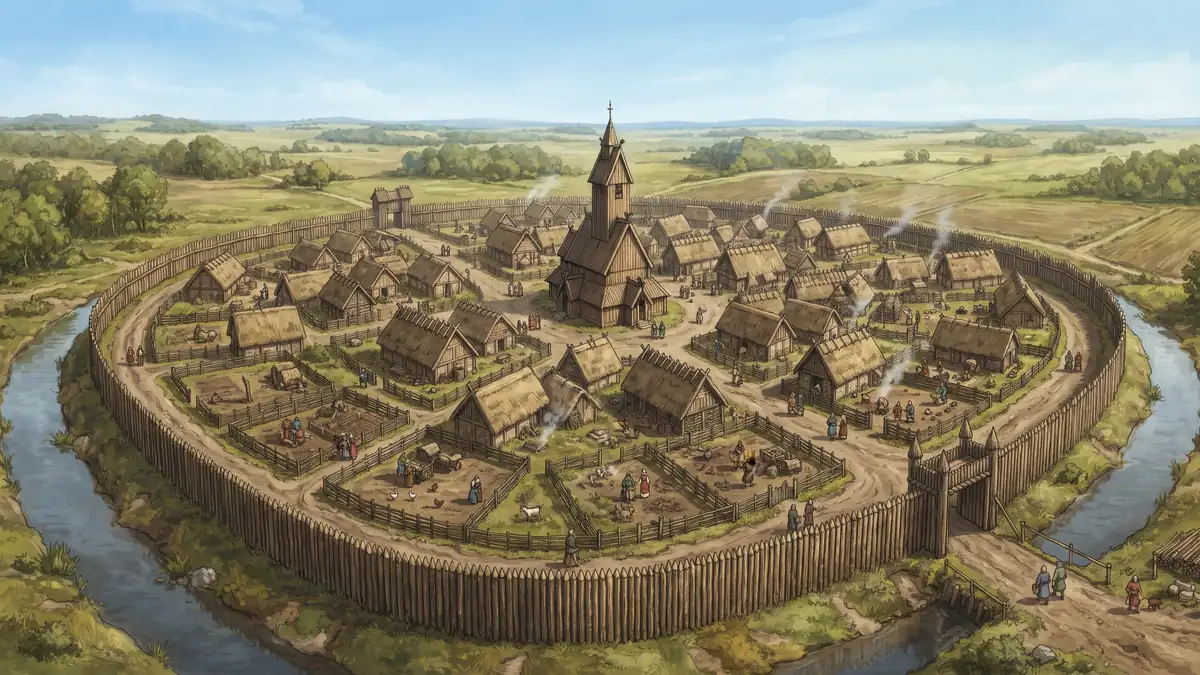
Lund, in Scania, now in Sweden, is “believed” to have been founded in 990. The article I consulted uses precisely that word, and the origin of the city is described as “unclear”. Older studies linked the foundation to Cnut the Great around 1000. Recent finds point to the first settlements around 990, in the reign of Sweyn Forkbeard.
A city against Uppåkra
Uppåkra, an early pagan centre about 5 km away, may have supplied settlers. The article says Lund was the “direct result” of the new power’s need to establish a centre competing with the old Uppåkra. The town was built on royal land.
The first church
The earliest known church was a wooden stave church, dendrochronologically dated to around 990. It stood partly over a Christian cemetery. In the early 11th century it was rebuilt in stone, and this is St Salvator, or Drottens Kyrka. The stone church measured 51.5 m long and 14 m wide, and the ruins can be visited.
Churches and bishops
Around 1050, five new churches were built, and five more in the following decades. Henry was appointed bishop of Lund in 1060/61 and died in 1066, and the plan for a separate archbishopric lapsed. A Scandinavian archbishopric came only in 1103, with its seat at Lund.
The cathedral
Construction of the Cathedral of St Laurentius began in 1080. The crypt, dedicated to St John the Baptist, was consecrated in 1123 and the cathedral in 1145.
Mint, plots and streets
The archaeologist Anders Andrén argued that the city was founded as an administrative centre, with a mint and a store for the royal taxes of three nearby hundreds. The article says the royal mint was “perhaps” near the royal manor.
The original 65–80 Viking farms became 600–700 medieval house plots. Plots along Stora Torget were about 2000–2500 m². The present street network is dated to the period after 1050. The town was enclosed by a ditch and a fortification around some 84 hectares, of which about 15% survives.
Population and uncertainties
The article estimates 3–4,000 people around 1100, but another calculation, from farm occupancy, gives a maximum of 1,200. By the end of the Middle Ages, it would have been 5–7,000. The article does not reconcile the two figures.
It also remains uncertain whether St Salvator or an earlier forerunner of St Laurentius served as the first cathedral, where the mint stood and whether Sweyn was buried at Lund and later moved to Roskilde, which the article calls “somewhat speculative”.
In short
Lund is considered founded around 990, on royal land, to rival Uppåkra. It had a wooden church dated to about 990, five churches around 1050, a cathedral begun in 1080 and consecrated in 1145, and went from 65–80 farms to 600–700 plots.
To mark each plot of the new town, play The plots of the new town.
Sources.
- Medieval Histories (medieval.eu), article "The Medieval City of Lund", with the dates of the foundation, the churches, the cathedral and the town's growth