 MMXXVI
Magnus the Blind: the iron chain across Bergen harbour in 1135, the mutilated king and the last battle at Holmengrå
Magnus Sigurdsson, king of Norway, was defeated at Bergen by his uncle Harald Gille in 1135, mutilated and sent to a monastery. He came back as king and died in 1139 at Holmengrå. See what the sources tell.
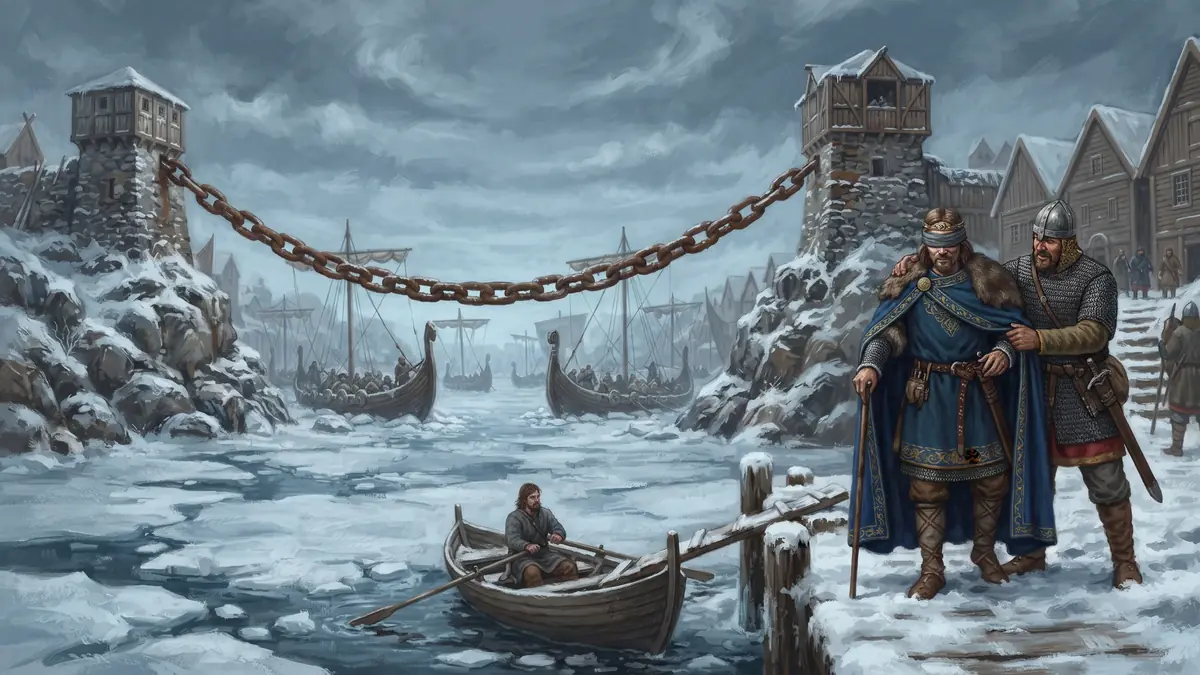
Magnus Sigurdsson was born around 1115, son of King Sigurd the Crusader and of Borghild Olavsdotter. When his father died in 1130, he became king jointly with his uncle, Harald Gille. The sources know him as Magnus the Blind, and the story of that blindness marks the start of the long era of Norwegian civil wars, which, according to historians, lasted until 1240.
Four years of uneasy peace
Harald was stronger in Viken, in the east. Magnus controlled Trøndelag and the west of the country. After about four years of uneasy peace, Magnus began openly preparing for war against his uncle. On 9 August 1134, at the battle of Fyrileiv, in Stångenäs, in present-day Bohuslän, he defeated Harald, who fled to Denmark.
The winter’s mistake
Against the advice of his lendmenn, the local chieftains, Magnus disbanded the army and spent the winter in Bergen. Harald came back with a new army and the support of the Danish king Erik Emune. He reached Bergen before Christmas 1134, but waited until 7 January 1135, because Christmas was a holy time. Then he entered the city, and Magnus’s small army dispersed. Magnus tried to escape with a few men on the king’s ship but, according to the source, the whole bay of Vågen was closed with an iron chain, and they could not get out.
The mutilation
Magnus was captured, deposed and handed over to Harald’s slaves. They gouged out his eyes, cut off a foot and castrated him. Hence the nickname. He was taken to Nidarholm Abbey, on Munkholmen in the Trondheim fjord, where he lived as a monk, supported by the income of the Hernes farm on the Frosta peninsula.
The return
In 1136, Harald Gille was killed by Sigurd Slembe, another pretender, who in 1135 had proclaimed himself king. Slembe took Magnus out of the monastery and made him co-king. They split their forces: Magnus went east, where he had more popular support, but was defeated at the battle of Minne by the troops of King Inge I. He fled to Götaland and then to Denmark, seeking help. The Danish invasion under Erik Emune failed.
Holmengrå
Magnus rejoined Slembe’s men, who had little support in Norway and lived more like bandits than kings. On 12 November 1139, they faced the forces of Inge I and Sigurd II in the naval battle of Holmengrå, south of Hvaler in the Oslofjord. Magnus fell. His loyal guard, Reidar Grjotgardsson, lifted him up during the fight, and a spear pierced them both. He was buried in St Hallvard’s church in Oslo. A monument at the Storedal farm in Skjeberg, in Østfold, commemorates him.
What remains
Heimskringla tells Magnus’s story in the first chapters of the saga of Magnus the Blind and Harald Gille. The poet Einar Skúlason, in his Haraldsdrápa, speaks of the battle of Bergen. The case shows how kings shared the throne without dividing the territory, and how a single winter of carelessness was enough to lose everything.
To parry with the shield the blows that come out of the dark at Magnus, play Blows from the dark.
Sources.
- Snorri Sturluson, Heimskringla, saga of Magnus the Blind and Harald Gille, chs. 1 to 8
- Einar Skúlason, Haraldsdrápa, quoted by Snorri on the battle of Bergen
- reference works (English), entry "Magnus IV of Norway", with the sources cited