 MMXXVI
Melkorka: the Irish princess sold as a mute slave, the talk with her two-year-old son that gave her away and the gold ring that proved the kinship
In Laxdæla saga, Höskuldr buys a slave woman who never speaks. One day he overhears her talking to her son and learns that she says she is Melkorka, daughter of an Irish king.
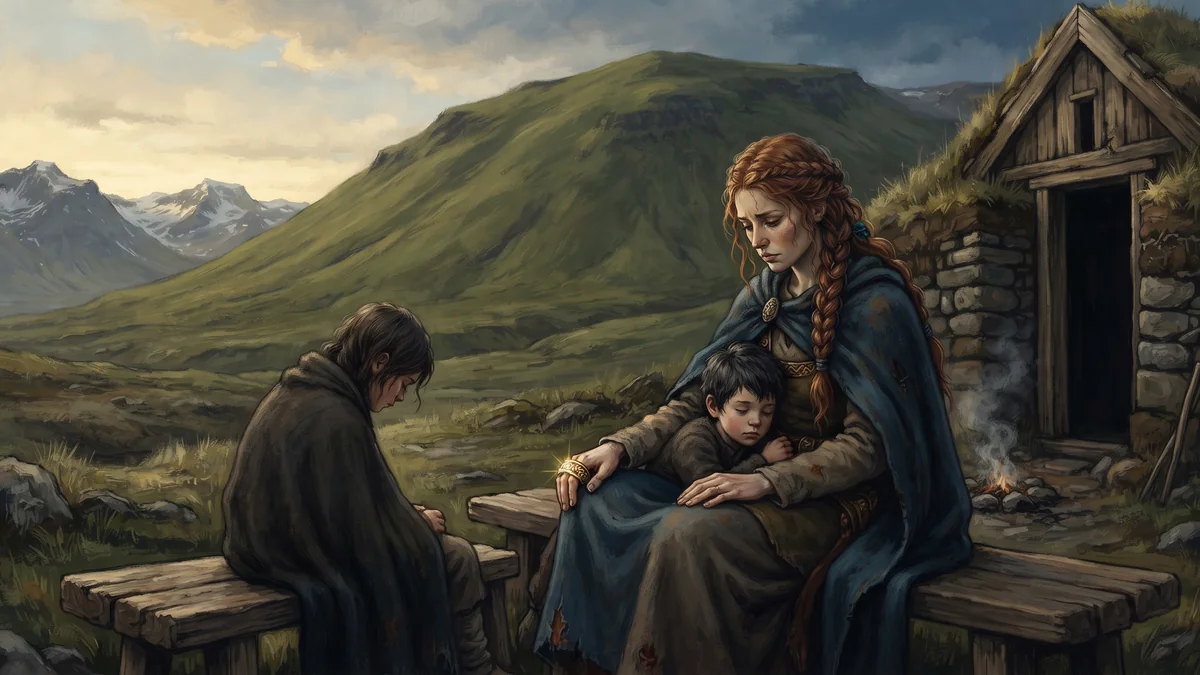
In Laxdæla saga, written in Iceland in the 13th century, the chieftain Höskuldr Dala-Kollsson buys a woman from a Rus’ merchant at Brännöyar, in Norway. She is beautiful, but Höskuldr thinks she is mute, and she never says a word. The Landnámabók also names Melkorka, as the mother of the goði Ólafr Höskuldsson.
The conversation that gave her away
Höskuldr takes the woman to Iceland. In spring a son is born, whom the saga names Ólafr after an uncle of Höskuldr’s who had died shortly before. The saga says that at two the boy already walks and talks perfectly. One day Höskuldr overhears her speaking with him. She then introduces herself: she is Melkorka, daughter of the Irish king Myrkjartan, taken in a Viking raid.
The divided household
Jórunn, Höskuldr’s wife, cannot stand the concubine. The quarrels in the house make Höskuldr send Melkorka and her son to another farm, later called Melkorkustaðir. The origin of the name is debated: it may be an Irish name, Mael Curcaig, or a Norse form with melr and korka.
The ring and the voyage
Melkorka teaches her son Irish. Around 956, at her urging, Ólafr sets out for Ireland. Höskuldr is against it and holds back the trade goods. Melkorka marries Þorbjörn skrjúpur, and the marriage helps pay for the expedition; their son is Lambi. Ólafr carries a gold ring that the king had once given her. Myrkjartan recognises the ring, accepts the kinship and offers to make him his heir. Ólafr declines for fear of the king’s sons and goes home, unable to bring back Melkorka’s nurse, whom the king will not release.
Saga or history?
The purchase from the Rus’ merchant, the princess and the ring belong to the saga’s narrative, and nobody knows which King Myrkjartan it would be; several Irish kings bore the name. The Landnámabók also names Helgi, a son of Melkorka whom the saga does not mention.
To pick up each passage and carry it to the right place, play Each step in its place.
Sources.
- Laxdæla saga (Iceland, 13th century), chapters on the purchase of Melkorka and Ólafr's voyage to Ireland
- Landnámabók, the genealogy of Iceland's first settlers, which names Melkorka and another son of hers, Helgi
- Studies of the name Melkorka, which may come from Irish Mael Curcaig or from a Norse root