 MMXXVI
Mírmanns saga: the pagan earl's son who became a leper, Princess Cecilia of Sicily and the wife disguised as Earl Hiringr
The Mírmanns saga is an Icelandic chivalric saga, probably of the fourteenth century, about a young man who kills his pagan father, is bewitched by his mother, cured by a princess, forgets his wife and is defeated by her in combat. See the plot and the debate over where it fits.
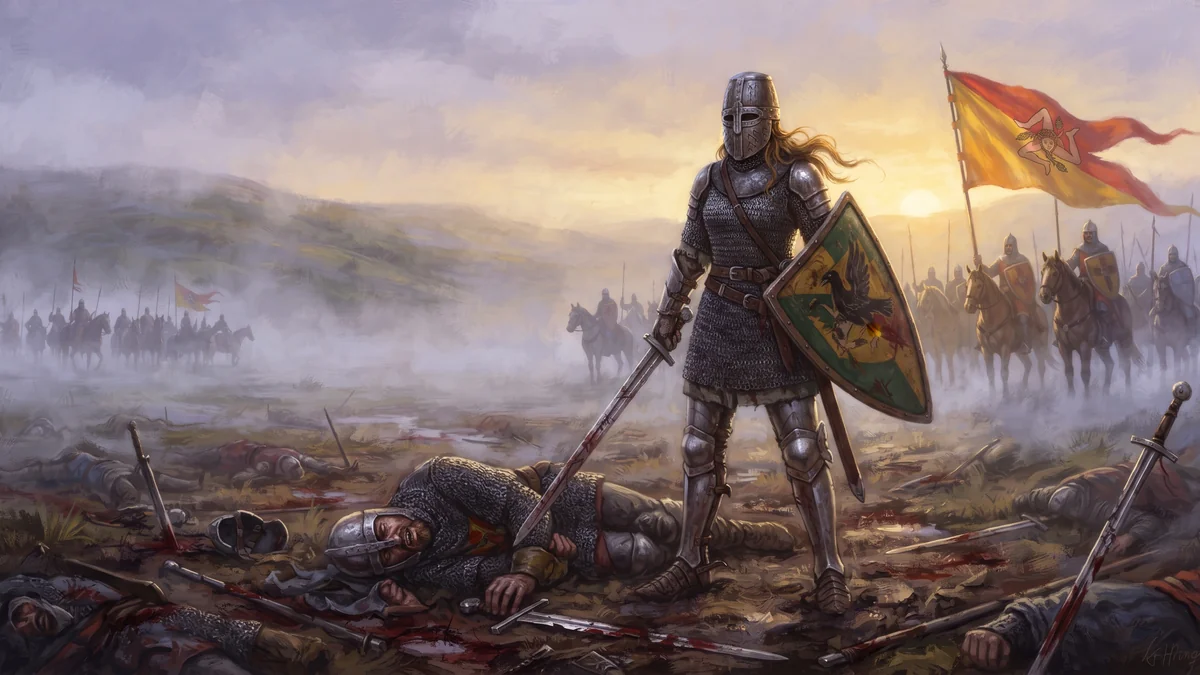
The Mírmanns saga is an Icelandic chivalric saga, probably composed in the fourteenth century. It has a plot full of reversals, in which the formulas of adventure sagas join the question of conversion to Christianity. At least 32 manuscripts survive.
The father, the mother and the leprosy
Mírman, son of the heathen Earl Hermann of Saxland, kills his own father. His mother wants revenge and gives him a potion that makes him a leper. Mírman travels to Sicily to be healed by Cecilia, the king’s daughter. He is cured and marries her.
The forgetting
Later Mírman visits his foster-father, King Hlöðver, in France. Hlöðver’s queen makes him forget Cecilia. When the king dies, Mírman marries the queen.
The disguised wife
Cecilia disguises herself as Earl Hiringr, joins Mírman’s enemies and defeats him in combat, taking him prisoner. The two are reconciled, and Mírman becomes king of Sicily.
Where it fits
The Mírmanns saga belongs to a Norse cycle of more than twenty sagas. With Sigurðar saga þögla and Flóvents saga, it forms a smaller cycle tied to the Christianisation of Scandinavia. Marianne Kalinke and P. M. Mitchell note that the focus on conversion is uncommon among Icelandic chivalric sagas, and some philologists debate whether it belongs to the original Icelandic sagas or the translated ones, since its main theme suggests the latter.
Astrid von Nahl sees two parts: the first, about heathenism and Christianity, typical of translated sagas; the second, about a deceitful mother, love and betrayal, typical of original ones. She suggests the saga may be a conglomerate of an earlier lost text and a later composition. She also notes structural similarities with Karlamagnús saga, in which a Christian king converts a heathen land or Christians are attacked by heathens.
What is not known
The date is hard to determine. The saga mentions a Pope Clement, supposedly one of Rome’s first bishops, but the poor condition of the manuscripts prevents exact dating. The original source is also unclear: Eugen Kölbing and Gísli Brynjúlfsson believed the names suggest a Latin original. In the Stockholm codex a whole quire is missing after Mírman’s fight with Bœring.
To bring down one knight after another like Cecilia disguised as Earl Hiringr, play Earl Hiringr.
Sources.
- Desmond Slay (ed.), Mírmanns saga (Editiones Arnamagnæanæ, Series A, Copenhagen, 1997)
- Ralph O'Connor (trans.), Icelandic Histories and Romances (Tempus, Stroud, 2002)
- Marianne E. Kalinke and P. M. Mitchell, Bibliography of Old Norse-Icelandic Romances (Cornell University Press, 1985)