 MMXXVI
Mosekonen: the old woman of the Danish bog who makes the mist, the cabinet of "poetry in bottles" and the twelve lights Andersen let loose in the town in 1865
In Denmark, the "bog woman" is the one who makes the mist that rises from the marshes. Hans Christian Andersen put her in a tale of 1865, where she taps at a man's window to warn that the lygtemænd, the bog lights, are in town.
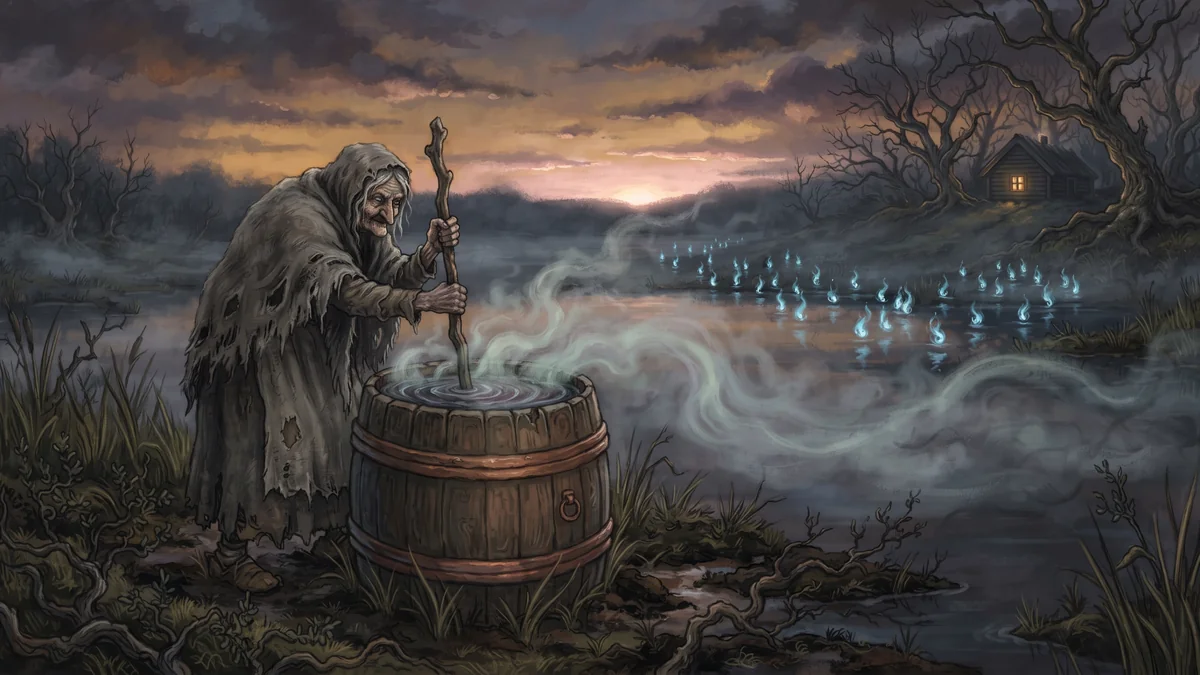
In Denmark, the Mosekonen, “the bog woman”, is the one who makes the mist that rises from the marshes and meadows after warm days. She was said to be brewing, and the mist was the “Mosekonen’s brew”. When the mist settled, she stopped fermenting. The best-known source for this figure is Hans Christian Andersen, who put her in a tale published on 17 November 1865.
The tale
“The will-o’-the-wisps are in town, says the Bog Woman” appears in the collection Nye Eventyr og Historier. A man who once knew many tales finds that they no longer visit him, after a war. He looks for them in the city, in books, in flowers and in the countryside, without finding them. At night, the Mosekonen taps at his window and warns that the lygtemænd, the bog lights, are loose in town. The man half believes her, but fears that nobody will take the warning seriously.
A troll who was an elf
In the story, the Mosekonen describes herself as a troll-being who was once an elf girl. She keeps a cabinet of “poetry in bottles”, an heirloom from the Devil’s great-grandmother, with the essence of various poets and genres. She tends a barrel, and when a tap falls out, the beer runs off.
The twelve lygtemænd
In the tale, twelve lygtemænd are born in the bog in a single night. For one year, each can take human form and lead 365 people astray. The one who succeeds earns a fiery place as the Devil’s runner. The one who fails is stuck, shining, in rotten wood. In popular belief, the lygtemænd are lights over the bogs that draw people off their path.
The fire that marks a treasure
Danes, Finns, Swedes and other peoples believed that the bog light marked a buried treasure, which could be taken only while the fire was burning. Science attributes the light to the oxidation of phosphine, diphosphane and methane, gases that come from the decay of organic matter.
To cross the bog, gathering the bottles of poetry and dodging the lights, play Poetry in bottles.
Sources.
- "Lygtemændene ere i Byen, sagde Mosekonen", by Hans Christian Andersen, in Nye Eventyr og Historier, second series, third collection (17 November 1865)
- Editorial notes to Andersen's work on the bog woman's "brew" and on the lygtemænd
- Folklore studies of the bog light in Nordic and Baltic countries and of scientific explanations