 MMXXVI
Möttuls saga: the cloak that tests the fidelity of ladies at King Artús's court, translated for King Hákon
The Möttuls saga, or Skikkju saga, is the Norse version of the French fabliau Le Mantel mautaillié, about a cloak that fits only the faithful. See the plot, what the saga adds, the errors in names, the manuscripts and the link with Samsons saga fagra.
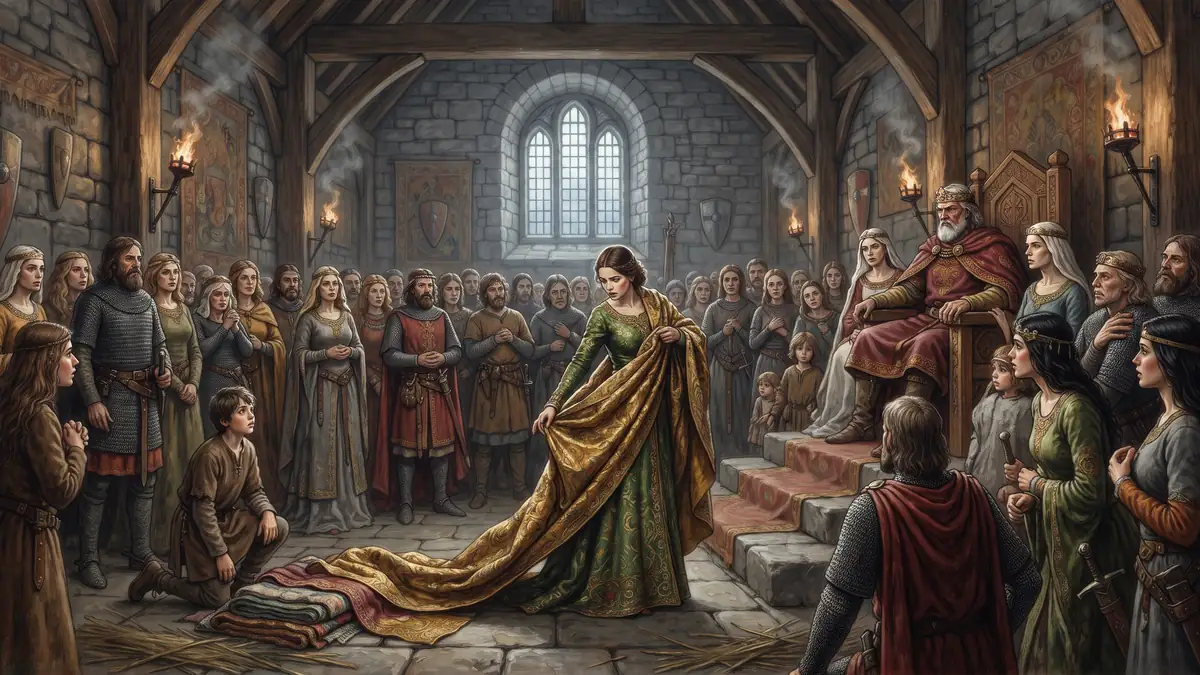
The Möttuls saga, also called Skikkju saga, is the Norse translation of a short French tale from the beginning of the thirteenth century, the Le lai du cort mantel, also known as Le Mantel mautaillié. It was translated under the patronage of Hákon Hákonarson, king of Norway, along with other chivalric sagas. The fabliau is about a fidelity-testing cloak that arrives at the court of King Artús.
The cloak
At the centre of the story is a magic cloak. Whoever wears it shows whether she has been faithful to her love: on ladies who have not been, it hangs badly. The cloak arrives at Artús’s court, and the test extends to all the women present, the queen included. In the French source the cloak looks bad on almost all of them, and only one lady wears it as if it had been made for her. At court the scene becomes a spectacle, with humour and embarrassment, in which no one escapes the eyes of the others.
What the saga changes
The Norse translator adds a long introduction describing King Artús, absent from the French. It suggests that the Norwegian audience did not know the king and his court well. This shows in another detail too: the saga misnames some well-known characters, which may indicate that listeners were unfamiliar with the Arthurian material.
Manuscripts
The medieval manuscripts are scarce. There is a single leaf, AM 598 Iβ 4to, which represents one version of the saga. Two other leaves survive from one codex, in Stockholm (Stock. Perg. 4to nr 6) and in Copenhagen (AM 598 Iα 4to), and date from the fourteenth century. Complete texts appear only in the seventeenth century, and Marianne Kalinke’s edition is based on a copy from that century, AM 179 fol.
The cloak in another saga
The story of the cloak came back in another work. Samsons saga fagra, an Icelandic chivalric saga, tells the history of the cloak before it reaches Artús’s court and refers to the Möttuls saga, which it calls Skikkju saga. Later the cloak appears in the second part of that saga, when a thief steals it from the aged Sigurðr.
Why it matters
The Möttuls saga shows how Arthurian matter reached Norway in small pieces. A short French tale about a cloak that tests loyalty in love was translated for Hákon’s court and left enough of a mark that another saga, Samsons saga fagra, gave it a history of its own.
To tap the cloaks that hang well and avoid the crooked ones, play The cloak of the test.
Sources.
- Marianne E. Kalinke and P. M. Mitchell, Bibliography of Old Norse-Icelandic Romances (Cornell University Press, 1985)
- Marianne E. Kalinke, King Arthur, North-by-Northwest: The Matière de Bretagne in Old Norse-Icelandic Romances (Museum Tusculanum, Copenhagen, 1981)
- Marianne Kalinke's edition of Möttuls saga, based on the seventeenth-century copy AM 179 fol.