 MMXXVI
Naddoddr and Garðar: the two men who saw Iceland before the settlers, the "Snowland" that vanished in the storm and the island that got a name of its own
According to the Landnámabók, the Norwegian Naddoddr reached Iceland by accident on his way to the Faroe Islands, and the Swede Garðarr Svavarsson sailed around the island in the 860s. Each gave the place a different name.
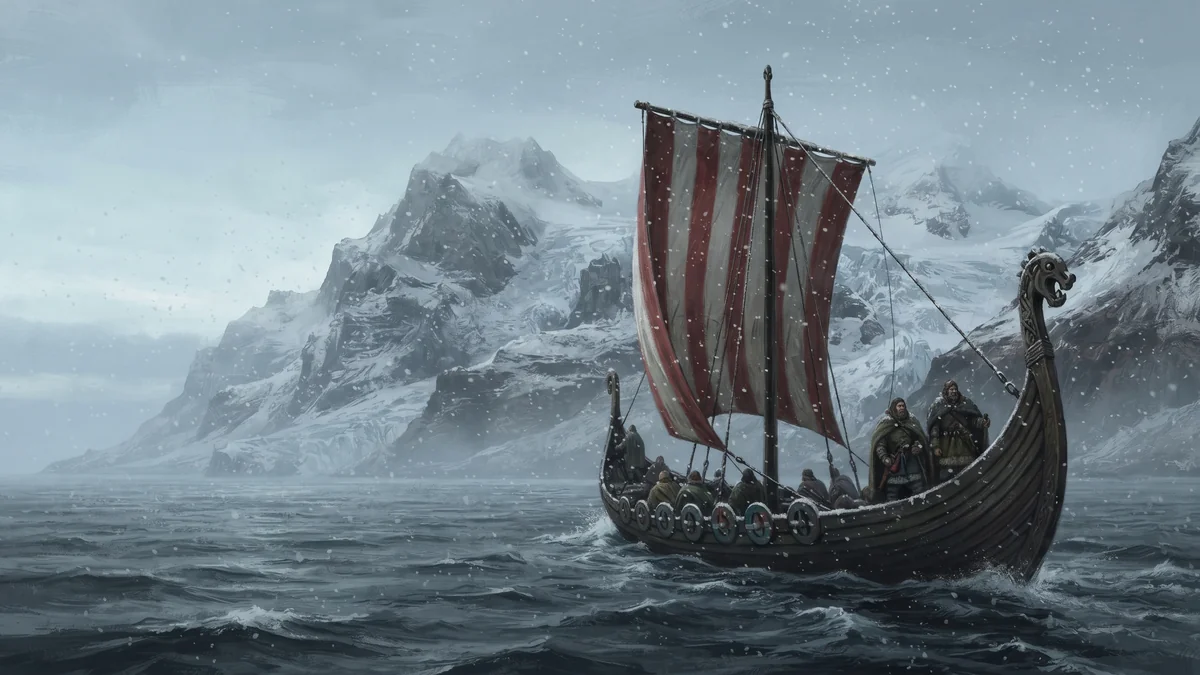
According to the Landnámabók, the first Scandinavian to reach Iceland was Naddoddr, a Norwegian. He was bound for the Faroe Islands when a storm pushed him west, and he sighted a coast nobody knew. He climbed a hill and saw no smoke and no sign of people. When he left, it began to snow, and so the place became known as Snæland, “Snowland”.
The Swede from Zealand
Garðarr Svavarsson was a Swede who owned land on Zealand and had a wife from the Hebrides. In the 860s he was heading there to claim his father-in-law’s inheritance when a storm in the Pentland Firth swept him north, to the east coast of Iceland. The Landnámabók in Haukr Erlendsson’s version is the main source on him.
Around the island
Garðarr was the first to sail all the way around the island, and so proved it was an island. He landed at Skjálfandi, built a house and wintered at the place now called Húsavík. When he went back he praised the land and called it Garðarshólmr, “Garðarr’s island”, after his own name.
Who stayed
In the Landnámabók’s version, when Garðarr left, a man called Náttfari stayed behind on the island with a male and a female slave. The place was named Náttfaravík. The Landnámabók presents them as the first permanent inhabitants. What remained of Garðarr was his son, Uni the Dane, who later emigrated to Iceland and tried to win it for the king of Norway, with himself as earl. He was killed.
Three names
Snæland, Garðarshólmr and, later, Ísland: each visitor named the island after what he saw or what he wanted. The name that stuck was the third, given by Flóki Vilgerðarson after seeing a fjord full of ice.
What the source does not settle
The account mixes a tradition that was only put on paper two centuries later with a common theme, that of the ship driven off course by a storm. Even so, the date (the 860s) and the short distance from the Faroes and the Hebrides make both accounts plausible.
To catch the snow without hitting the rocks of the coast, play Snowland.
Sources.
- Landnámabók, the Book of Settlements (Iceland, 12th and 13th centuries), Haukr Erlendsson's version, on Naddoddr, Garðarr and Náttfari
- Studies of Norse and Icelandic literature on the first voyages to Iceland before about 870
- Archaeological accounts of the first human settlement on the island