 MMXXVI
Nicholas Breakspear: the English cardinal who reached Norway in 1152, created the archbishopric of Nidaros and later became the only pope born in England
In 1152, the English cardinal Nicholas Breakspear reached Norway in the midst of civil war, reorganised the Church and made Nidaros an archbishopric for Norway, Iceland, Greenland, Orkney and the Faroes. See the mission and its result.
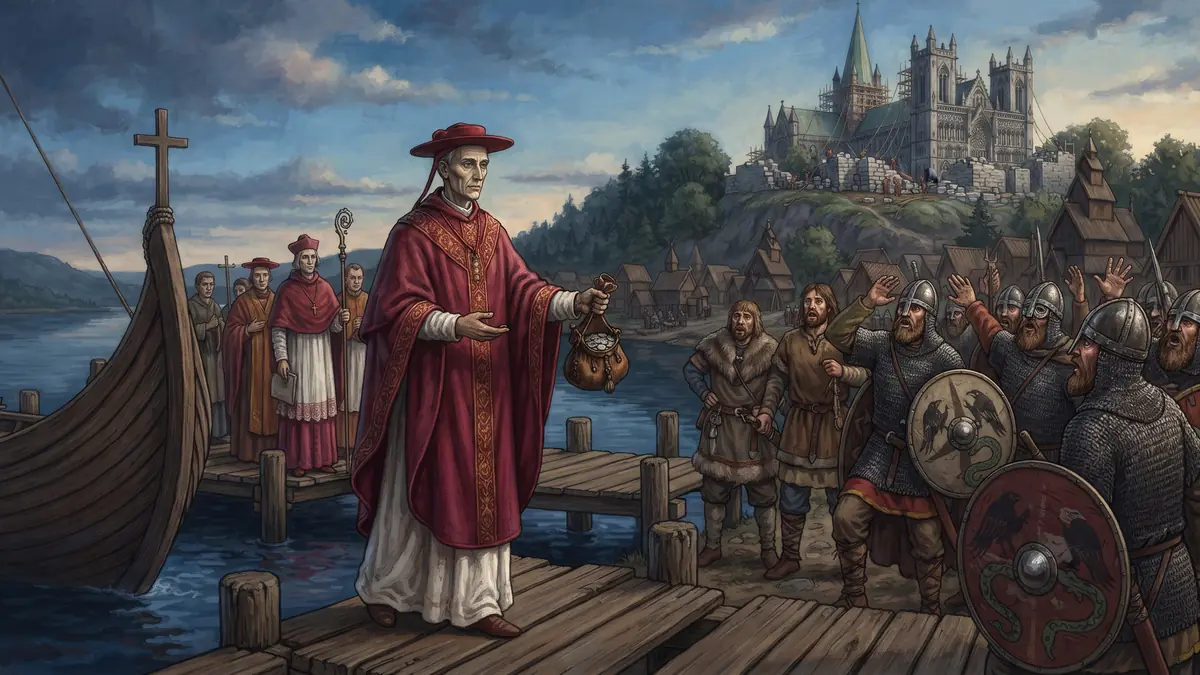
Nicholas Breakspear was born around 1100, probably in or near St Albans, and would become the only pope born in England and the first from an English-speaking country. Before that, he was a canon regular at the abbey of Saint-Ruf in Avignon, where he rose to prior and then abbot. The monks complained that he was too strict. Pope Eugenius III made him cardinal-bishop of Albano, around 1149, and in mid-1152 sent him as legate to Scandinavia.
An unexpected arrival
The cardinal reached Norway in the midst of civil war. His arrival seems to have been unexpected: Archbishop Eskil of Lund was in France, and King Inge I was on campaign. Breakspear reconciled the warring factions, if only for a time, and reorganised the Church.
The council of Nidaros
Until then, Nidaros was only a bishopric. The date of the council that raised it to an archbishopric is uncertain: Bergquist suggests early 1153, because autumn 1152 would leave too little time to organise it. The new archbishopric covered Norway, Iceland, Greenland, the Faroe Islands, Orkney and Shetland. Breakspear authorised the expansion of Trondheim cathedral, which the source describes as the northernmost and largest of medieval Europe, and founded cathedral schools at Nidaros, in 1152, and at Bergen and Hamar, in 1153.
Sweden and Peter’s Pence
In Sweden, the legate held a council at Linköping, which placed the Swedish Church under the Archbishop of Lund and ended the old German oversight. He obtained permission to introduce Peter’s Pence, the denarium sancti Petri, a payment acknowledging the primacy of the pope, and to reduce lay influence over the Church. He tried to create a Swedish archiepiscopal see, but the Swedes and Geats could not agree on the place, and the plan failed. Later, the new Swedish metropolitan see was placed under Eskil.
From legate to pope
Breakspear left Scandinavia in the autumn of 1154. Eugenius III had died in July 1153, and Anastasius IV died on 3 December 1154. The next day, Breakspear was elected pope, and enthroned the day after, taking the name Adrian IV.
What remains
Duggan calls the legation a “diplomatic triumph”. Andrew Beck writes that Breakspear “gave the Swedish church its hierarchy and its attachment to Rome”. The bull Laudabiliter, which supposedly authorised Henry II to invade Ireland, is not part of this mission, and scholars are not even sure it existed. For Iceland and Greenland, the essential point is that, from 1152, their bishops depended on Nidaros.
To catch the silver pennies, without touching the arrows of the war, play The legate’s pence.
Sources.
- reference works (English), entry "Pope Adrian IV", with the sources cited, among them Duggan and Beck
- reference works (English), entry "Nidaros Cathedral", on the date of 1152