 MMXXVI
Niels Ebbesen and the death of Count Gerhard in Randers in 1340: the forty-seven men, the bridge over the Guden river and the Danish hero
On the night of 1 April 1340, the squire Niels Ebbesen entered Randers with 47 men and killed Count Gerhard of Holstein, who ruled Jutland. See what the sources say and what stayed in tradition.
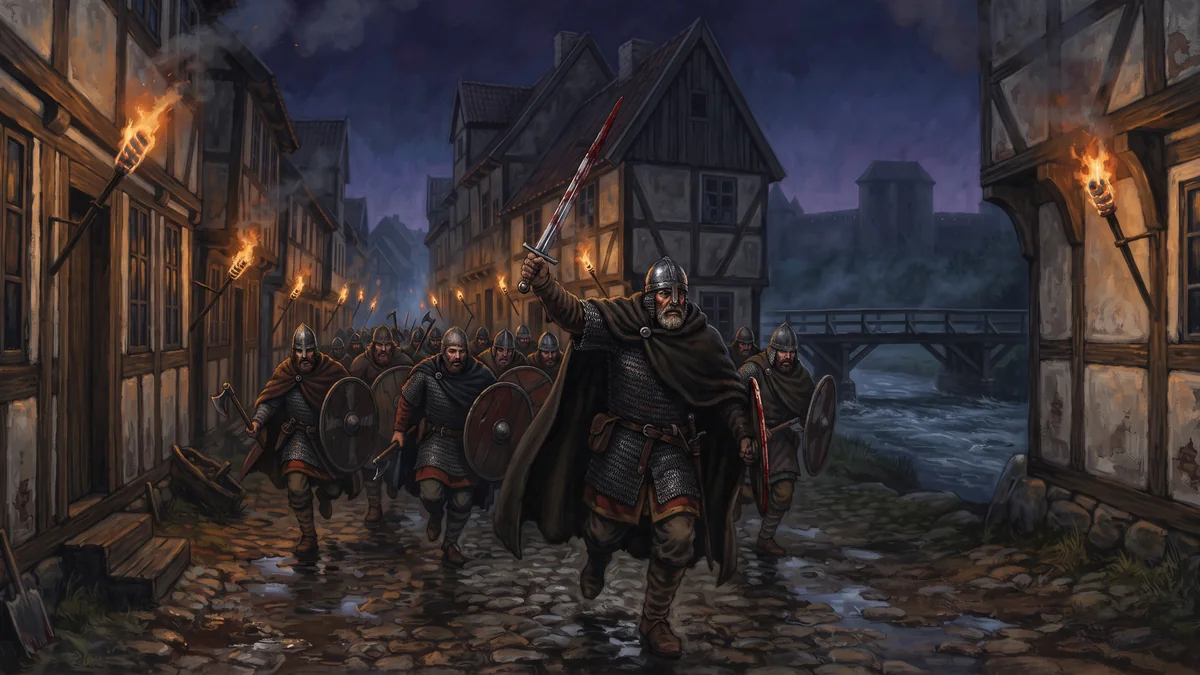
In Danish history, few names are as tied to the idea of resistance as that of Niels Ebbesen. He was a provincial nobleman from Jutland. According to the sources, on the night of 1 April 1340 he entered Randers with a small group of men and killed the German count who ruled the region.
A kingdom without a king
In 1332, King Christopher II died and Denmark was left without a monarch. The realm was in debt and largely pledged to German princes. Count Gerhard III of Holstein, called “den kullede greve” (the shaven-headed count), held Funen and Jutland as security for a loan of about 100,000 marks of silver. In 1340 he had around 4,000 mercenaries. For peasants and the lesser nobility, their presence meant taxes and plunder.
The night in Randers
Gerhard was in Randers. Niels Ebbesen, who had earlier negotiated with him, gathered 47 men, forty-eight counting himself, and entered the town at night. According to tradition, the count was killed in his bed, beheaded over the foot of it. The band left quickly. To block pursuit, the bridge over the Guden river was weakened and brought down behind the fugitives. According to the account, only one man was lost.
Ebbesen died a few months later, in November 1340, in the fighting at Skanderborg. The sources disagree on the exact day, so it is only said “in November”.
What no one knows
Niels Ebbesen’s motive is not known with certainty. It may have been patriotism, revenge or political calculation. What the Danish ballad records, and what national memory kept, is the image of the man who faced the count. In 1351, Gerhard’s kin accepted compensation of 500 Lübeck marks for his death, which shows the case was treated as a killing with a legal price.
From the nineteenth century to the stage
The figure became a symbol in the nineteenth century. Randers has a statue of him by F. E. Ring, from 1882, and at Skanderborg there is a memorial from 1878. In 1942, during the German occupation, the pastor and playwright Kaj Munk wrote a play about Niels Ebbesen, read at the time as a message of resistance. Munk was murdered in 1944.
The story reached us above all through oral tradition and the Danish ballad catalogued as DgF 156, and not through an account written on the same day. For that reason, details such as the number of men, the exact manner of the count’s death and the fate of each fugitive should be read with caution. What the sources support together is the essential: a night attack in Randers, the death of Gerhard and the death of Ebbesen in the same year.
To parry the mercenaries’ blows on the night in Randers, play The night in Randers.
Sources.
- Lex.dk (Den Store Danske), entry "Niels Ebbesen"
- Danmarks gamle Folkeviser (DgF), ballad no. 156, on Niels Ebbesen
- Kaj Munk, play "Niels Ebbesen" (1942), and F. E. Ring's monument in Randers (1882)