 MMXXVI
Nils Holgersson: Selma Lagerlöf's wonderful journey, the shrunken boy who crossed Sweden on the back of a goose
Commissioned in 1902 as a geography reader for schools, Selma Lagerlöf's novel (1906–1907) sends a boy shrunk by a tomte flying across Sweden with wild geese.
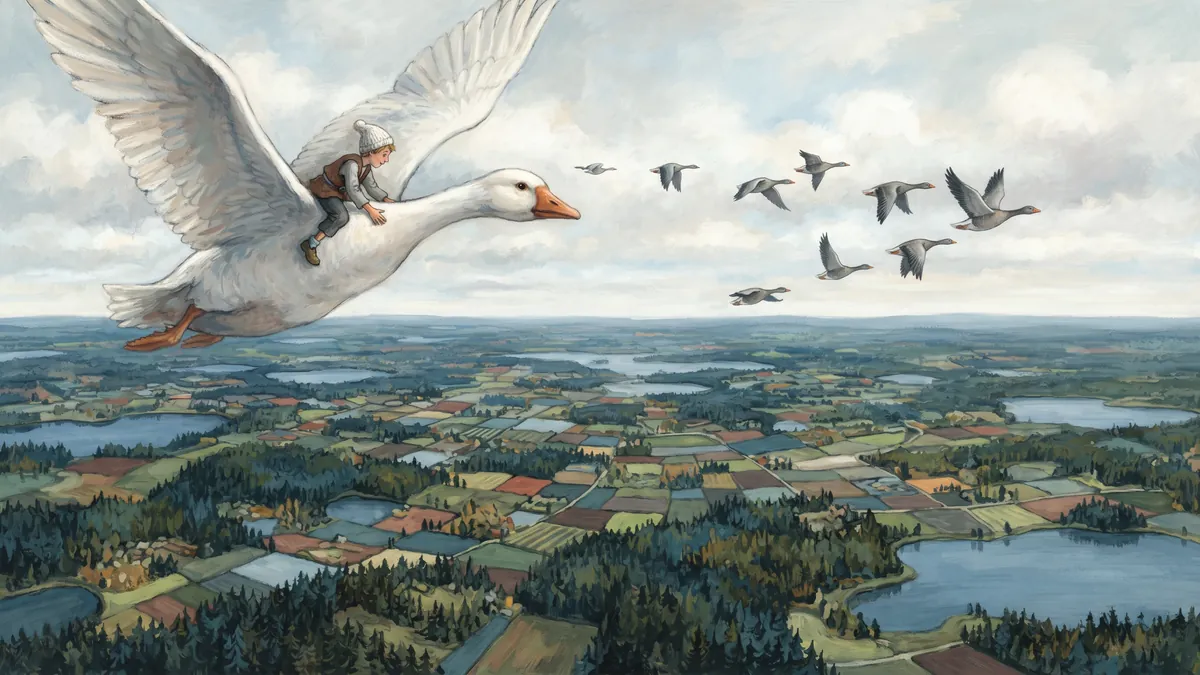
Nils Holgerssons underbara resa genom Sverige, “Nils Holgersson’s wonderful journey across Sweden”, is a novel by the Swedish writer Selma Lagerlöf. According to the sources, it came out in two books, in 1906 and 1907, and was one of the first to use the new Swedish spelling mandated by a government resolution of 7 April 1906.
A geography reader
The National Teachers Association commissioned the work in 1902 as a geography reader for public schools. Selma Lagerlöf, born in 1858 at Mårbacka, in Värmland, had taught in Landskrona between 1885 and 1895 and had published her first novel, Gösta Berlings saga, in 1891. In 1909 she became the first woman to receive the Nobel Prize in Literature, and in 1914 the first to enter the Swedish Academy. She died in 1940, at Mårbacka.
To write the book, according to the introduction by the English translator Velma Swanston Howard, she devoted three years to nature study and to learning about animal and bird life, and sought out unpublished folklore and legends of each province, which she wove into the story.
The story
The boy Nils’s chief delight is to eat and sleep, and he mistreats the farm animals, until a tomte shrinks him after he traps it in a net. He rides Martin, the farm’s white goose, who tries to join a flock of wild geese led by Akka from Kebnekaise. The geese carry the two across the historical provinces of Sweden, from Scania to Lapland.
The book has characters such as Karr and Grayskin, the eagle Gorgo, Thumbietot, the goose girl Osa, Little Mats and the Ulvåsa Lady. In one episode, a provincial man in Stockholm befriends the King of Sweden, who is walking incognito.
Chapters, cuts and criticism
The original 1906 volume had 21 chapters, and the 1907 volume had 34, numbered 22 to 55. Howard’s English translation, of 1907 and 1911, cut some chapters entirely and abridged others, and so Dalarna, visited in four chapters of the original, does not appear in it. The book was also criticised because the goose and the boy fly over Halland in chapter 53 without stopping, and some translations added a chapter about the region. Nils is usually drawn wearing a red cap, which the source calls an error, since the original describes a white one.
A Swedish classic
The book is so well known in Sweden that Nils, riding a goose over Scania, appeared on the reverse of the 20-krona banknote until the new notes came into use in 2015. He is also in the logo of the digital map company Tele Atlas, and the Rörstrand pottery produced a series of Christmas plates with scenes from the journey from 1970 to 1999. The work has been translated into more than 30 languages.
The adaptations include a 1955 Soviet animated film, a 1962 Swedish film directed by Kenne Fant and shot largely from helicopters, a 1980–81 Japanese anime series by NHK with 52 episodes, a 2011 German live-action version and a 2017 CGI series.
To run across the fields with Martin, gathering grains of wheat and dodging the fences, play Across the fields with Martin.
Sources.
- Reference work in English, article "The Wonderful Adventures of Nils"
- Reference work in English, article "Selma Lagerlöf"