 MMXXVI
Nydam: the oak boat of AD 310 found in a Danish bog and taken as a spoil of war
In the Nydam bog in southern Denmark, the archaeologist Conrad Engelhardt found in 1863 a 23-metre oak boat with 14 pairs of oars, offered as a sacrifice more than 1,700 years ago. See what was found, what the war of 1864 changed and where the boat is today.
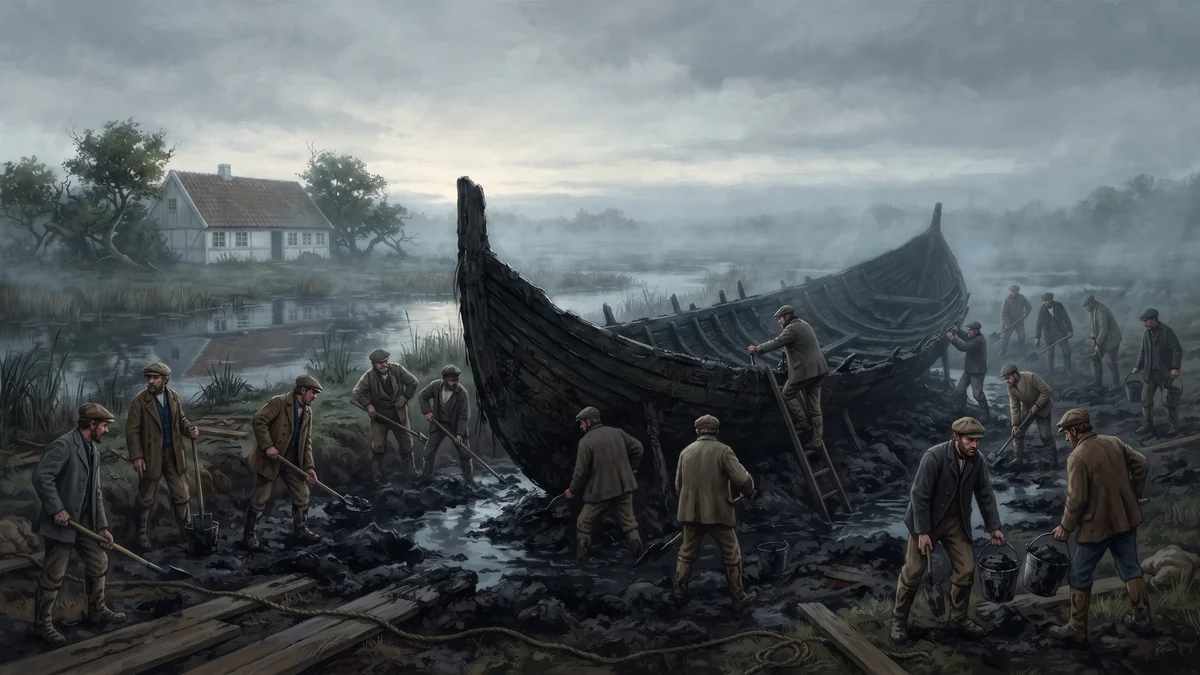
Before the Viking ships there were already rowing boats on the North Sea and the Baltic. One of them lay hidden for nearly 1,700 years in a bog in southern Denmark.
Where it is
Nydam Mose is in Øster Sottrup, in Sundeved, about 8 km from Sønderborg, Denmark. Today the site is a green meadow. There is parking on Nydamvej, and a path, the Nydamstien, leads in about ten minutes to Nydamhuset, a small white house beside the site.
A sacred bog
In the Iron Age the bog was a “sacred place”, according to Wikipedia. Captured weapons and boats were offered to the gods in thanks for victory. Many objects were bent, broken or hacked up in ritual acts, dated to 200 to 400 CE. The site was probably used on different occasions between 200 and 450 CE.
The first finds
The first known finds date from the 1830s, when a local farmer gave old swords and shields to his children as toys.
Engelhardt’s excavation, 1859 to 1863
The archaeologist Conrad Engelhardt excavated the bog from 1859 to 1863. He found lances, spears, bows, arrows, round shields, tools, pieces of clothing and two intact clinker-built boats, one of oak and one of pine. Beneath them were the remains of a third boat, apparently demolished during the sacrifice. On 17 August 1863 he discovered the Nydam Boat.
The boat
- Length: 23 metres. Width: about 3.5 metres.
- Clinker-built, of oak.
- Weight: more than three tonnes.
- Oars: 14 pairs. Likely crew: about 45 men.
- Dated by dendrochronology to 310 to 320 CE.
It is the first and largest of the three boats found, and the only one preserved. It is one of the oldest known rowing vessels in northern Europe. The Hjortspring boat, also found in Denmark, is older.
The war of 1864
Engelhardt’s work stopped when the Second Schleswig War broke out in early 1864. Some finds were lost. The smaller pine boat, perhaps 19 metres long, was hacked up and used as firewood by troops, and Wikipedia says it was entirely destroyed during the war. Denmark lost the war and part of its territory, and was forced to transfer the Nydam Boat to Prussia.
Where it is today
The boat is displayed at Gottorf Castle, in the archaeological museum in Schleswig, Germany.
After 1989
The National Museum of Denmark resumed excavation of the bog in 1989. Finds included swords, spears, bows, arrows, belt buckles, brooches and ornate clasps, dated to 250 to 550 CE. The Nydam Society, founded in 1983, contributed to the resumption. There is also a replica of the oak boat, the Nydam Tveir, built using period techniques.
In short
The Nydam boat predates the Vikings by more than four centuries, but it shows that the tradition of rowing boats in the north already existed. It was offered to gods, buried in mud, found by an archaeologist and carried to another country because of a war.
To train your attention with the oars and the planks of the hull, play The planks of the hull.
Sources.
- English Wikipedia, article "Nydam Mose", with the excavations of 1859 to 1863 and from 1989 onwards, the dating and the boat's present location
- National Museum of Denmark and the Nydam Society, cited in Wikipedia