 MMXXVI
Ögmundar þáttr dytts: the Icelander who swapped cloaks, the fugitive Gunnarr in Sweden and the man who took the place of Freyr's idol on the wagon
Ögmundar þáttr dytts tells how Gunnarr helmingr, blamed for a crime he did not commit, flees to Sweden and takes the place of the idol of Freyr in a wagon procession. The story mocks heathenism and is read as an account of a fertility rite.
Ögmundar þáttr dytts ok Gunnars helmings is a þáttr, a short Icelandic tale, in two linked parts. It survives in Óláfs saga Tryggvasonar en mesta, a large saga about King Óláfr Tryggvason from the beginning of the 14th century, and in a shorter form in the Vatnshyrna manuscripts of Víga-Glúms saga. That shorter form suggests the story was composed before the middle of the 13th century.
The Icelander who swapped cloaks
Ögmundr, a relative of Víga-Glúmr, is in Norway when he accidentally sinks the ship of Hallvarðr, a favourite of Jarl Hákon. The jarl punishes him with a wound that is also an insult. Glúmr urges him to restore the family’s honour, and Ögmundr returns two years later. By then the heathen jarl has been succeeded by the Christian King Óláfr Tryggvason. Ögmundr kills Hallvarðr, but first he swaps cloaks with a Norwegian named Gunnarr helmingr, so that he takes the blame. Then he goes back to Iceland.
The flight to Sweden
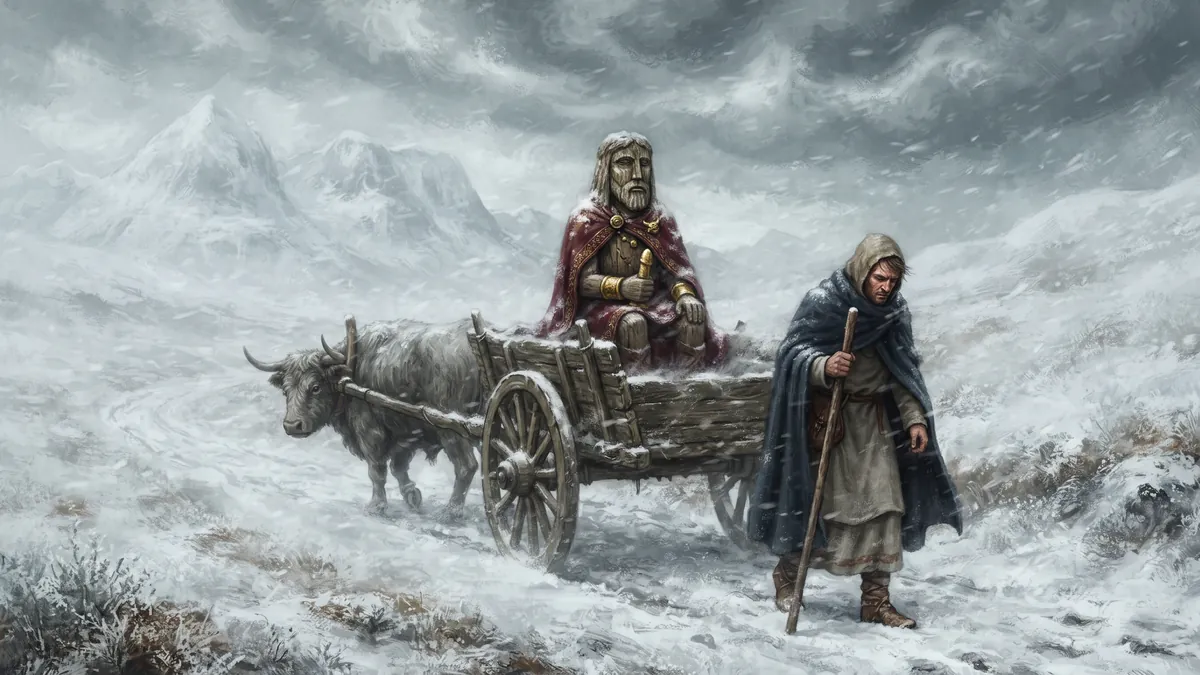
Gunnarr flees to Sweden, where he finds a young woman who is the cult bride of Freyr. She is about to take a wooden image of the god, who stands for her husband, on an autumn procession through the countryside, in a wagon. A blizzard in the mountains makes the rest of the party give up, and Gunnarr takes over guiding the draught animal. When he sits down in the wagon to rest, the woman rebukes him, and the image attacks him. Outmatched, Gunnarr calls for help on the Christian king and on God, defeats the being inside the idol, which the text calls a demon, and destroys the image.
The false Freyr
Gunnarr puts on the idol’s clothes and ornaments and takes its place in the wagon. At each stop he asks the devotees for valuable gifts instead of sacrifices, and joins in their feasts. The Swedes like it. The saga also says that the woman becomes pregnant, which is seen as a very good omen, and the harvest is good. King Óláfr sends Gunnarr’s brother to fetch him, and he returns to Norway with a fortune and with the priestess, who is baptised.
What scholars say
The story is full of scorn for heathenism and for the Swedes, and it was written by a Christian author. Even so, it is cited as evidence for seasonal processions of a deity in a wagon, linked to fertility, like the one Tacitus describes for Nerthus in the Germania. The name Gunnarr helmingr, “Gunnarr half”, has drawn scholars’ attention. Joseph Harris sees in the story a coherent novella written by a skilled author, and he and Anne Heinrichs think the unifying theme is identity. Others think the tale may rest on an imported narrative motif, and not on memories of the rite.
To help Gunnarr cross the blizzard, gather the gifts and dodge the snowdrifts, play The wagon in the blizzard.
Sources.
- Ögmundar þáttr dytts ok Gunnars helmings, in Óláfs saga Tryggvasonar en mesta
- Shorter version in the Vatnshyrna manuscripts of Víga-Glúms saga
- Studies by Joseph Harris and Anne Heinrichs on Ögmundar þáttr dytts