 MMXXVI
Ólavsøka: the Faroe Islands' national festival on 28 and 29 July, tied to Saint Olaf's death at Stiklestad
Ólavsøka, "Olaf's vigil", gathers the Faroese in Tórshavn on 28 and 29 July, with rowing races, chain dancing and the opening of parliament. The name recalls Saint Olaf's death in 1030.
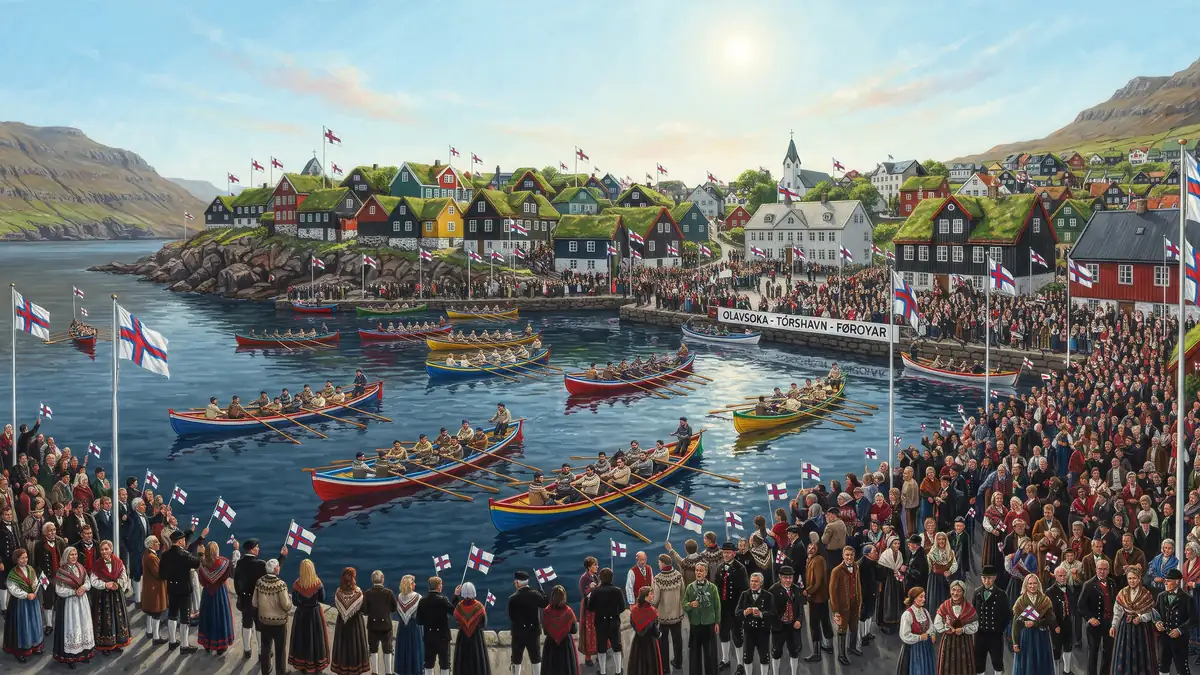
Ólavsøka is the biggest summer festival in the Faroe Islands. It lasts two days, 28 and 29 July, and, according to the sources, for most Faroese it is a national holiday, alongside Flag Day on 25 April.
The name
The name means “Olaf’s vigil”. It refers to Saint Olaf’s death at the battle of Stiklestad, in 1030. The word vøka derives from Old Norse vaka, a religious celebration that also lasted two days.
In Tórshavn
Many Faroese travel to the capital. On 28 July, the opening starts with a procession to Tinghúsvøllur, in front of the parliament building, where an appointed speaker opens the festivities, usually with a brass band.
On 29 July, the parliament, the Løgting, opens its session, and the prime minister, the løgmaður, gives a speech. A procession goes to Tórshavn Cathedral before the session, followed by a cantata composed by Sunnleif Rasmussen.
Rowing, music and dance
The national rowing finals are on 28 July and are among the highlights of Faroese sport. The Ólavsøka boat race is held on the eve of the festival. The boats are wooden, with two rowers per seat and a steerer, and are grouped by size (five, six, eight and ten rowers). The festival includes folk music, art exhibitions and Faroese chain dancing, open to everyone, usually at the Sjónleikarhúsið theatre in Tórshavn. The one-day Tórsfest now takes place the weekend before.
Limits of the source
The the source article warns that it needs additional citations, and it does not tell the history of the festival over time, only the origin of the name and the link to 1030. Exact timings, such as that of the cantata, vary from year to year, and unions differ on the day off.
To row in the right rhythm, play The rhythm of the regatta.
Sources.
- Reference work in English, article "Ólavsøka"