 MMXXVI
Ole Bull: the violinist from Bergen who founded the first theatre spoken in Norwegian and a colony in Pennsylvania
Born in Bergen in 1810, Ole Bull was a virtuoso compared to Paganini, co-founded the Det Norske Theater in 1850 and in 1852 bought land in Pennsylvania for a Norwegian colony.
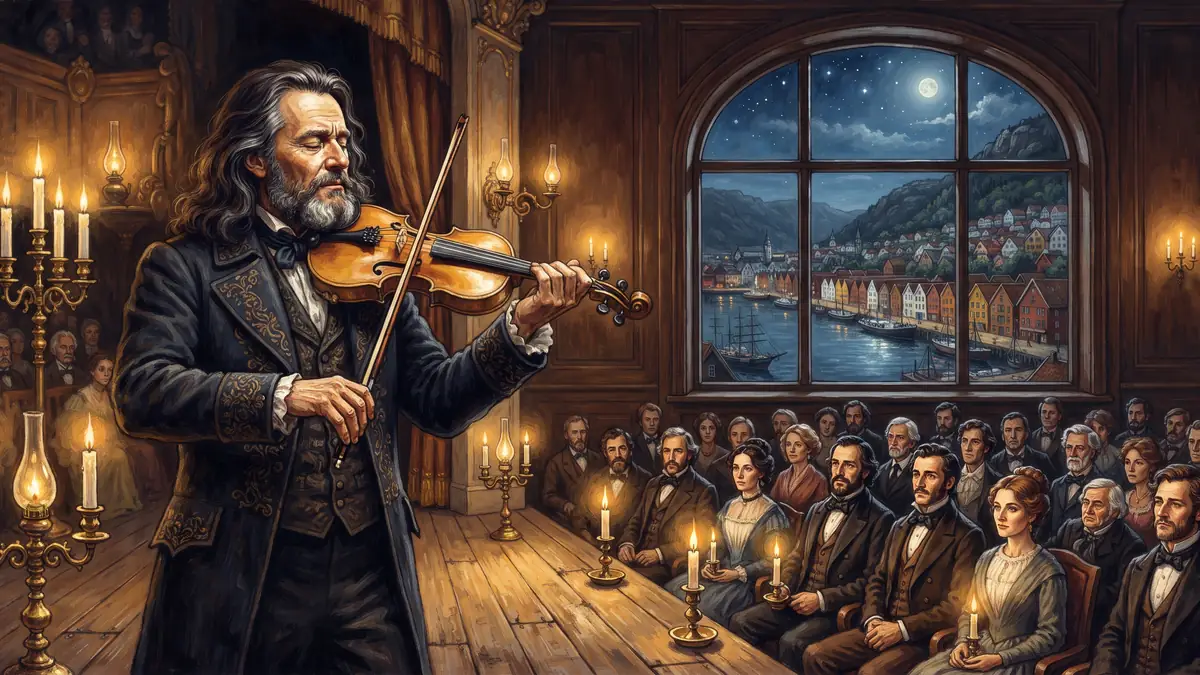
Ole Bull was born on 5 February 1810 in Bergen, then part of Denmark-Norway, the eldest of ten children. According to the sources, at 4 or 5 he could already play on the violin the songs his mother played. At 9 he was first violinist in the Bergen theatre orchestra and a soloist with the Bergen Philharmonic Orchestra. His father wanted him to become a minister.
From failing university to Paris
At 18 he entered the University of Christiania and failed his examinations. In 1828 he became director of the Musical Lyceum and the theatre orchestra after Waldemar Thrane fell ill. In 1832 he shared rooms in Paris with Chopin and Heinrich Wilhelm Ernst, and fared badly for a year or two before establishing himself as a virtuoso. He later studied in Paris with the luthier Jean-Baptiste Vuillaume.
The virtuoso
Robert Schumann wrote that Bull was on a level with Paganini for speed and clarity, and a letter from Catherine Darwin in 1836 called him “very superior to Paganini”. In 1837 he gave 274 concerts in England. In the 1860s and 1870s he toured the United States and was concertmaster at the National Peace Jubilee in June 1869, with 525 players. He owned violins and violas by Amati, Gasparo da Salò, Stradivari, Guarneri and others. His Gasparo da Salò violin, from about 1574, made for Archduke Ferdinand II of Austria, is now in the Western Norway Museum of Decorative Art in Bergen.
Theatre and colony
In 1850 he co-founded the Det Norske Theater in Bergen, described as the first theatre where the actors spoke Norwegian rather than Danish. It later became the Den Nationale Scene. On 24 May 1852 Bull bought 11,144 acres in Pennsylvania for $10,388 and founded New Norway, known as the Ole Bull Colony. The town of Oleona was named after him and his mother. The colony was abandoned, and he returned to concert work.
Grieg and Lysøen
In the summer of 1858 he met the 15-year-old Edvard Grieg, a family friend, and persuaded Grieg’s parents to send him to the Leipzig Conservatory. Bull is believed to have written more than 70 works, of which only about ten are known today; the best known is Sæterjentens søndag, “the dairymaid’s Sunday”. In 1872 he bought the island of Lysøen and hired Conrad Fredrik von der Lippe to design his residence. He died on 17 August 1880, at home on Lysøen, of cancer, after giving a last concert in Chicago that year.
To tap the golden notes of the violin and avoid the snapped strings, play Ole Bull’s notes.
Sources.
- Reference work in English, article "Ole Bull"