 MMXXVI
Ole Lukøje: Andersen's sandman, the two umbrellas, Hjalmar's seven nights and the brother called Death
In Hans Christian Andersen's tale, published in 1841, Ole Lukøje puts children to sleep with sweet milk in their eyes and opens an umbrella over them. For seven nights he takes the boy Hjalmar to dreams of weddings, storms and journeys.
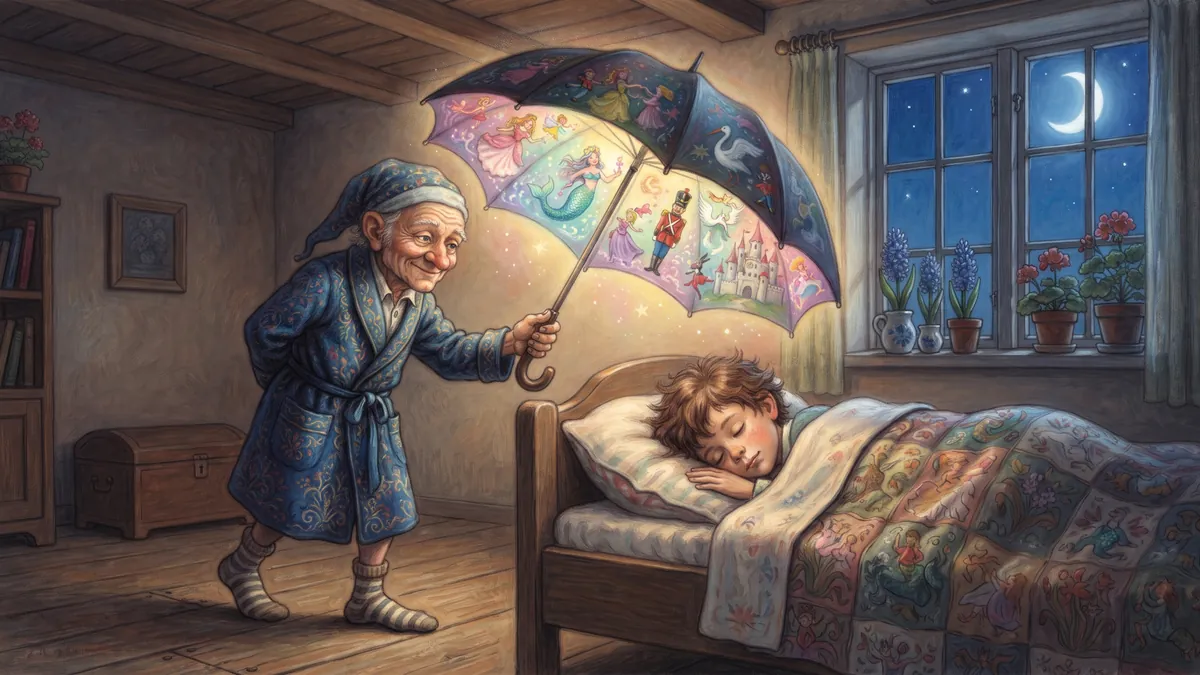
In several traditions there is a being who makes children fall asleep. In Denmark he got the name Ole Lukøje, “Ole Shut-Eye”, in a tale by Hans Christian Andersen published on 20 December 1841, in Eventyr, fortalte for Børn. Ny Samling, in the third booklet of the series. The name joins Ole, a common male name, to lukøje, from luk, “close”, and øje, “eye”.
Who Ole Lukøje is
In Jean Hersholt’s English version, Ole walks about in his socks, without a sound, sprinkles sweet milk in children’s eyes and breathes on the backs of their necks, so that their heads grow heavy. He wants them to be quiet, so that he can tell stories. He carries two umbrellas. The one with pictures, opened over good children, gives them lovely dreams all night. The plain one, opened over naughty children, gives them restless sleep with no dreams.
Seven nights with Hjalmar
The boy in the tale is Hjalmar, and the tale runs through seven nights, one for each day of the week. On Monday, the flowers in the pots turn into trees, and the letters in the copybook, crooked as they are, run off their lines. On Tuesday, the furniture talks, and a landscape painting comes alive, with Hjalmar sailing in a boat pulled by six swans. On Wednesday, a flood brings a ship, and a tired stork is mocked by the hens until Hjalmar sets it free. On Thursday, he shrinks and goes to a wedding of mice. On Friday, it is the turn of the wedding of his sister’s dolls, Herman and Bertha, their hundred-and-first wedding. On Saturday, Ole polishes the church bells and the stars, and prepares the world for Sunday.
The brother called Death
On Sunday, Ole introduces Hjalmar to his brother, who is also called Ole Lukøje and is also called Death. He rides a horse and takes people along with him, asking each one the grade they got at school. Those with high grades ride in front and hear a lovely story, and those with low grades ride behind and hear a frightening one. Hjalmar is not afraid. The tale ends with the narrator saying that Ole may tell more tonight.
A tale for bedtime
The tale mixes dreams, everyday objects and the idea of death in a calm tone, like someone telling a bedtime story. In English it has also circulated under the title “The Sandman”.
To catch the drops of sweet milk with Ole’s umbrella, without letting the hail fall inside, play Ole’s sweet milk.
Sources.
- Hans Christian Andersen, "Ole Lukøje", in Eventyr, fortalte for Børn. Ny Samling. Tredie Hefte, 1841
- English translation by Jean Hersholt, on the Andersen site of the University of Southern Denmark
- H. C. Andersen Centre, University of Southern Denmark