 MMXXVI
Orms þáttr Stórólfssonar: the strongest Icelander of his time, the hay carried on his back and the fight against the giant Brúsi on the island of Sauðey
The Orms þáttr Stórólfssonar tells the life of Ormr, son of Stórólfr, the strongest man in Iceland, who mows a field in one day, avenges his sworn brother Ásbjörn on the giant Brúsi's island and proves his strength before Jarl Eiríkr. See what the tale says.
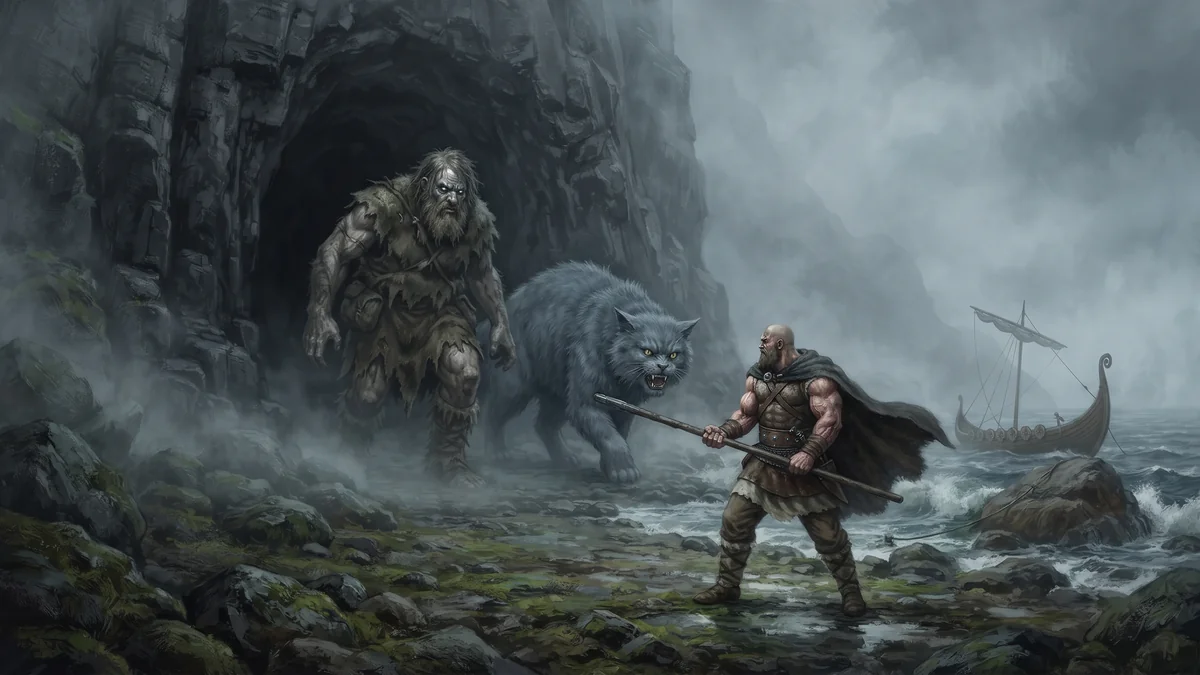
The Orms þáttr Stórólfssonar is the tale of the strongest man in Iceland, and it mixes physical strength, a duel with a giant and the end of a hero who becomes a Christian. It is part of the Flateyjarbók, in the cycle of King Óláfr Tryggvason.
Stórólfr’s son
Stórólfr, Ormr’s father, lives at Hváll, in southern Iceland, and is held to be the strongest man in the country and a sorcerer. His son Ormr is huge, strong and unruly. At twelve, he lifts a haystack with the ox-cart and hurls it onto his father, who falls and breaks three ribs. Later he forges his own scythe and mows a whole field in a single day.
In a hard winter, the farmer Dufþakr of Holt refuses to sell hay. Ormr takes two bundles by himself, ties them with ropes made from ten horses’ tethers and carries them on his back all the way home. Dufþakr demands payment, Ormr refuses, and a lasting feud begins between the two families. At the Alþingi, Ormr bends iron shoes and lifts a great kettle with a single finger.
Ásbjörn and the island of Sauðey
Around thirty, Ormr goes to Norway and meets Ásbjörn prúði, whose sworn brother he becomes. In Mæri, the two hear of Sauðey, an island of a giant called Brúsi and of his mother, a monstrous cat. Ormr advises against the trip. Ásbjörn goes anyway, with twenty-four men. The cat kills nearly all of them, and Ásbjörn is overcome in Brúsi’s cave and dies reciting verses.
Ormr returns to Norway after being baptised. In a dream, a woman named Menglöð, Brúsi’s half-sister, tells him how Ásbjörn died and gives him gloves that never lose their strength, asking for the island in return for victory. In the cave, Ormr kills the cat after praying to God and Saint Peter, fights Brúsi, tears off his beard and face and breaks his back. He burns the bodies, takes two chests of gold and silver and gives the island to Menglöð. Then he makes the pilgrimage to Rome he had promised.
Jarl Eiríkr
At Hlaðir, Jarl Eiríkr receives him. In a debate about the battle of Svöldr, Ormr says that the Ormrinn langi, King Óláfr’s ship, would not have been taken so soon if he had been aboard. The jarl challenges him. Alone in a boat, Ormr sinks seven of fifteen attacking ships and, on land, beats sixty men with an ash pole. The jarl admits the ship would not have fallen with him and accepts him as a follower. Ormr returns to Iceland, lives at Stórólfshváll and dies of old age, faithful to the Christian faith.
What remains uncertain
The place names and the relatives, such as Hængr, Ketill Naumdælajarl and King Haraldr Dofrafóstri, tie Ormr to the people who settled Iceland. The feats of strength and the duel with Brúsi belong to the tale and are not proven history. The date of composition is not secure, and the scene with Jarl Eiríkr engages with the battle of Svöldr, the subject of other narratives.
To stack the hay bundles without letting the tower fall, play Ormr’s hay bundles.
Sources.
- Orms þáttr Stórólfssonar, in the Flateyjarbók, in Óláfs saga Tryggvasonar en mesta (Old Norse text available at heimskringla.no)
- Ármann Jakobsson, "The life and death of the medieval Icelandic short story", Journal of English and Germanic Philology 112:3 (2013)