 MMXXVI
Oslo, 1161: the night battle in which King Inge fell and young Haakon Broad-Shoulders came to the throne, until Sekken in 1162
On the night of 3 February 1161, near Oslo, King Inge was defeated and killed by Haakon Herdebrei, his nephew. A year later, Haakon fell at Sekken. See the battle, the defectors and what the sources make clear.
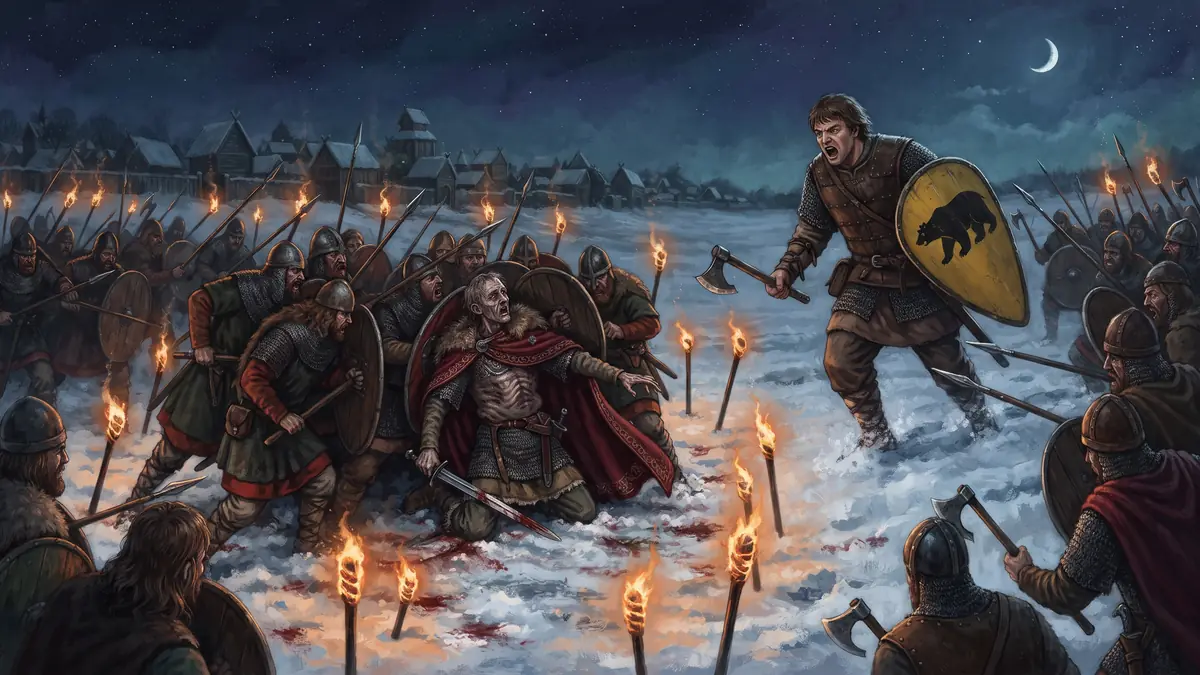
In 1157, the deaths of the brothers Sigurd Munn and Eystein left Inge as the only king of Norway. The supporters of the two dead men would not accept this, and gathered around Sigurd’s son Haakon, who went down in history as Herdebrei, “Broad-Shoulders”. The nickname comes from his build: he was big for his age and had very broad shoulders.
A boy as a banner
Haakon, born in 1147, was an illegitimate son of Sigurd Munn. His supporters, led by Sigurd Håvardsson of Hedmark, resumed the war against Inge. The king counted on the local chieftains, the lendmenn, and had as advisers Gregorius Dagsson and Erling Skakke. Gregorius was killed on 7 January 1161, in a skirmish with Haakon’s forces, and Inge’s position grew weaker.
The night of 3 February
The battle of Oslo took place on the night of 3 February 1161, outside the town. According to Heimskringla, Inge had 4,800 men. Many of them, led by his vassal Guðrøðr Óláfsson, the exiled king of the Isles, went over to Haakon’s side. Inge was defeated and killed. He was buried in St Hallvard’s church in Oslo.
After Inge
Inge’s supporters regrouped around Erling Skakke and his son Magnus Erlingsson, the “party of the lendmenn”. Archbishop Eystein Erlendsson, appointed by Inge, had not yet taken his seat when the king was killed. Haakon reigned only one more year. On 7 July 1162, he was killed in the battle of Sekken, near the market town of Veøya in Romsdalen, by the forces of Erling Skakke. Magnus Erlingsson succeeded him as Magnus V.
What the sources do not say
The sources consulted do not say how many men Haakon had, nor do they detail how the desertion happened. What they make clear is the result: Inge died, Haakon began to reign and, a year later, another party, Erling’s, took from him the kingdom and his life.
What remains
The night of 3 February 1161 shows how the civil war was decided less by pitched battles than by loyalties that changed sides when the wind changed. A king of frail health and a teenage king left the decision to men who counted on the next winner.
To tap, in the dark, the torches that light up on the night of Oslo, without waking the sentries, play The night of Oslo.
Sources.
- Snorri Sturluson, Heimskringla; Fagrskinna; Morkinskinna
- reference works (English), entries "Battle of Oslo (1161)", "Haakon II of Norway" and "Inge I of Norway", with the sources cited